Category: Uncategorized

  • Susana Reisman: Rough–cut slab

    6”×1”×36” Rough-cut slab, 28 × 20 inch archival pigment print, 2013

    The theme of ‘wood culture’ and a rather multifarious display of their functions circulate in Susana Reisman’s photographic exhibition, Standardizing Nature: Trees, Wood, Lumber.  The eclectic photo series display through the transition of tree to lumber, an order by which nature is transformed to the composite wood. The wood in some of the photographs is neither standardized nor naturalized, but a peculiar representation of the idea.

    The surface of the rugged slab is partially painted white with an unpainted section in the size and form of a standardized lumber. This piece of wood leans against a backdrop of a white wall, which visually emphasizes on the unpainted surface of what it looks to be a common piece of lumber. Reisman standardizes the wood by de-naturalizing its visual form through painting part of it, while not painting the rest, creating two different shapes in one.

    Although it is a rough slab, the first thing we notice is the unpainted shape of a standardized lumber. Through this piece, Reisman distinctively expresses how we recognize the conventional matter in a material rather than in the natural form.

    Eun Byul Jo

    *Exhibition information: Standardizing Nature: Trees, Wood, Lumber, September 12 – October 18, 2014, Gallery 44 | Centre for Contemporary Photography, 401 Richmond Street West, Toronto. Gallery hours: Tue – Sat 11 – 5 p.m.

  • Queen West Art Crawl

    Queen West Art Crawl

    Queen West Art Crawl, 2013. Photo: Phil Anderson

    Queen West Art Crawl
    September 13 – 14, 2014
    Queen West around Trinity-Bellwoods Park

    For Events and Locations please check: http://www.queenwestartcrawl.com/.

    The Queen West Art Crawl began as a one-day event in 2003. Since then it has blossomed into a weekend-long festival of creativity and community. Our goal is to celebrate and cultivate the unique character, diversity and ethos of Parkdale and Queen West – a natural habitat for individual artists, arts organizations, artist run centres and businesses that promote art and culture.

    2014 marks the 12th anniversary of the Queen West Art Crawl.

    Come on down and enjoy the festivities along Queen Street West from Bathurst to Roncesvalles, taking place from September 21 – 22. Purchase a great work of art from one of our 250+ jury-selected artists at the Outdoor Art Show and Sale in Trinity-Bellwoods Park, or take part in a walking tour and attend a talk by one of our featured guest speakers. There are plenty of art events for crawlers of all ages, from the family-friendly KidsZone, to the New Crawl West, an art walk on Saturday and Sunday. Don’t miss out on all the action!

    The 11th annual Outdoor Art Show & Sale will take place at Trinity Bellwoods Park on Saturday, September 13 to Sunday, September 14, from 11 am – 6 pm.

    The main hub of the Queen West Art Crawl, the OASS is a two-day juried art exhibition featuring over 250 artists and artisans, food vendors, community booths, an exciting entertainment stage and our family friendly Kidz Zone.

  • Over the Rainbow / Speaker Series

    Attila Richard Lukacs, Coo coo ka-choo, Mr. Robinson (detail), 1999. Collection of Salah Bachir and Jacob Yerex. Photo: Toni Hafkensheid

    Thursday, June 26, 2014  / 7  – 8 p.m.
    Museum of Contemporary Canadian Art
    952 Queen Street West

    Over the Rainbow /  Speaker Series

    Exhibiting artists Stephen Andrews, Andy Fabo, Elle Flanders, and Attila Richard Lukacs will join Artistic Director and Curator David Liss to discuss themes of seduction and identity.

    The exhibition represents a modest selection of works from the collection of Salah Bachir and Jacob Yerex, by both queer and heterosexual artists, broadly assembled around the themes of seduction and identity. Grouped together the exhibition presents works, mostly in drawing, painting and photography, which acknowledge certain archetypes associated with Queer Culture, drawing relationships between a historically marginalized culture and mainstream culture, and ways in which these have influenced each other. By focusing on reciprocal influences and relationships, and presented within the context of WorldPride 2014 Toronto, the thematic approach is meant to consider commonalities of human experience over opposition and difference.

  • Katzman Contemporary  Opens at New Location

    Katzman Contemporary Opens at New Location

    Katzman Contemporary
    86 Miller Street

    Katzman Contemporary is the new iteration of the former Katzman Kamen Gallery and the original Leo Kamen Gallery. With a critical directorial vision, refined mandate, and new location, Katzman Contemporary is growing and expanding from its original ethos and roster of artists to include new visions and international exchanges.

    Jeannie Thib, Catch, 2004

    Katzman Contemporary first exhibition is JEANNIE THIB: Imprint
    Opening Reception: Saturday, February 1, 3 – 6 p.m., Remarks at 4:30 p.m.

    Jeannie Thib led an outstanding career. She was an integral part of the Katzman Contemporary roster, an inspiration and influence to the artistic community, and an irreplaceable friend to many. In the spirit of her remarkable artistic contributions, Thib’s career will be celebrated at the inaugural exhibition of Katzman Contemporary on February 1, 2014.

    Accompanying Thib’s work will be artistic responses by four contemporary artists, Randy Grskovic, Shelley Miller, Meghan Price, and Pete Smith, as a tribute to her artistic legacy.

    Imprint features seminal works from multiple eras of Thib’s career to offer a holistic instance of her practice and artistic ethos. Many of the included sculptural and wall works have not been shown in Toronto, and never together in this context.

    Exhition dates: February 1 – 18, 2014, Katzman Contemporary at 86 Miller Street. Gallery hours: Tue – Thurs 11 – 5, Fri 11 – 7, Sat 11 – 6 p.m.

  • ECO ART 2014 / Opening Reception

    Opening Reception: January 9, 2014, 8 – 11 p.m.
    Gallery 1313
    1313 Queen Street West

    ECO ART 2014 explores a number of environmental concerns such as air quality, urban sprawl, water quality and nature preservation. Artists have long filled the role of social activists expressing their concerns about issues important to them. In this exhibition they also mirror the concerns of today. The artists featured in the exhibition include Ghanesh Da, Heather Ahn, Carmen Lee, Dason Pak, Anna Snyder, Lindsay A. Veh, Jenny Li, Paul Brandejs, Arthur Ostrowski, Ruth Hartman, Daniel Sun, Stefan Herda, Adam Filek, Gregory Robin, Tibor Bedi, Katlin Brough, Sandra Herman, Catharine Somerville, Valerie Sabaliauskas, The Department of Biological Flow and Vjosana Shkurti.

    The ECO ART Exhibit opened just as things were starting to warm up in Toronto having experienced a cold spell that some could argue was a result of the erratic climate patterns caused by global warming. The annual exhibit true to its traditions contained a variety of expressions drawing our attention to different environmental concerns.

    Gregory Robins (left) and John Wiles with their sculpture Whale Coffin.

    As you enter the gallery you see the work of Gregory Robins and John Wiles called Whale Coffin. The large sculpture of a whaling ship with a whale in its belly effectively makes its point. A very different sculpture installation by Arthur Ostrawski titled Industrial Migration covers the gallery floor with plastic fish lying on a bed of steel.

    Arthur Ostrawski, Industrial Migration

    Winnipeg artist, Tibor Bodi took a look at the fast food industry’s use of disposable containers and recreated them using  more traditional glass and porcelain moulds. Carmen Lee also used photographs she took with her camera phone to depict disposable objects such as coffee cups and then using an Galaxy S Pen to create illustrated  messages on them.

    Carmen Lee with one of her works

    Medicated by Valeria Sabaliauskas, an Ottawa artist, is a book installation using an old set of children’s encyclopaedias with representations of endangered animals in the centre cut out portion in the books. She reminds us that if we continue our path of treating the earth the way we have then one day our only experience with animals will be in books.

    Valeria Sabaliauskas, Medicated

    Vjosa Shkurti examines our experience with artificial light from technology in her video work Sundown. The video is a playful interactive performance between a candle and a light bulb.

     Vjosa Shkurti, Sundown

    Stefen Herda’s The Litmus Tests uses various organic dyes and household chemicals reacting with paper to create his video work. The results are an ever changing canvas of chemical reactions creating abstract forms. Video maker, Adam Flex’s work I will Grow Tall starts with a solitary figure crouched naked in the wild. As the title says, the figure gradually rises and with arms out stretched.

    Adam Flex, I will Grow Tall (left)

    Jenny Li is originally from Shanghai  and she depicts the air pollution preset there with her three oil on canvas paintings including one titled Little Sister.

    Jenny Li with Little Sister

    The installation by The Department of Biological Flow titled Mon Santos! My Farmville is Burning takes a different approach and uses poetry, video and objects to create its message.

    The Department of Biological Flow, Mon Santos! My Farmville is Burning

    At the opening new friendships were formed as the artists talked about each others work and artistis methods. And of course they all shared their common concern for our environment.

    Now if someone can just explain what’s up with the weather ?!

    Text and photo: Phil Anderson

    *Exhibition dates: January 8 – 19, 2014, Gallery 1313, 1313 Queen Street West. Gallery hours: Wed – Sun 1 – 6 p.m.

  • A Journey to Belong

    Reading the title of the two-part exhibition at Robert Kananaj Gallery I’ve found it interesting, as belonging is a major issue in our society. But when I went to see the show and talked to gallery owner/curator Robert Kananaj, I realized how wrong I was since I totally misunderstood the title. He completely turned around the meaning of belonging and instead of focusing on its social relations he went back to the roots of the problem, the person. A Journey to Belong for him starts with the individual and not with the society. We waste our energy in focusing so much on what supposedly significant, said Kananaj, instead of giving ourselves to what is really important to us as human beings. Kananaj wants to create an awareness of the “insignificant”. Society could wait with it’s demanding, sometimes even depressing, pressure. Finding ourselves is the first step to belonging to anything or anywhere.

    Installation view of Part 2. Courtesy of Robert Kananaj Gallery

    So the Journey starts inside, finding yourself – who you are – going back to the roots, and then slowly recognizing yourself as an individual. Then you can belong to yourself, contemplate your newly found character, maybe build it further for a while, and then, if you want, reach out to others and the society.

    Lula Motra, Embroidery. Courtesy of Robert Kananaj Gallery

    It is indeed a very interesting theme to cover. The first exhibition was dedicated to Lula Motra’s work. This was the first solo exhibition of the Italian based Motra with drawings, embroidery and sculptures. She is a total outsider, with no formal art training. She started three years ago with drawings, then embroidery and most recently assembly like sculptures. Embroidery is one of the oldest art forms practised traditionally by women. It requires skills, discipline and persistence to finish something like an altar cover or even a bed cloth. Motra wasn’t influenced by any school or style. Her sensitive hands, guided by her special imagery, created a one of-a-kind-piece. There are large areas of empty spaces surrounded or disrupted by light colored silk lines depicting flowers, lakes or city maps mainly in abstract forms; a very unusual but also very beautiful embroidery. Motra’s drawings are colored pencil compositions also mixing realistic images like a piazza with abstract elements. They are very colorful and full of emotion – great fun to look at and try to decode. Motra’s drawings and embroideries are visual diaries of her state of being, recording her inner journey.

    Lula Motra installation from Part 1.  Courtesy of Robert Kananaj Gallery

    Kananaj put up the second show in an unusual way, since some of Motra’s pieces from Part 1 continue into Part 2. A few of her drawings and embroideries are there and her tubes made of plastic straws are still moving over the gallery’s walls. Three more artists are included in Part 2: Torsten Richter, Hollis Alexis Baptiste, and Luca Reffo. Torsten Richter is a Berlin based artist whose drawings depict everyday objects such as scythe, pitchfork, an old fence or just a piece of wood the carpenter left behind with his tool is still in it. Richter’s realistic drawing skills are great and he is a true follower of the old German masters. The focal point of each drawing is an object on a white surface of the paper, calling attention to simple functionality of the device with amazing sensual properties. There is an almost religious dedication in his method of sitting long hours in front of his object and lovingly depicting the smallest details. The final product is almost conceptual with its imbedded super realistic parts. It is again a journey to the self, motivated by the meditative process of creating these drawings by worshipping the objects and cultivating the self.

    Torsten Richter, Board with Right Hand, 2011, graphite pencil drawing on paper, 75 x 350 cm. Courtesy of Robert Kananaj Gallery

    Hollis Alexis Baptiste, the only Toronto based artists in this show, also works with everyday object. For more than 15 years, Baptiste has been incorporating these objects of no significance, like plastic bottles or unusual shaped objects, to be part of his strange structures. Large plastic bottles become abstract compositions and detergent containers create a group of strange figures, “illegal aliens”, as he calls them. Baptiste paints some of them bright yellow or deep blue or even Halloween black and red. They are funny and scary at the same time, an out-of-the-real-world assembly of his ghostly journey.

    Hollis Alexis Baptiste’s installation. Courtesy of Robert Kananaj Gallery

    Luca Reffo’s from Milan, Italy brings artistic research to his paintings, rendering disquieting movie-like atmospheres, imitations of original stage-set photographs and vintage film frames into his paintings. Each event is portrayed as a still image, conveying a sense of anguish for dream-like situations often heavy with psychological references. The visionary aspect of his realistic images is further emphasized by an original and disturbing use of lighting.

    Luca Reffo, The Reader, 2010-2011, oil on canvas 50 x 70 cm. Courtesy of Robert Kananaj Gallery

    The exhibition is interesting itself and you can easily lose yourself in the details of the artworks. If you go there, I suggest that you talk to Robert Kananaj and listen to his enthusiastic comments about the Journey, the artists and their work.

    Emese Krunák-Hajagos

    *Exhibition dates: October 10 – November 23, 2013, Robert Kananaj Gallery, 1267 Bloor Street West, Toronto. Gallery hours: Tue – Sat 11 – 6 p.m.

  • Trade Marks at Prefix  / Opening Reception

    Trade Marks at Prefix / Opening Reception

    Opening Reception: September 19, 2013, 6 – 8 p.m.
    Prefix Institute of Contemporary Art
    401 Richmond St West, Suite 124,

    Entering 401 Richmond is always a delight, seeing eclectically dressed, fast talking creators zipping in and out of the massive cultural hub. But tonight artists, writers and enthusiasts wandered in to celebrate the opening of Trade Marks, a group exhibition featuring four young contemporary indigenous artists.

    Betty Julian, curator of the show, opens the reception by giving a brief introduction to the themes discussed in the multi-media exhibition. Julian highlights the use of symbolism and the emphasis on mark making when discussing the theme of indigenous interaction in modern day Canada. This is evident in Keesic Douglas’ work where by using the point blanket to stand in for the tradition and conflict that exists between the Indigenous people and the Hudson Bay Company respectively. Douglas uses photography to comment on the trade relations and its corresponding inequities with a minimalist language.

    Keesic Douglas’s interaction between traditional textile and old-rye Whiskey to highlight the divide between customs and commodities

    Keesic Douglas busy in conversation describing the distinct stripes of the point blanket and their connotation in his photograph

    Symbolism is also present in Nigit’stil Norbert’s work where she uses a stencil inspired by her grandmother’s Gwich’in needlework to make a mark on urban spaces. This leads to a fantastic new lens through which to look at Toronto.

    Norbert intersects two separate symbols of urban living and Indigenous handiwork to create a new space. One of my favourite works of the night

     Nigit’stil Norbert displaying her work

    Meryl McMaster interprets mark-making by creating a sculpture made out of paper swallows cut out of North American history books. Then she moves within this swirl of paper birds. The large scale triptych is fascinating and immediately grabs your eye and very successfully elicits a sense of movement within the photographs.

    Meryl McMaster standing by one of her beautiful photographs, Murmur

    The fourth artist of the collective is Bear Witness who was not present at the opening. In his audio element in the show, his spoken worlds and sound piece summons you into the gallery and makes you feel like a cherished part of the community; much like the numerous Indigenous gatherings he’s appropriated.

    The show is open from September 19th to November 23rd with plenty of interactive events including a curator’s talk on September 28, 2013 at 2 p.m. and the Image Native Art Crawl on October 18, 2013. Prefix Institute of Contemporary Art, 401 Richmond St West, Suite 124,  Toronto. Gallery hours: Wed – Sat 12 – 5 p.m.

    Text and photo: Aliya Bhatia

  • Power Plant / Fall 2013 Opening Party
    Power Plant / Fall 2013 Opening Party
    Fall 2013 Opening Party
    Friday, September 20, 2013 | 8:00 p.m.
    The Power Plant
    231 Queens Quay West, Toronto

    Join The Power Plant for the celebration of the opening of the fall exhibition Micah Lexier: One, and Two, and More Than Two on our lakeside patio. Party under the stars with featured artist Micah Lexier and many of the artists represented in the More Than Two portion of the exhibition. Enjoy music by Kikileaks and food by Gourmet Bitches. A cash bar will be available all evening.

    In Fall 2013, The Power Plant presents a survey of significant work by Toronto-based artist Micah Lexier, bringing together an important selection of recent work that reflects the artist’s diverse and dynamic practice. At his most ambitious, however, is Lexier’s More Than Two (Let It Make Itself), a curatorial project that displays over 200 new and recently created artworks and objects by 101 artists/duos/collectives in and around Toronto.

    The exhibition is open: September 21, 2013 – January 5, 2014, The Power Plant 231 Queens Quay West. Gallery Hours: Tue – Sun 10 – 5 p.m., Thurs 10 – 8 p.m.

  • Geoffrey Farmer wins the 2013 Gershon Iskowitz Prize

    Geoffrey Farmer

    The Art Gallery of Ontario (AGO) and the Gershon Iskowitz Foundation are pleased to announce that Vancouver-born artist Geoffrey Farmer is the recipient of the 2013 Gershon Iskowitz Prize at the AGO. The award, which is presented annually to one artist who has made an outstanding contribution to the visual arts in Canada, includes a $50,000 cash prize and a solo exhibition at the AGO. Farmer’s exhibition will open in February 2014.

    Borrowing elements from conceptual and installation art, Farmer’s works boldly combine sculpture, video, performance, drawing, photography and found objects. Internationally recognized for his singular approach and ability to blend poetry and social commentary in large-scale works, Farmer has received praise for his recent exhibition The Surgeon and the Philosopher at London’s Barbican Art Gallery from the Guardian for its “compelling vision.”

    “Geoffrey Farmer’s works are unique because they are constructed anew each time they’re assembled,” said Kitty Scott, curator of modern and contemporary art at the AGO. “In this sense, the display at the AGO will offer visitors a chance to see the most recent workings of Geoffrey’s mind. We’re delighted to collaborate with the Gershon Iskowitz Foundation in presenting this prize to him.”

    Born in British Columbia in 1967, Farmer lives and works in Vancouver. A graduate of the Emily Carr Institute of Art And Design in Vancouver, he first exhibited at the AGO in 2000. The Gallery purchased a significant work by Farmer in 2012 entitled And Finally the Street Becomes the Main Character (Clock).

    “I’m deeply touched to receive this prize,” said Farmer. “Gershon Iskowitz has set an example through his generosity of spirit—a legacy that asks artists to support and help each other. I’m truly honoured.”

    “One of the most important aspects of the Iskowitz Prize over time has been that it is grounded in one artist’s wish to help other artists,” said Jeanette Hlinka, president of the Gershon Iskowitz Foundation. “Gershon would be very happy that this idea is still central to the Prize, and that the artists who receive it—like Geoffrey Farmer—recognize this.”

  • Shaping Up by Paul Wysmyk

    Shaping Up by Paul Wysmyk


    October 4 – 28, 2012
    Opening Reception: Thursday October 4, 6 – 8 p.m.
    DAVID KAYE GALLERY
    1092 Queen Street West
    (entrance on Dovercourt)
    Toronto, ON M6J 1H9
    T: 416.532.9075
    E: info@davidkayegallery.com
    www.davidkayegallery.com
    Hours: Wed – Fri 11 – 6, Sat – Sun 11 – 5 p.m

    I am pleased to be inviting you to preview a new body of work titled Shaping Up by Toronto-based artist PAUL WYSMYK.

    PAUL’s pictures tend to be of domestic interiors featuring arrangements of furniture, plants or objects. Often the elements are deconstructed. For PAUL deconstruction is about a literal space puzzled back together to make a picture. He sees it as a metaphor for the creative process itself. He feels we generally make things by adding and subtracting bits that sometimes fit or at other times are out of proportion. Eventually something emerges that is possibly useful and attractive.

    These stunning new works are appealing on many levels… graphically; for the colours that are bold and dynamic; and for the nod he gives the past in art history. I think there is an upbeat, nostalgic quality to the work that for me, makes these paintings very compelling and satisfying.

  • Frida & Diego: Passion, Politics and Painting

    Frida & Diego: Passion, Politics and Painting

    October 20, 2012 – January 20, 2013
    ART GALLERY OF ONTARIO
    317 Dundas Street West
    Toronto, ON M5T 1G4
    T: 416.979.6648
    www.ago.net
    Hours: Tue & Thurs–Sun 10–5:30, Wed 10–8:30

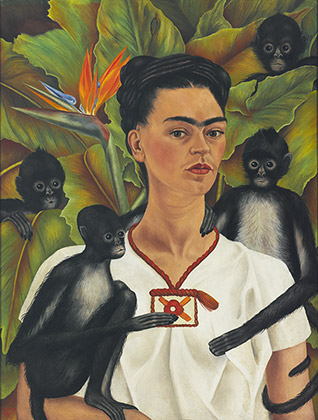
    Frida Kahlo (1907-1954). Autorretrato con monos, 1943 (Self-Portrait with Monkeys, 1943), oil on canvas, 81.5 x 63 cm. The Jacques and Natasha Gelman Collection of Mexican Art. (C) Banco de Mexico Diego Rivera Frida Kahlo Museum Trust, M.D.F./Artists Rights Society (ARS), New York

    The exhibition Frida & Diego: Passion, Politics and Painting features more than 80 paintings and works on paper by Frida Kahlo and Diego Rivera and more than 60 photographs of the couple, whose shared passion for each other and Mexico’s revolutionary culture during the 1920s and 1930s have made them Mexico’s most famous artists. Assembled from three distinguished Mexican private collections on Mexican art, the Museo Dolores Olmedo, Colección Gelman, and Galería Arvil, the exhibition provides the opportunity to view almost one quarter of Kahlo’s entire body of work and a range of Rivera’s painting styles from his early cubist period and studies for his Mexican murals to his portraits and later landscapes.

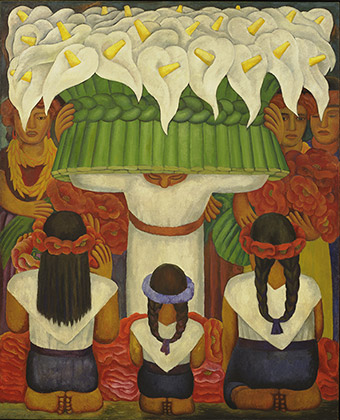
    Diego Rivera (1886-1957). Vendedora de alcatraces, 1943 (Calla Lily Vendor, 1943), oil on masonite, 150 x 120 cm.  The Jacques and Natasha Gelman Collection of Mexican Art. (C) Banco de Mexico Diego Rivera Frida Kahlo Museum Trust, M.D.F./Artists Rights Society (ARS), New York

    During their lifetime together as a married couple, Rivera achieved international prominence as a muralist artist, while Kahlo‘s intimate paintings were embraced by the Surrealist movement and the Mexican art world but not well known in the broader context of art and modernism. Guest-curated at the AGO by Dot Tuer, Frida & Diego: Passion, Politics and Painting offers a new perspective on their artistic significance for the 21st century: one which encompasses how their paintings reflect both the dramatic story of their lives together and their artistic commitment to the transformative political and cultural values of post-revolutionary Mexico.

    Featured image: Frida Kahlo (1907-1954). Autorretrato con tehmana (Diego en mi pensamiento), 1943. (Self-portrait as a Tehuana, Diego in My Thoughts), 1943, oil on masonite, 76 x 61 cm – detail. The Jacques and Natasha Gelman Collection of Mexican Art. (C) Banco de Mexico Diego Rivera Frida Kahlo Museum Trust, M.D.F./Artists Rights Society (ARS), New York

  • Michael Snow: Objects of Vision


    July 18, 2012 – March 17, 2013
    ART GALLERY OF ONTARIO
    317 Dundas Street West
    Toronto, ON M5T 1G4
    T: 416.979.6648
    www.ago.net
    Hours: Tue & Thurs–Sun 10–5:30, Wed 10–8:30

    Michael Snow is a Toronto born artist known internationally as a painter, sculptor, filmmaker, musician and author. This exhibition celebrates his achievement as the 2011 winner of the Gershon Iskowitz Prize.

    Snow has always been a sculptor. “A pure sculptor,” he explains, “an artist who makes objects.” He makes things to look through, look around, look along, look at, up, down and behind, to look at yourself looking at things. By making vision the subject of the object, the looking activates the object. Looking that sometimes require touch, sometimes invites sitting and sometimes necessitates caution.

    “All these works are Directors of Attention in the sense that their forms suggest the paths a spectator’s eyes should take,” he writes. In the most literal sense, Snow makes visual art: objects for you to see.

    The sculptures in Objects of Vision are abstract-form sculptures from three distinct yet essentially connected moments in the artist’s career: the late 1950s, the late 1960s and 1982. The sculptures are instruments in the artist’s orchestration of thinking about looking. While each work has a rich exhibition and publication history in varied contexts, they are presented here for the first time as one cohesive and focused investigation of sight and materiality.

    Meet the Artist – Michael Snow
    Wednesday, October 3, 7 – 8 pm
    Signy Eaton Gallery
    Free Admission