Category: Hugh Alcock

  • Steve Rockwell at modern.toronto

    Steve Rockwell at modern.toronto

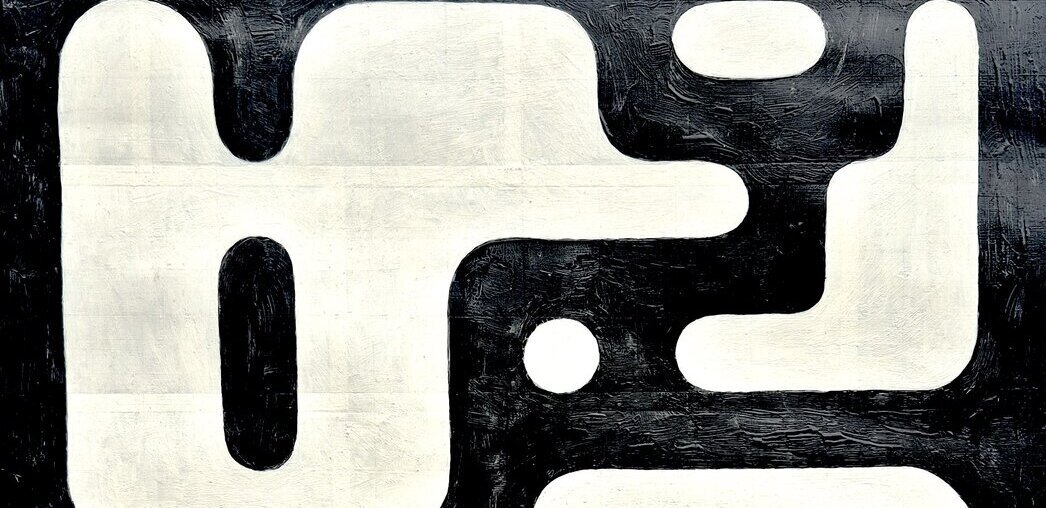
    Previously I wrote about the work of Ron Shuebrook on display at modern.toronto, a recently opened space aimed at showcasing abstract paintings. I now turn to the work of Steve Rockwell, on display at the same time in the front half of the exhibition space. While his work complements Shuebrook’s it is quite distinct in nature. Rockwell’s practice might best be described as conceptual with a strong element of performance. But first we need to consider a bit of history behind it.
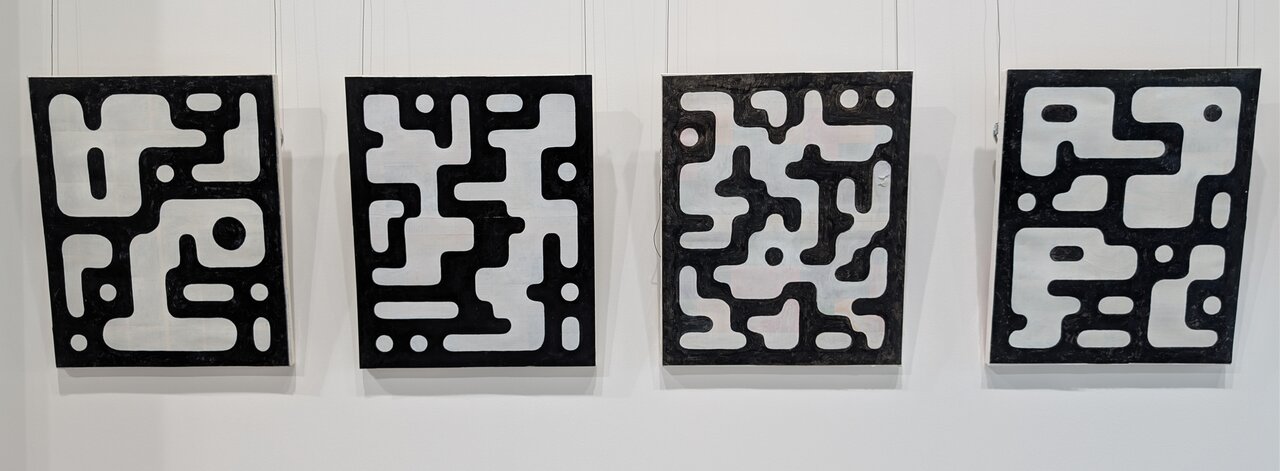
    Installation view of Steve Rockwell’s exhibition at the modern.toronto

    While we each undergo radical changes from birth to death, from infancy to old age, it is assumed we are the same person throughout. This assumption is largely premised on continuity. The changes across a lifetime are seldom abrupt, but rather gradually evolve. And so there is a path we can trace along the way. Who we are, our personal identity, is defined by this path – shaping our character, preferences, memories and so on. By this measure we cannot alter who we are by means of changing our name, disavowing our past and radically altering the course of our life. Who we each are is given to us, not created by us. Our identity is the grounds for our actions. Our actions do not shape our identity.
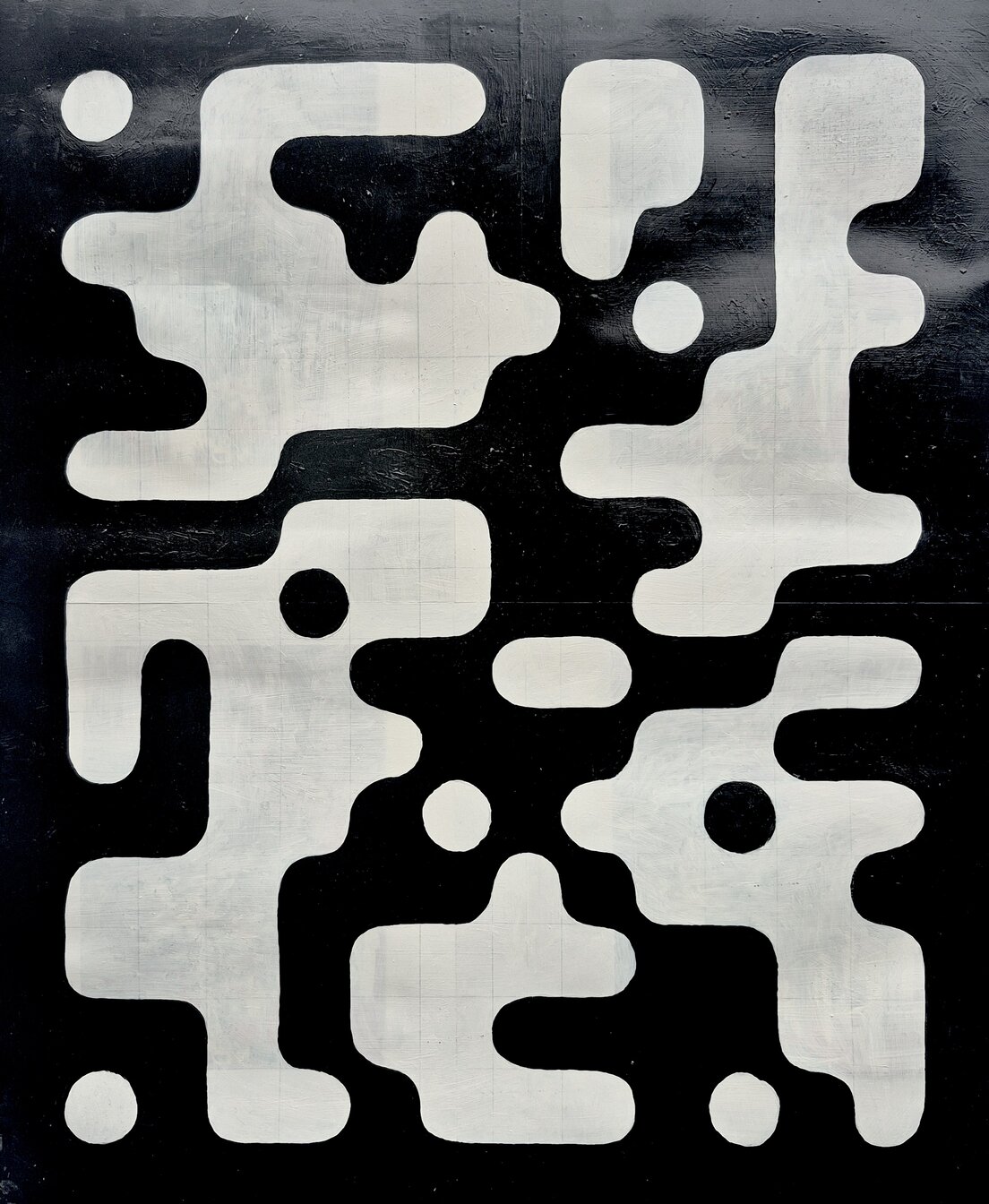
    Steve Rockwell, Tenet #1, 2026, 17 x 14 inches

    But perhaps this assumption is not entirely true. Insofar as an artist defines himself in terms of what he creates, it seems at least imaginable that he might create himself. He might become his own creation, so to speak. That in a sense is what Steve Rockwell has in fact done. While normally artists make work without inspecting their underlying identity, Rockwell has in essence used his artmaking to create the artist self-consciously – to deliberately develop his artistic persona. Born in Finland with the legal name Jouko Salomaa, when later in life he committed himself to developing art career he chose as his nom de plume, or stage name, ‘Steve Rockwell’. His use of this name is now so pervasive, he effectively has become that person.
    Steve Rockwell, Tenet #2, 2026, 17 x 14 inches

    Early in his career Rockwell – or Salomaa as he only known then – was mindful of the widespread belief that painting is dead. Yet he still felt an urge to paint. In response, his approach was to make painting a performance. Instead of putting brush to paper to express this or that he set out a method mark-making based on rule-following. To give an example, after arriving at his studio in the morning he performed a specific ritual, namely he sat down with a coffee and read the newspaper, always checking the weather report. After this he made his way up to the building’s rooftop. There he shaded in with pencil a blank sheet of paper that was a ‘reflection’ of the weather conditions around him. Then he painted a line across the middle of the paper. This he did everyday for a week. Crucially, the resulting images did not derive from direct observation, but rather it derived from a preconceived method and the interpretation of the results of it.
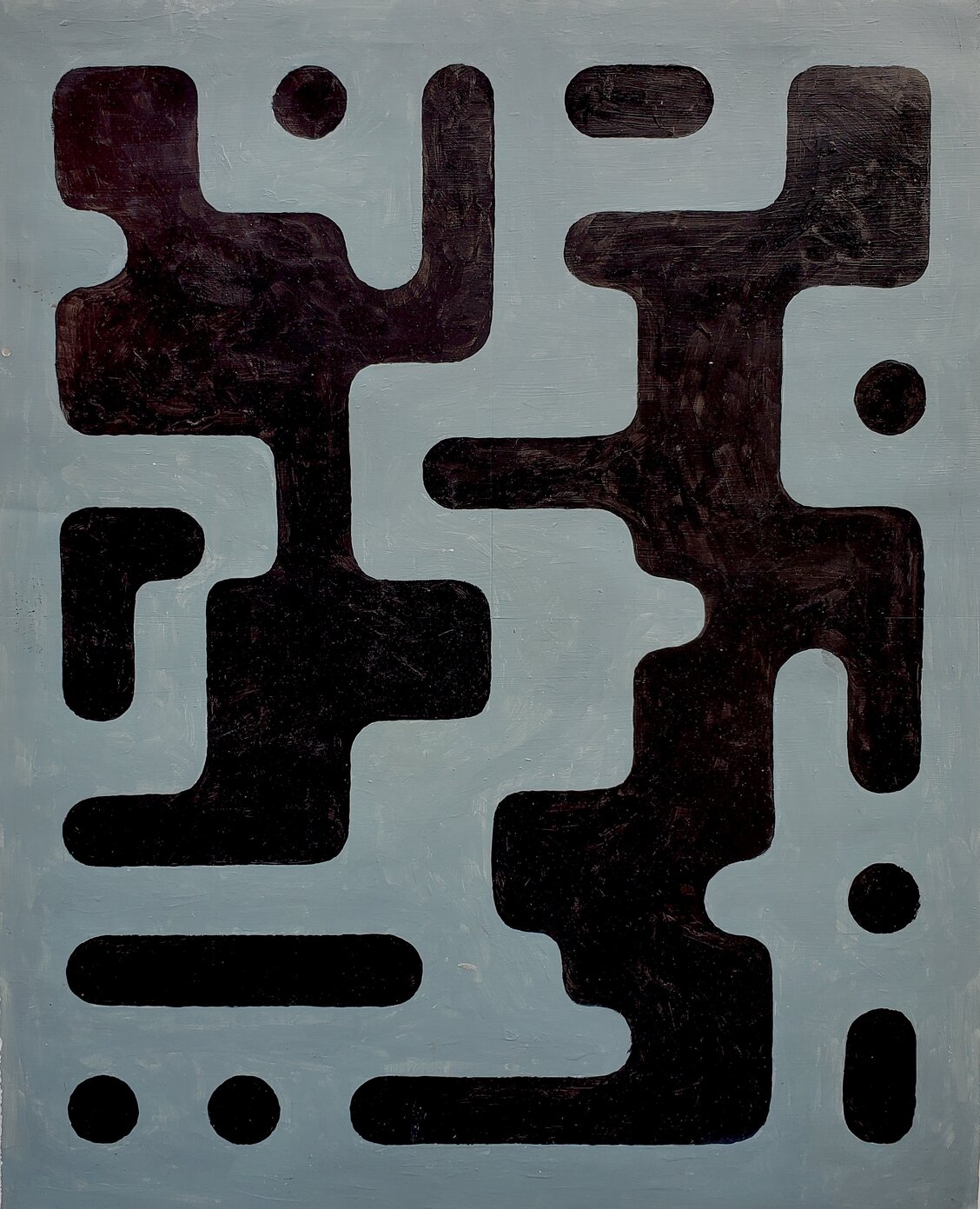
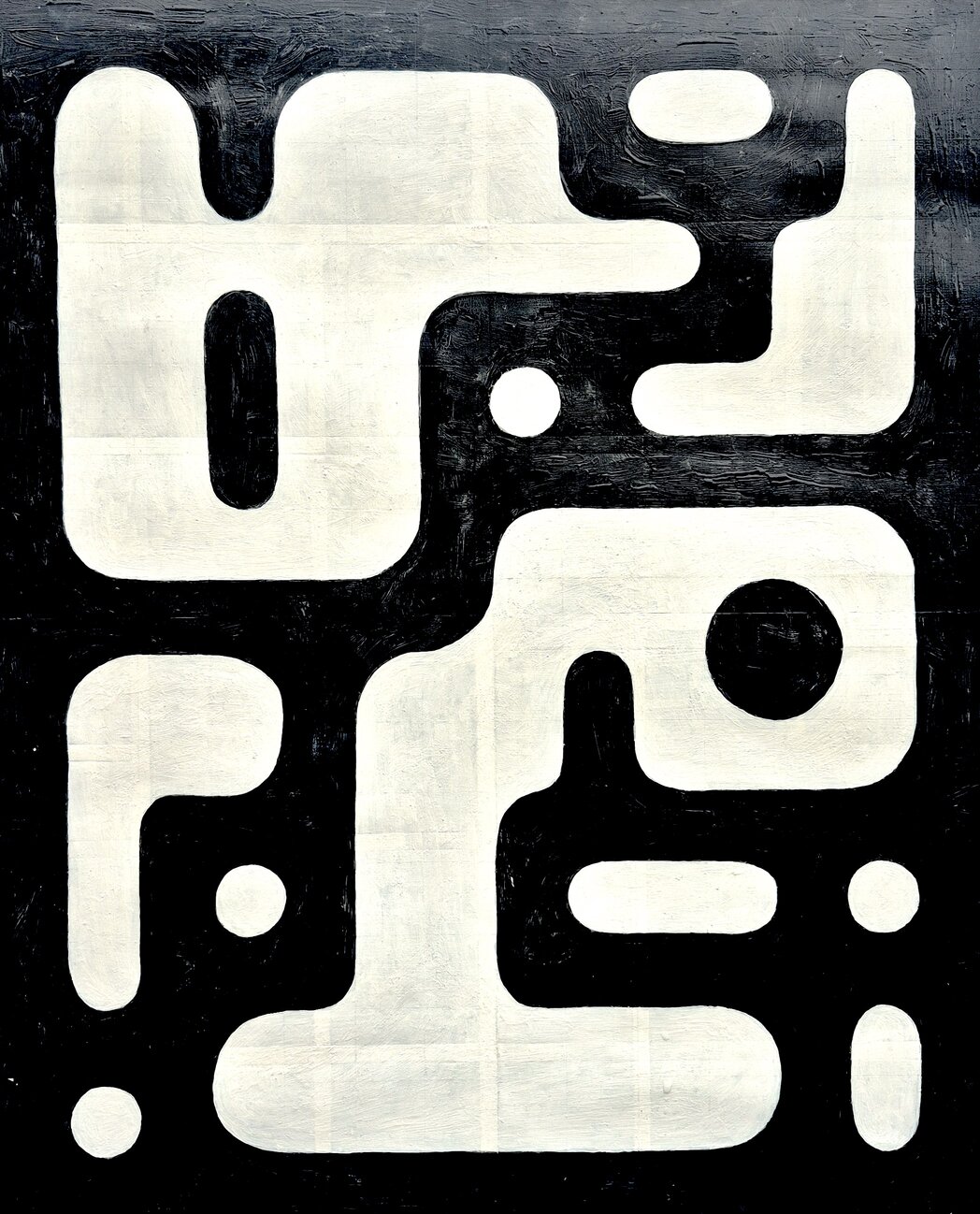
    Steve Rockwell, Tenet #3, 2026, 17 x 14 inches

    The results were essentially abstractions. This approach he has used in his most recent work on display here, namely his Tenet series. For each painting he laid out a grid of squares on the canvas. Then he traced a route from one square to the next with no predetermined direction. At each point he deliberated on where to move – up, down, across even jumping a square in the process.  At each point he recorded, as paint over the square, the resulting journey. Again the consequent painting is, as one might say, non-objective, that is, with no reference to the observable world. Rather, it is mediated by a rule-based method, a sort of algorithm – information-based – on the weather, momentary decisions and so on. These ‘algorithms’ are not, as is typical, executed mechanically. There is always a human element involved in their making. Indeed, it is this element that breathes life into his works, makes them relatable to the viewer.
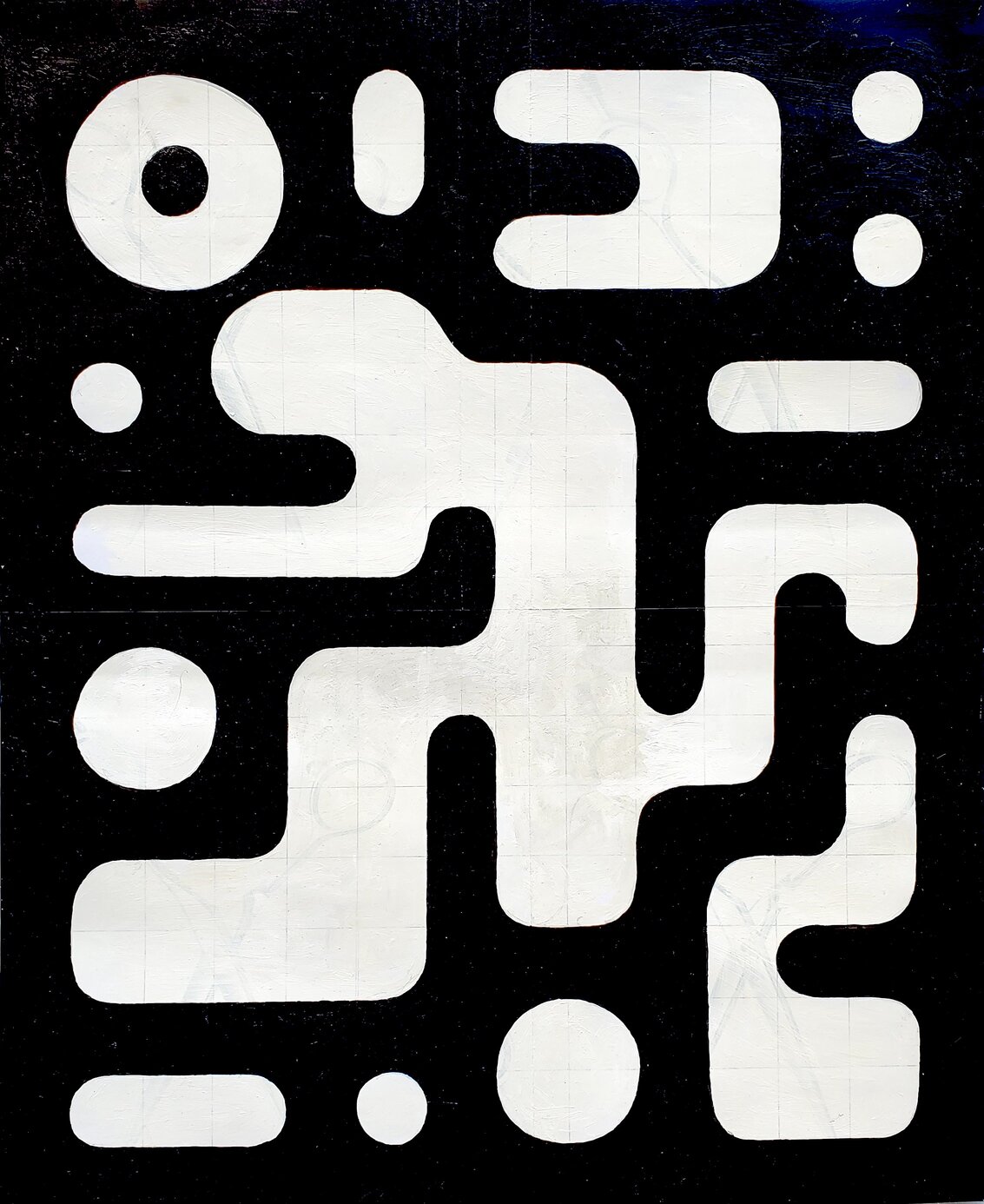
     Steve Rockwell, Tenet #7, 2026, 17 x 14 inches

    Prima facie, nonetheless, these paintings are simple. But, what matters in most cases is the context. How and why a work is made is key. Few artworks, he claims, are valued primarily in virtue of their appearance. When you and I encounter some abstract painting, say by an anonymous artist, as a rule we pass over it. There is little for us to grasp.
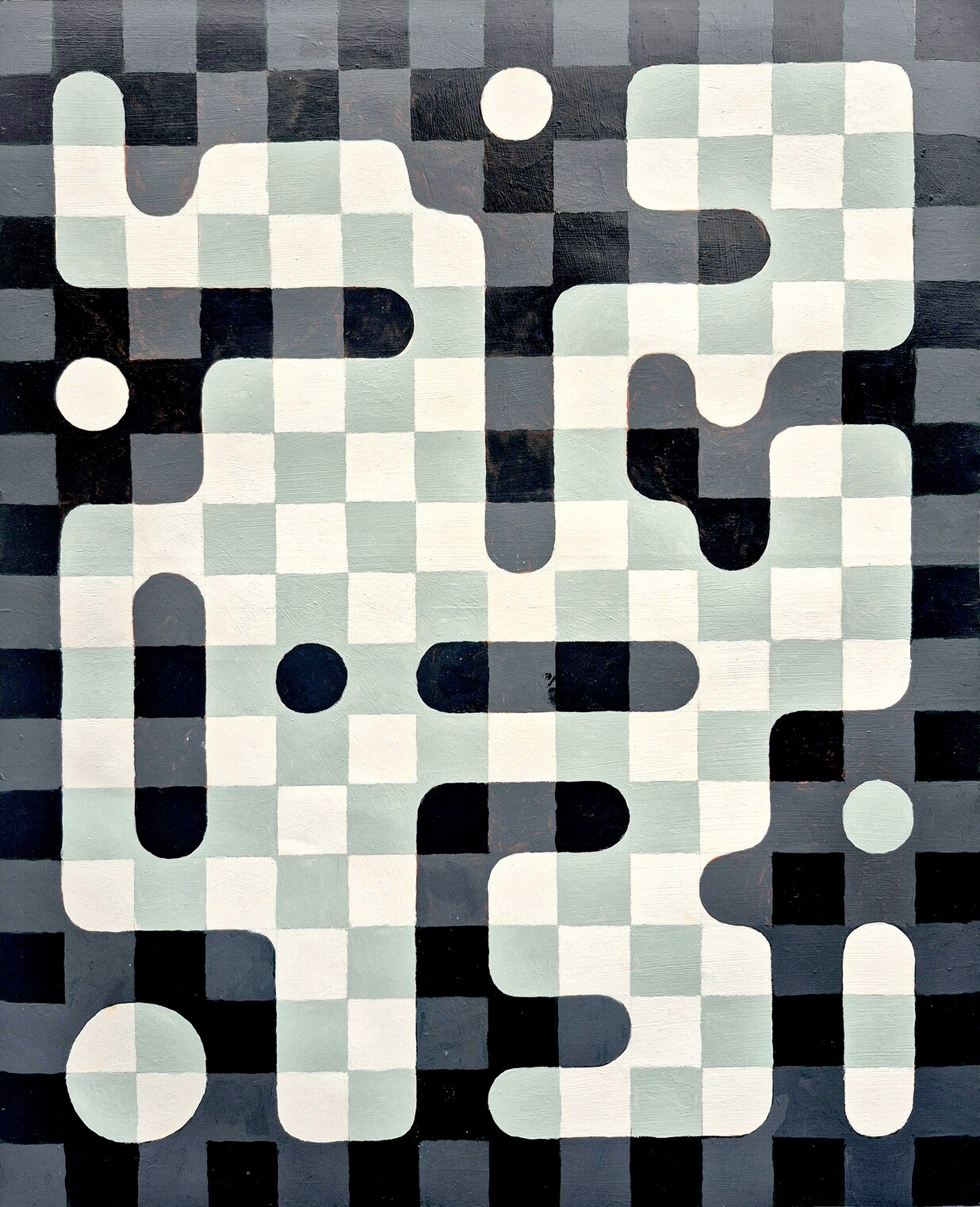
    Steve Rockwell, Tenet #4, 2026, 17 x 14 inches

    The claim by Rockwell that the appreciation of art is dependent on context accords with the long established prevalence of today’s art practices generally. Ever since Marcel Duchamp’s ready-mades artists have increasingly come to the view that what matters when looking at an artwork is not its retinal qualities, as Duchamp put it, but the artist, the ideas and the historical context behind it. And this helps explain Rockwell’s artistic persona. Creating such a persona is a piece with the cultivation of context behind the work. He effectively has created his own legend, that is, an edifice made out of the material of his own life story, the historical developments in art and narratives around them. Indeed, his decades-long project of writing, editing and publishing dArt International Magazine can be understood as supporting this goal. In this respect Rockwell’s practice reminds me very much of that of Joseph Beuys.

    Hugh Alcock

    Images are courtesy of the artist.

    *Exhibition information: Tenet & four Trees on Brant Street, September 12 –27, 2026, The modern.toronto, 230 Niagara Street, Toronto. Gallery hours: Sat – Sun 12 – 5pm.
  • Paul Orenstein: Stranger on a Train

    Paul Orenstein: Stranger on a Train

    Orenstein gives urban dwellers new ways of enjoying a city abroad by encouraging them to walk the same street twice, because there is always a chance they’ll see something interesting. Cities are no longer a bore, where every train ride feels like routine, but rather a chance to get lost in urban spaces like no traveler has done before. Urban fatigue of graffiti wired fences, and train stations have been captured in a new type of documentation in photography for some time now, giving the familiar spaces a fresh look. Stranger on a Train by Paul Orenstein takes us to Vienna back in 2024.

    City natives and urban dwellers will always appreciate the fresh perspective of a foreigner. As for a local, not much is absorbed, especially when one becomes accustomed to such things as the line at a coffee shop, or passing the time on the ride to work to decipher tags on the walls or identify the themes of graffiti tattooed on out-of-service trains. Nothing like a tourist, especially a photographer, can change their perspective on how they can explore their own city spaces.

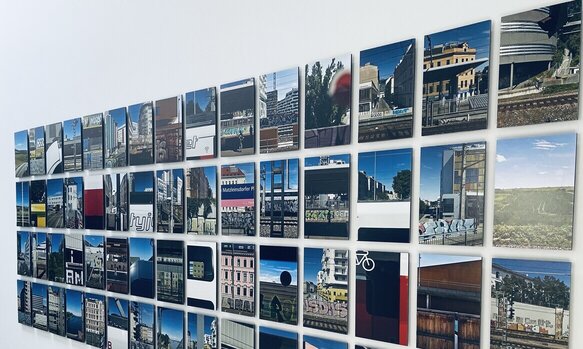
    Installation view of Paul Orenstein, Stranger on a Train “Gang of 60”

    The exhibition presents 74 colour photographs taken in Vienna, in both in printed forms, including large formats, and on digital monitors mounted on the other side of the gallery hall. The pieces depict Vienna’s modern and historical elements, sometimes side by side, in unexpected parts of the city. One can’t help but wonder what stories were told under the bridge in a partly renovated neighborhood.

    Even the colours at the entrance of this exhibition match the colours of vibrantly painted residential buildings and tagged warehouses. Orenstein describes how quickly the excitement shifts when visiting a new country without knowing the language yet somehow managing to move around by looking at street signs, stores, office buildings, etc. The shapes and colours are so different from what you used to it at home, that you feel like an alien on another planet. Even the electrical wires seem to create a picture if you squint your eyes.

    Installation view of Paul Orenstein, Stranger on a Train

    Some of the prints displayed in Stranger on the Train might be shocking to see yet not surprising how much graffiti and tags are covering the surfaces, showing the rapid changes with so much construction going on even in a historic European city like Vienna. This fact reminds us that we must pay more attention to our own space, that may change in a blink, so, we might never see the same city again.

    Installation view of Paul Orenstein, Stranger on a Train with Sot T, cacophony (left) and Sot T, red E (right)

    Text and photo: Polyna Alexseev

    All images are installation views of Paul Orenstein: Stranger on a Train.

    *Exhibition information: Paul Orenstein: Stranger on a Train, May 18 – June 30, 2025, The Hall, 166 Clinton St, rear building, Toronto. Opening hours: Sat – Sun 11am – 6pm. Part of CONTACT Photography Festival.

  • New Mineral Collective at Mercer Union

    New Mineral Collective: The Pleasure Report

    New Mineral Collective (NMC) is a collaborative art initiative by Tanya Busse and Emilija Škarnulytė, based in Ontario. This exhibition celebrates the artists’ tenth year of collective practice. Held at Mercer Union, this installation is a mixed media work that includes soothing narration, pink light and surrounding sounds blended with field recordings, printed textile and sculptural elements. We enter a reflective state in which we ask the question, how much has the mining industry of Canada continuously ground down these sacred lands, and for how long do we have to wait until there is no land to excavate, let alone to preserve? NMC challenges destructive mining practices through poetic activism, pushing visitors to see those behaviours through a fresh perspective on the scars of extraction and loss.

    New Mineral Collective, The Pleasure Report, 2025. Installation view: Mercer Union. Courtesy the artists. Photo: Vuk Dragojevic.

    NMC demonstrates a method called “counter prospecting,” an innovative act of claiming mineral rights to prevent mining. They call this new form “speculative fiction,” inspired from the term “geopoetics” by Scottish poet Kenneth White. Placing molds of unusual shapes of dried sand and hanging textiles of printed marble-like terrains, the work addresses past experiences of excavation disasters and encourages us to question the impact of mining. With the help of a guiding narrative voice and the combination of meditative sound filling the space (collaborated with artist Tuomas A. Laitinen), we are tuned in with these scars or “geotraumas” in a gentle, yet powerful way. This work is a form of activism, focusing on prevention by saving the land from excavation.

    New Mineral Collective, The Pleasure Report, 2025. Installation view: Mercer Union. Courtesy the artists. Photo: Vuk Dragojevic

    The exhibition also includes the collective’s recent publication, The Pleasure Report which summarizes NMC’s work over the past decade. It demonstrates the artists’ practices, skills and dedication through photographic images of landscapes, both physical and metaphorical, as resistance, but also the pleasure and memory of these spaces.

    New Mineral Collective, The Pleasure Report, 2025. Installation view: Mercer Union. Courtesy the artists. Photo: Vuk Dragojevic

    Polyna Alexseev

    *Exhibition information: New Mineral Collective, The Pleasure Report, January 25 – March 22, 2025, Mercer Union, 1286 Bloor Street West, Toronto. Gallery hours: Tuesday- Saturday, 11am – 6 pm.

  • Views of Art Toronto 2021

    Views of Art Toronto 2021

    A Small Sampling of Interesting Things

    Seeing work in person lets you discover all the subtle material qualities of an artist’s process that is otherwise easily lost in reproduction. It’s great to have the opportunity to get up close to so much interesting art all in one place! On the outer wall of Daniel Faria Gallery hangs a large tapestry by Shannon Bool. Bool has reproduced one of her small photo collages as a large woven Jacquard tapestry. On close inspection, you’ll find fine hand embroidered details that harken back to the way the original smaller works are stitched together.

    Shannon Bool, The Borderline, 2021, tapestry with silk and hand embroidery, 102” x 67”, Daniel Faria Gallery, Toronto

    Miriam Shiell Fine Art have on display a painting by Graham Gillmore. Gillmore uses power tools to router words into the surface before applying layers of paint. The drips and washes create beautiful, complex textures. The piece is from 2005 but the bright wet glossiness of the surface makes it appear as though it could have been finished less than an hour ago.

    Graham Gillmore, Back to the Motherload, 2005, oil and enamel on panel, 72” x 60”, Miriam Shiell Fine Art, Toronto

    The show has an area dedicated to artist books and multiples. Gallery 44 presented books created by their artist members as well as show catalogues.

    Gallery 44 – Centre for Contemporary Photography’ table at Art Toronto, 2021

    The Sandra Ainsley Gallery specializes in glass art. Near the front of the booth is a cube of glass by Wilfried Grootens that seems to contain an organic spherical object. The piece is made up of flat images on layers of glass that have been fused together. When you look from the side, the object within seems to vanish.

    Anemone By Wilfried Grootens, 8.5” x 8” x 8”, Sandra Ainsley Gallery, Toronto

    At the RBC booth (RBC is a sponsor of the fair) there are four photographs by Nadia Belerique (represented by Daniel Faria Gallery).  At first glance they are compositions of mostly recognizable objects, but it gets more confusing on closer inspection. How are these things physically composed and arranged? You will have to look closely to figure it out!

    Nadia Belerique, Buoys 1, 3, 7, & 10, 2016, Inkjet photograph mounted on dibond and plexiglas, 65cm x 43.2cm, RBC booth

    The Nikola Rukaj Gallery has two works by McKay Otto. These are subtle pale paintings built up from translucent layers of paint. The effect is one of shallow depth. Are they flat or are they actually three dimensional behind a milky surface? 

    McKay Otto, Ever Flicker into Harmony Ever, 2019, acrylic and mixed media on wood, 35” x 35”, Nikola Rukaj Gallery, Toronto

    Galerie Mur have two concrete sculptures by artist David Umemoto. They are complex miniature architecture made from cast concrete.  They allude to buildings but remain abstract and enigmatic. They make you move around and look at them from all sides.

    David Umemoto, Cubic Geometry Twelve: 5 Oxidized, 2019, Concrete, 30cm x 30cm x 30cm, Galerie Mur, Montreal

    Zhuang Hong Yi’s sculptural painting Flowerbed 140 at Galerie Le Royer creates an intriguing visual effect as you move around. The surface is made up of coils and tubes that are covered in subtle washes of paint. Light and colour shift with each slight change of viewing angle. 

    Zhuang Hong Yi, Flowerbed 140, Ink, acrylic and rice paper on canvas, 47.25” x 71”, Galerie Le Royer, Montreal

    Text and photo: Mikael Sandblom

    Walking around in Art Toronto

    This year’s fair was a more spaced-out affair, affected of course by COVID guidelines. There was an amazing range of art of all media, shape and size. As a first-time visitor, it was almost overwhelming attempting to take it all in, but each gallery had amazing works and it was well worth taking the time to see it all. The fair had lots of artworks by contemporary Indigenous artists from many nations across North America.

    Shawn Hunt, Whispers from the Spirit World, 2020 at Equinox Gallery

    Tim Pitsiulak, 186-0638, 2015 at Patel Brown Gallery 

    I spoke to gallerist, Federico Rosario, from K Art Gallery, Buffalo, who were at Art Toronto for the first time. The native-owned gallery champions work by indigenous artists, such as Luzene Hill’s, whose effortless sketches take inspiration from cave drawings. Evoking ideas of femininity and anatomy, but also nature and landscape, Hill’s style stems from a reflexive, instinctive practice that relinquishes control to the subconscious. 

    Installation view, Luzene Hill at K Art Gallery

    Edgar Heap of Birds, a Cheyenne/Arapaho artist collaborating with K Art Gallery, spoke about his practice. The gallery included a scaled-down version of one of his pieces, as well various signs which he has exhibited at numerous university campuses. His work highlights the importance of indigenous identity and sovereignty within colonial contexts. He also spoke about the difficulties young artists face in the beginnings of their careers, and his own decision to represent himself as an artist. 

    Installation view, Edgar Heap of Birds at K Art Gallery

    Marion Scott Gallery had works by Inuit artists, both traditional and contemporary, including prints, painting, and sculpture. 

    Installation views at Marion Scott Gallery 

    In many galleries, pastel tones reigned supreme this year. Swirling pale shades, pastel landscapes and mesmerizing abstract compositions were present at various galleries. 

    Rosi Maria di Meglio, Casa d’Ischia, 2019 at Corkin Gallery 

    Francois Lacasse, Spectres II, 2020 at Blouin Division

    Kym Greeley, I Would Do Anything, 2021 at Christina Parker Gallery. 

    Text and photo: Bronwen Cox