Category: LISTING ARCHIVE

  • The Era of Doubt / Are You Alright?

    ARE YOU ALRIGHT? New Art from Britain
    February 1 – March 24, 2013
    MUSEUM OF CONTEMPORARY CANADIAN ART

    Kitsch and cuteness are fundamental elements of contemporary consumer culture. The combination of the two creates a grotesque vision of the world around us.

    ARE YOU ALRIGHT?, a group exhibition of British artists at the MOCCA, curated by Derek Mainella and Elizabeth Eamer, invites viewers to explore the feelings of a new generation of artists living in an era of rising doubt. This exhibition is a meeting of kitsch and filth within the contemporary British landscape that is composed of iconic faces, vivid colour, and household products.
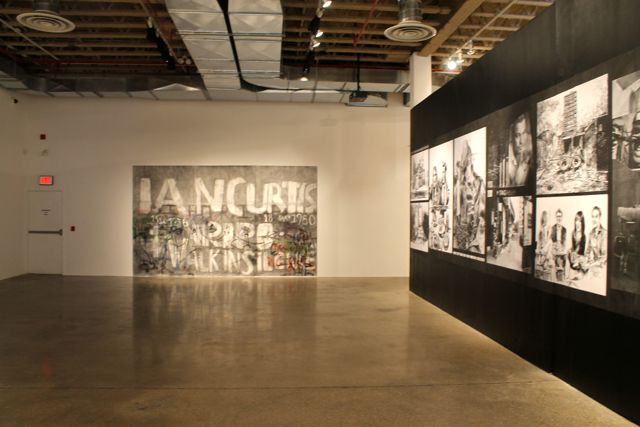
    Installation view with Graham Dolphin, Wall (Walk In Silence), 2012 (left) and Laura Oldfield Ford, Drifting through the Ruins (right)

    This new generation of artists acknowledges the legacy they have inherited from the Young British Artists (YBA) movement of the 1990’s. A movement of artists that were characterized by their commercial skills and their elitist patronage. This cohort of contemporary artists appears to be in conflict with the values of both society and the art world.

    Upon entering the space, the viewer is first impressed with the giant collaged works of Laura Oldfield Ford that resemble the advertisements that plaster our urban streets. Oldfield Ford’s Drifting through the Ruins, photocopied images are mounted on the wall that divides the large gallery space in two. She mixes images of luxury item advertisements with images of subsidized housing, demonstrating the ever widening social gaps that exist within contemporary Britain, and echoed across the rest of the world.
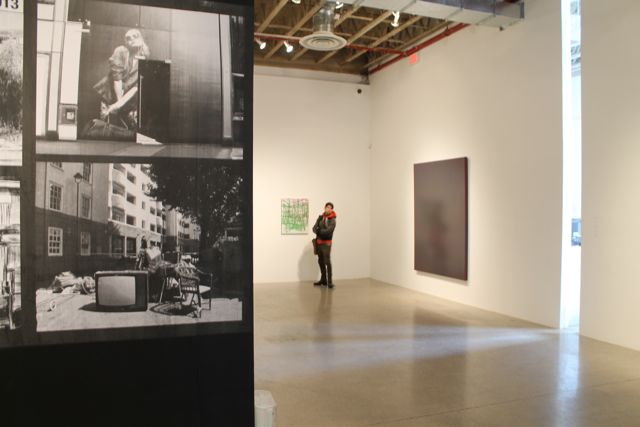
    Installation view with Laura Oldfield Ford Drifting through the Ruins (detail, left) and Boo Savillle Boo, To Your Scattered Bodies Go (right)

    The title of the exhibition ARE YOU ALRIGHT?, asks the spectator to question and reflect upon their own stability within a society in flux and does so using the empty construct of kitsch. The mixture of the collective works creates an atmosphere of a shared feeling of absence. The art spans across medium and meaning, the lack of coherence between the styles illustrates a sense of doubt among the exhibition’s participants and is intended to make the viewer feel alienation within the gallery.

    Most of the pieces occupy the walls of the large open gallery space. The few exceptions that enter into the viewer’s space was Jonathan Baldock’s Pierrot, mock installation of an imagined museum display of sculptures made out of plush materials and in palette of infant-pastels. This installation demonstrates how even within museums, culture has been degraded to something that can be commoditized.
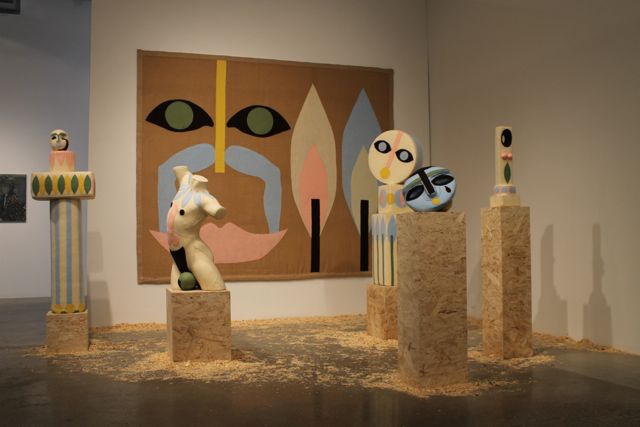
    Jonathan Baldock, Pierrot, 2011

    Harry Burden also explores the commodification of art in his clever appropriation of modern sculptures, recreating these using household cleaners. These three sculptures, which the artist has entitled Sterile Anthromorphic Figure, have been photographed and printed on bleached poster paper, alluding to the bleach bottles the artist used to create his sculptures.
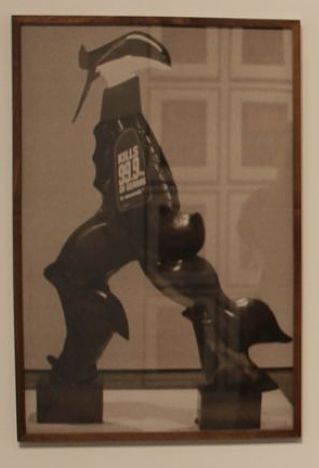
    Harry Burden, Sterile Anthromorphic Figure (Boccioni), 2012, digital print on bleached poster paper

    The white walls of the gallery contrasted with the bright commercial colours, iconic faces and objects, and images imitating urban realties. Graham Dolphin recreates a homage of graffiti in commemoration to the late Ian Curtis, with his mixed media drawing Walk in Silence. Dolphin further explores the relationship between iconography and mass productions. In his video installation, 1500 Images of Kate Moss, the artist demonstrates an iconic image through its mass proliferation can move from the singularity of an idol into a homogenous pattern.
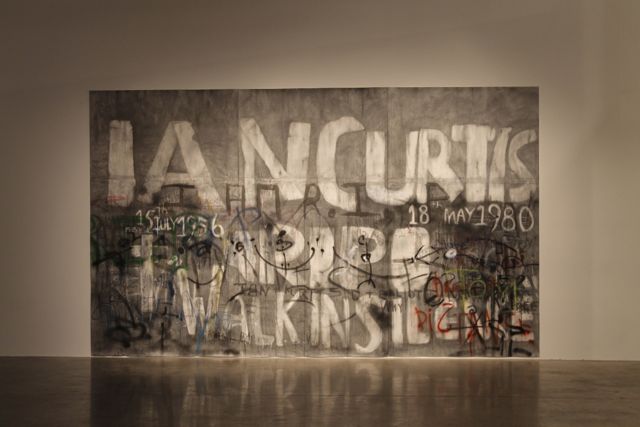
    Graham Dolphin, Wall (Walk In Silence), 2012, graphite ink, spray paint, crayon, tippex, marker pen biro on paper

    Caroline Achaintre’s ceramic and leather sculptures Panto and Betzy, and the tapestry Swirler are both representations of male and female genitalia. They demonstrate a clear critique of fetishism and vulgarity that has been commodified within society and art.
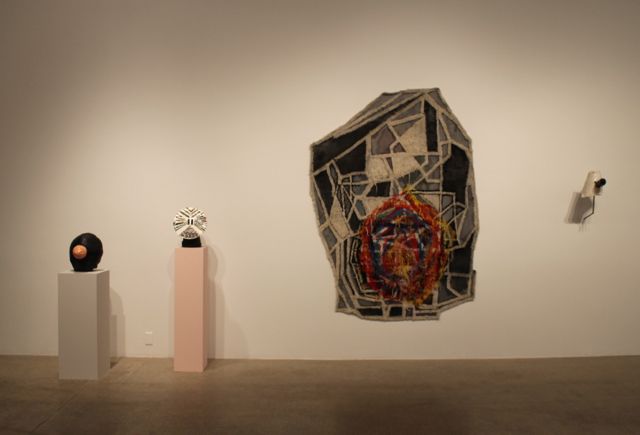
    Caroline Achaintre, Panto (far left), leather and ceramic, 2012, and Swirler (middle), 2010, tufted wool, 255 x 164 cm
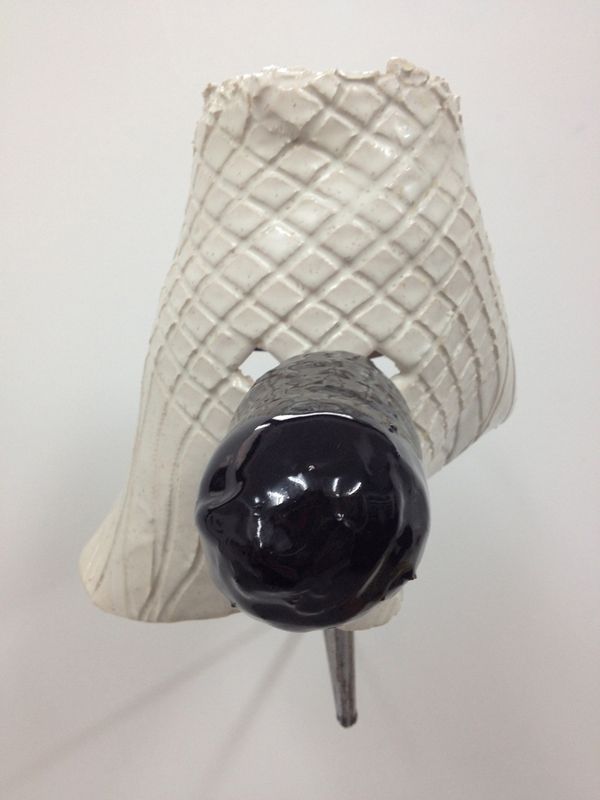
    Caroline Achaintre, Betzy, 2012 Ceramic, 23 x 37 x 26 cm

    The experience of this exhibition evolves from the bombardment of an abject reality to a retreat into abstraction. This withdrawal is evident in the final piece of Boo Saville. Her canvas, To Your Scattered Bodies Go, harkens back to the Abstraction movements of the twentieth century with their rejection of a world that has lost its moral compass.
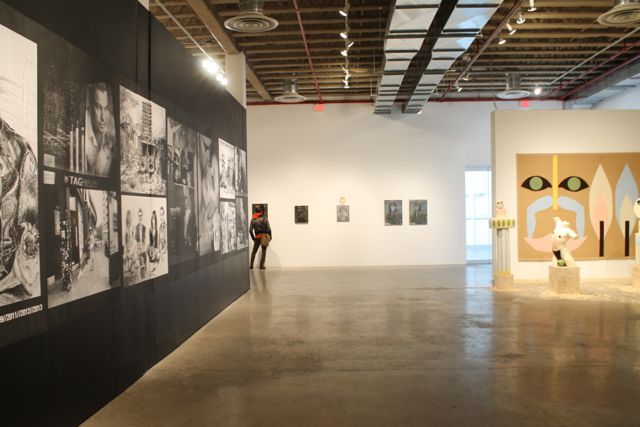
    Installation view

    Currently the Art Gallery of Ontario has printed works from their own collection on display by the pioneer British Pop artist Richard Hamilton. The work of this new generation of British artist, is a continuation of what Hamilton began when he first pasted together newspaper clippings of the Rolling Stones and Marilyn Monroe. Hamilton’s Swingeing London (1967-1968), with its proliferation of images foretells the ever-increasing infiltration of mass media into our daily lives. Since the rise of the mass media, artists have incorporated and appropriated these images by taking them from the everyday and putting them into galleries as art. By doing so, they ask us to question their value and meaning in our lives. They reveal the effectual truth about these images as they are mindlessly devoured by society.

    Text and photo: Alice Tallman

  • Black and White Ball

    Black and White Ball

    Thursday, February 7, 2013, 7 – 10 p.m.
    PROPELLER CENTRE FOR THE VISUAL ARTS

    Visitors in front of Sarah Walterhouse’s work, Hold in My Chest

    The weather forecast was really bad for Thursday night and a blissard just started about the time of the Black and White Ball. That didn’t  keep the exhibiting artists, their friends, art critics and art lovers away from the event. The gallery back packed with people wearing black and white surrounded by art works of the same colors.

    Tony Saad with his work “Snow on the Seafloor”

    Black and White III is one of Propeller’s most anticipated annual exhibitions. It is a juried exhibition featuring works in black and white. The organizers invited guests to ‘dress- to- impress’ in black and white attire to the Black and White Ball and let these art works inspire and engage you…

    Sharron Corrigan Forrest, Lake Leaves Series, mixed media, 16 x 32 inches

    W.W. Hung, Suspended Man, polymer, pulverized marble, steel, nylon, 21 x 21 x 21 inches

    Artists, Philip Hare with Maria Teresa Hernandez’ painting, “The Prayer”, in the background

    The show of more than 30 artists’ black and white works are open till February 17, 2013. Gallery hours: Wed – Sat: 12 – 6, Sun: 12 – 5 p.m.

    Photo: Fox Martindale

  • Michael Snow: Objects of Vision

    Michael Snow: Objects of Vision
    July 18, 2012 – March 13, 2013
    Art Gallery of Ontario

    “In my work I’m always a sculptor,” says Michael Snow. This is a rather unexpected comment coming from an artist whose extensive oeuvre spanning six decades includes painting, sculpture, film, photography, and music. But a key link between his works in various media is their quality of unfolding in time as they interact with the viewer’s perception and position. The fourteen sculptures that make up Snow’s current retrospective at the AGO, aptly titled Objects of Vision, are of no exception.

    Michael Snow (Canadian, born 1928), Zone, 1982, plexiglass, rubber, 57.7 x 36.5 x 298.0 cm. AGO, purchase with funds from an anonymous donor, 2001 (2001/21). © Michael Snow 2012

    Born in Toronto, Snow relocated to New York City in 1962. Abstract Expressionism had by this time become ubiquitous and hegemonic, and resistance to its spiritualizing and mystifying tendency was shown by a generation of younger artists. Reified as Minimalism by 1968, this aesthetic shift emphasized the role of the viewer’s perception in the sculptural experience. Robert Morris, a key figure within Minimalism, wrote that “the object is but one of the terms in the newer aesthetic,” operating within a “function of space, light, and the viewer’s field of vision.”

    Michael Snow (Canadian, born 1928), Sighting, 1982, aluminum 38.5 x 102.0 x 32.5 cm. AGO, gift of Michael Snow, Toronto, 2001 (2001/206) © Michael Snow 2012

    Snow’s sculptures from this period in New York were formed very much out of this cultural milieu. 1968’s Sighting is a rectangular work with a diagonal slot, which functions as a viewfinder that crops a section of the space beyond and incorporates it into the sculptural work. The image within the frame changes as the viewer shifts positions, such that the act of looking becomes involved in the composition and constant re-composition of the work.

    Michael Snow (Canadian, born 1928), Blind (with Joyce Wieland), 1968, steel and aluminum, 246.4 x 245.7 x 246.4 cm. National Gallery of Canada, purchase, 1969. © Michael Snow 2012

    Blind is a work from the same year made of four parallel mesh screens of increasing gauge of opening. The viewer is encouraged to walk through the space between the meshes and is made aware of occupying the same space as the sculpture. If the slot of Sighting emulates a camera’s viewfinder, Blind calls for the viewer’s eyes to zoom in and out like a camera lens. The superimposed mesh screens “establish different focal planes” that prompt the viewer’s eyes to zoom back and forth from one plane to another.

     Michael Snow (Canadian, born 1928), 432101234, 1969, Chromed steel, aluminum and polyurethane foam, 27.6 x 59.2 x 68.0 cm. AGO, gift of Michael Snow, Toronto, 2001 (2001/202) © Michael Snow 2012

    Snow’s sculptural practice also embodies Minimalism’s other key trope of truth to materials and transparency of construction, an aesthetic of materiality that finds its roots in Constructivism. Departing from the phenomenological investigation of Blind, the 1969 sculptures Membrane and 432101234 call forth the viewer’s attention toward the materials (rubber and polyurethane foam, respectively) and the procedure behind its formal presentation.

     Michael Snow (Canadian, born 1928), with Transformer, 1982, wood, varnish, rope and cardboard, height adjustable x 490.0 x 12.0 cm tapering to a point. AGO, purchase with funds from an anonymous donor, 2001 (2001/120). © Michael Snow 2012

    In the exhibition catalogue, Curator Georgiana Uhlyarik commented that Transformer (1982) and Core (1982-1984) are the anchors of the exhibition. Both works possess a sense of drama that makes them stand out from the others. Even more, both are demonstrative of the two Minimalist tendencies evident in Snow’s earlier sculptural work – to involve the viewer’s vision in a participatory manner and to present material and procedural clarity. The imposing Transformer is composed of a narrow, five-meter-long tree trunk that hangs horizontally by a rope. The wood is whittled on one end to a sharp point, which persuasively directs our gaze along the wood and past the tip into space, away from itself. Yet, the work’s exposed materials and clear articulation of parts also function to direct attention to itself, toward its materiality and process. Likewise, the pillar-like Core makes manifest in the viewing of the work the materiality of ceramic from which it is made and the process of its production on a pottery wheel. The concentric piece entices the viewer to walk around it, but towering two meters high and despite its title, the core is impossible to access with the eye.

    Michael Snow (Canadian, born 1928), Core, 1982-84, unglazed ceramics, 206.5 x 82.o cm (10 sections). AGO, Collection of Canada Council for the Arts, Art Bank © Michael Snow 2012

    Transformer and Core powerfully attract and play with the viewer’s attention. This playful interaction between the object and the perceiver is present in the experience of all of the sculptures in the show. Snow’s objects deftly direct the viewer’s eyes and body, providing an entry-point for engaging with his art for visitors of all levels of visual literacy. By heightening our awareness of looking and of being in space, the fourteen sculptures successfully and playfully keep the viewer active and engaged.

    by Amy Luo

  • Open Studio’s Annual Scholarship Exhibitions

    October 26 – December 1, 2012
    Artist Talks: Friday, October 26, 6 – 7 p.m.
    Opening Reception: Friday, October 26, 7 – 9 p.m.
    OPEN STUDIO GALLERY
    401 Richmond Street West, Suite 104
    Toronto ON, M5V 3A8
    T/F: 416-504-8238
    E-mail: sara@openstudio.on.ca
    W: http://www.openstudio.on.ca
    Hours: Tues – Sat, 12 – 5 p.m.

    Open Studio is pleased to present the 2011-12 Scholarship/Fellowship Exhibitions from October 26 – December 1, 2012, featuring artists Liz Menard (Nick Novak Fellowship), Jennie Suddick (Donald O’Born Family Scholarship), and Alexander Froese (Don Phillips Scholarship).

    All three artists will give illustrated talks about their work and the progress of their projects over the year on Friday, October 26 at 6 pm at Open Studio, followed by an opening reception. As Orono, ON-based artist and curator Maralynn Cherry points out in the accompanying essay, the common thread between these three exhibitions is the unique way in which the artists re-read sites in an ever more complex cultural landscape.

    Open Studio Gallery 
    Liz Menard: Nature of the River
    Nick Novak Fellowship Exhibition

    Former Eastern Avenue Bridge, hand drawn etching, aquatint, 22” x 30”, 2012

    Nature and the environment inspire Liz Menard’s Nature of the River. Sustaining environmental biodiversity is important and a recurring theme in her work. She is interested in native and invasive species and the natural, abandoned and built environments where they live. Fascinated by the Don River, Menard researched archival maps and images, which she combined with personal explorations (on foot and by canoe) to create hand drawn etched copper plates exploring what was and what is the Nature of a river. This work is rich in detail and open ended to engage viewers and encourage dialogue about our role in helping nature and the environment continue to withstand the pressures, stresses and tests of our times.

    Print Sales Gallery
    Jennie Suddick: I was here
    Donald O’Born Family Scholarship Exhibition

    Odessa, watercolour paper, Mylar, velum, masonite, LEDs, 12” x 2” x 6”, 2011. Photograph by Thomas Blanchard.

    Jennie Suddick’s work reflects on tourism’s role in facilitating access to Canada’s vast and iconic geography. Influenced by key moments throughout the history of tourism in Canada, as well as her own personal memories of childhood family vacations, Suddick creates two-dimensional and three-dimensional paper works that reference the symbols and sites of this distinct aspect of Canadiana. In I was here, Suddick reflects on the celebrated “pit-stops” found along our countries Trans-Canada highway. These multi-faceted buildings serve a unique dual-purpose – being hubs for the communities in which they are found, as well as sought out (or accidental) landmarks for travelers. Through her handmade papercraft structures Suddick elevates the status of roadside sites by presenting them as carefully constructed, detailed architectural forms.

    George Gilmour Members’ Gallery
    Alexander Froese: A Motel for Words & Ideas
    Don Phillips Scholarship Exhibition

    Impulse Arrested, screenprint on paper & mixed media, 4 3/4″ x 1″ x 5/8″, 2012

    In A Motel for Words & Ideas, Froese engages in the aesthetics of mid-twentieth century commercial design through the practice of printmaking, inhabiting the form of common products and advertisements to serve as a meeting point between the text and the visual. By inhabiting recognizable commercial forms Froese is able to express new words for old desires. It is immediate yet nostalgic, sentimental yet fleeting. The dated structures become relevant and contemporary vehicles through the engagement of encompassing and enduring issues. Taking from the artist’s own understanding of the meaning of pain and joy the work is filtered through the language of text and image, providing a space in which viewers can commiserate, laugh and find hope. There exists an inherent beauty and consolation in the collective human desires for stability, authenticity and reason in the navigation of an individual existential understanding. Immediately familiar yet sensitive in their subjectivity, expressions of hope and desire can find a unique access point through the implementation of commercial imagery. By embodying a highly personal sentiment in a familiar object the message becomes at once accessible and anonymous.

  • Frida & Diego: Passion, Politics and Painting

    Frida & Diego: Passion, Politics and Painting

    October 20, 2012 – January 20, 2013
    ART GALLERY OF ONTARIO
    317 Dundas Street West
    Toronto, ON M5T 1G4
    T: 416.979.6648
    www.ago.net
    Hours: Tue & Thurs–Sun 10–5:30, Wed 10–8:30

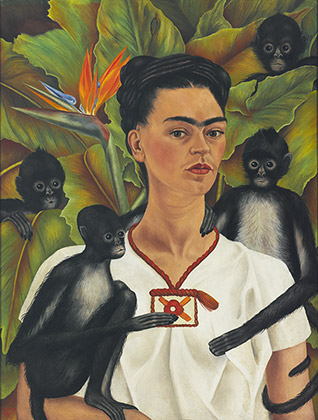
    Frida Kahlo (1907-1954). Autorretrato con monos, 1943 (Self-Portrait with Monkeys, 1943), oil on canvas, 81.5 x 63 cm. The Jacques and Natasha Gelman Collection of Mexican Art. (C) Banco de Mexico Diego Rivera Frida Kahlo Museum Trust, M.D.F./Artists Rights Society (ARS), New York

    The exhibition Frida & Diego: Passion, Politics and Painting features more than 80 paintings and works on paper by Frida Kahlo and Diego Rivera and more than 60 photographs of the couple, whose shared passion for each other and Mexico’s revolutionary culture during the 1920s and 1930s have made them Mexico’s most famous artists. Assembled from three distinguished Mexican private collections on Mexican art, the Museo Dolores Olmedo, Colección Gelman, and Galería Arvil, the exhibition provides the opportunity to view almost one quarter of Kahlo’s entire body of work and a range of Rivera’s painting styles from his early cubist period and studies for his Mexican murals to his portraits and later landscapes.

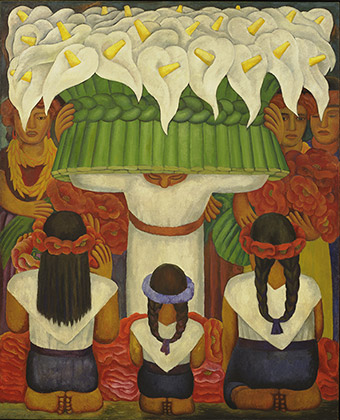
    Diego Rivera (1886-1957). Vendedora de alcatraces, 1943 (Calla Lily Vendor, 1943), oil on masonite, 150 x 120 cm.  The Jacques and Natasha Gelman Collection of Mexican Art. (C) Banco de Mexico Diego Rivera Frida Kahlo Museum Trust, M.D.F./Artists Rights Society (ARS), New York
    During their lifetime together as a married couple, Rivera achieved international prominence as a muralist artist, while Kahlo‘s intimate paintings were embraced by the Surrealist movement and the Mexican art world but not well known in the broader context of art and modernism. Guest-curated at the AGO by Dot Tuer, Frida & Diego: Passion, Politics and Painting offers a new perspective on their artistic significance for the 21st century: one which encompasses how their paintings reflect both the dramatic story of their lives together and their artistic commitment to the transformative political and cultural values of post-revolutionary Mexico.
    Featured image: Frida Kahlo (1907-1954). Autorretrato con tehmana (Diego en mi pensamiento), 1943. (Self-portrait as a Tehuana, Diego in My Thoughts), 1943, oil on masonite, 76 x 61 cm – detail. The Jacques and Natasha Gelman Collection of Mexican Art. (C) Banco de Mexico Diego Rivera Frida Kahlo Museum Trust, M.D.F./Artists Rights Society (ARS), New York

  • Michael Snow: Objects of Vision


    July 18, 2012 – March 17, 2013
    ART GALLERY OF ONTARIO
    317 Dundas Street West
    Toronto, ON M5T 1G4
    T: 416.979.6648
    www.ago.net
    Hours: Tue & Thurs–Sun 10–5:30, Wed 10–8:30

    Michael Snow is a Toronto born artist known internationally as a painter, sculptor, filmmaker, musician and author. This exhibition celebrates his achievement as the 2011 winner of the Gershon Iskowitz Prize.

    Snow has always been a sculptor. “A pure sculptor,” he explains, “an artist who makes objects.” He makes things to look through, look around, look along, look at, up, down and behind, to look at yourself looking at things. By making vision the subject of the object, the looking activates the object. Looking that sometimes require touch, sometimes invites sitting and sometimes necessitates caution.

    “All these works are Directors of Attention in the sense that their forms suggest the paths a spectator’s eyes should take,” he writes. In the most literal sense, Snow makes visual art: objects for you to see.

    The sculptures in Objects of Vision are abstract-form sculptures from three distinct yet essentially connected moments in the artist’s career: the late 1950s, the late 1960s and 1982. The sculptures are instruments in the artist’s orchestration of thinking about looking. While each work has a rich exhibition and publication history in varied contexts, they are presented here for the first time as one cohesive and focused investigation of sight and materiality.

    Meet the Artist – Michael Snow
    Wednesday, October 3, 7 – 8 pm
    Signy Eaton Gallery
    Free Admission

  • SAUL LEITER

    Saul Leiter, Tanager Stairs, 1954, chromogenic print, printed later,13 1/2 x 9 inches (image) 14 x 11 inches (paper)

    September 13 – October 6, 2012
    Opening Reception: Thursday, September 13, 6 – 8 p.m.
    NICOLAS METIVIER GALLERY
    451 King Street West,
    Toronto, M5V 1K4
    T: 416.205.9000
    www.metiviergallery.com
    Hours: Tuesday-Saturday 10 – 6 p.m.

    Nicholas Metivier Gallery is pleased to announce an exhibition of photographs by New York artist Saul Leiter. The exhibition will open on September 13 and will be on view through October 6 with a reception on Thursday, September 13 from 6– 8 PM.

    Saul Leiter was born in 1923 in Pittsburgh, the son of an Orthodox Jewish scholar. Developing an interest in art as a teenager, he quit theology school and moved to New York when he was 23 to pursue a career in painting. Leiter was introduced to the darkroom shortly after his arrival and while he has continued to paint throughout his career, it was his exploration into colour photography in the 1950s onwards that set him apart creatively and has been the subject of recent acclaim.

    Leiter was considered a member of the New York School, a group of photographers working between the late 1930s and early 1960s in New York City that redefined street photography. Most of Leiter’s contemporaries in this group, including Walker Evans and Robert Frank, only released works in black and white, adhering to the view that colour undermined the integrity of a photograph. Leiter in contrast exploited colour distortions and allowed for the accidental in the darkroom, abandoning notions of control.

    This will be Saul Leiter’s first exhibition in Canada and will feature photographs from his seminal body of work, Early Color. A collection of metropolitan scenes, Leiter employed mirrors, windows and the random passerby in a spontaneous manner to create alluring and unusual compositions. His background as a painter is evident in his poetic use of subdued colour and eye for the abstract.

    The exhibition coincides with an era of unprecedented recognition for Leiter’s work. This past spring, Leiter had a major career retrospective at the Hamburg House of Photography accompanied by a catalogue. Museum collections include: The Museum of Fine Arts, Houston; The Art Institute of Chicago; The Baltimore Museum of Art and The Victoria and Albert Museum, London. Leiter is represented by Howard Greenberg Gallery in New York.

  • GALLERY HOP / TORONTO / 2012

    Gala Dinner & Auction  September 20 / Talks & Tours September 22

    Gala Dinner & Auction: Totonto’s Smart Art Party
    Thursday, September 20, 6 – 11 p.m.
    The Carlu
    444 Yonge Street, Toronto
    For more information please check http://galleryhop2012.canadianart.ca/gala/

    HOP DAY: Saturday, September 22, 2012

    MORNING: 11:00 a.m. – 12:30 p.m.
    CONVERSATION WITH CANADIAN ART EDITOR RICHARD RHODES AND PANEL
    Cinema 4 | TIFF Bell Lightbox, Reitman Square, 350 King Street West

    Begin your Gallery Hop with a conversation featuring artists Micah Lexier, Alain Paiement and Laurel Woodcock, moderated by Canadian Art Editor Richard Rhodes. Visit this page to view more panel details.

    AFTERNOON: 1:00  – 5:00 p.m.
    FREE GALLERY TOURS AND TALKS
    Various locations across Toronto

    Engage with the art and artists of Toronto through a series of free tours and talks. Special guests and speakers include Canada’s representative at the 2013 Venice Biennale, Shary Boyle, and Toronto Star art critic Murray Whyte. Members of the Canadian Art editorial team, including Richard Rhodes, Bryne McLaughlin, Leah Sandals and David Balzer, will also be speaking across the city. Visit this page to plan your afternoon, choose a tour, several talks or a combination of both: http://galleryhop2012.canadianart.ca/hop-day/tours-talks/.

    EVENING: 5:30  – 7:30 p.m.
    MAGAZINE LAUNCH
    Diaz Contemporary, 100 Niagara Street

    End the day with fellow art lovers at the launch of Canadian Art’s fall issue. Please RSVP for the magazine launch by email to rsvp@canadianart.ca by September 17

  • Caven Atkins: Gathering Clouds

    3 Willows #2 (1935) 16.25 x 25.75 tempera on card


    September 8 – 29, 2012
    Opening Reception: Saturday, September 8, 11 – 1 p.m.
    INGRAM GALLERY
    49 Avenue Road (@ Yorkville)
    Toronto, ON M5R 2G3
    Tel. 416-929-2220
    www.ingramgallery.com
    Hours: Tues – Sat 11 – 5 p.m.

    A multi-talented visionary, painting alongside Carl Schaefer, Charles Comfort and Fritz Brandtner — Caven Atkins (1907-2000) was a master of all media.  Curated as a significant part of our 2011 exhibition In the Neighbourhood, Caven Atkins had studios on both Howland and Ossington in Toronto. In addition to his Ontario days, Caven Atkins was also part of the artistic communities of Winnipeg, Manitoba and Detroit, Michigan.

    “Caven Atkins’ beginnings were shaped by Lionel Lemoine FitzGerald and Fritz Brandtner in Winnipeg, by his industry and determination; later, in the company of friends like Charles Comfort, Carl Schaefer, Paraskava Clark, Peter and Bobs Cogill Haworth, Pegi Nicol MacLeod, and Charles Goldhamer.

    Atkins created a body of work which vividly represents his time.

    Not satisfied with a set formula for making pictures, he strove to reveal the fundamental structure, the essential rhythms in nature. To accomplish this end, he constantly experimented; Charles Sheeler, Lyonel Feininger, Paul Cézanne, Marsden Hartley, Albert Pinkham Ryder and John Marin were sources of inspiration. But, finally, it was the landscape of Canada itself – the winding Beausejour River, the lakes and woodlands of Flin Flon; the bluffs at Scarborough, the rolling countryside of Baie St. Paul, and Grafton – that fired his mind and shaped his art.” Ted Fraser, 1979

  • Interview with Toronto artist, Sasha Pierce

    Interview with Toronto artist, Sasha Pierce

    Interview with Toronto artist, Sasha Pierce (S.P.) by Phil Anderson (P.A.)

    Sasha Pierce. Photo: Toni Hafkenscheid.

    P.A: Your current geometric paintings are very detailed and intricate. Can you explain the process of  constructing these works?     

    S.P: I have an unusual way of painting. I mix a number of oil paint colours on a palette and carefully place the paint in a small plastic bag at the corner, then I cut a small tip off the corner to squeeze the multi-coloured paint out. I apply a line of paint with a small repetitive gesture to create texture. I use a ruler to straighten the paint from a thin line to thinner line and ultimately to a vanishing point. I repeat this process onto the entire surface, using over 30 paint-filled bags at a time to achieve a variety of hues and tones.

    P.A: The process seems rather labour intense. How long does it take to complete a piece?

    S.P: Yes, the process is labour intensive. Each painting takes a month to two months to complete, depending on the complexity.

    P.A: Do you have a draft pattern to work from? How do you decide on how it will look when finished?

    Sasha Pierce, Fire Agate, 2012, oil on linen, 23 x 18 inches

    S.P: I use tessellations pattern to guide my compositions. Tesselations are the process of creating a two-dimensional plane using the repetition of a geometric shape with no overlaps and no gaps. For example the tessellation I appropriated for “Fire Agate” is the tilling of congruent pentagons that was discovered by Marjorie Rice in 1995 and whose work is installed on the floor of the Mathematical Association of America headquarters in Washington, D.C. I choose to work with certain tessellations because of the way the interlocking shapes combined to make a variety of new ones. The various shapes create an unstable or multi-focus that contrasts with the central point. Because of the different systems I use to create the work I don’t have a clear idea how the painting will look until it is finished.

    P.A: Previously your works replicated textiles. Is there a connection?

    S.P: I have been using the formal and abstract qualities of textiles as a reference point for my paintings starting with work I completed during my undergraduate degree at the University of Guelph. My early work was focused on mimetic representation such as a thick paint bas-relief of my personal sleeping bedding. Later I shifted away from representation towards abstraction. Currently the connection to textiles is conjured through my process where I use geometry and architecture as the source for my paintings.

    Sasha Pierce, White Diamond  detail, 2012, oil on linen, 23 x 18 inches

    P.A: I understand you feel there is a tie with textiles and your family roots. Can you elaborate on this relationship?

    S.P: Textiles not only serve a vital function to keep us warm they also non-verbally communicate the identity of an individual or group. I feel textiles connect me to my ancestors, family, and memories. My ancestors were working class people and my great grandmothers created beautiful quilts using worn out clothes. My grandfather used to fix my great grandmothers sewing machine and he has repaired and sold sewing machines for the past 70 years. My earliest memories include shopping for clothes with my mother and sister.

    P.A: You have had some very successful exhibits in the Houston and Los Angeles. How you see the American contemporary art scene compared to Toronto? Is there a difference in attitudes?

    S.P: I was only in Houston and Los Angeles for a short time for the openings, so it is difficult for me to discuss the differences in attitudes. I have been lucky because my experience with galleries has been very positive both in the US and Canada. Los Angeles does have a large art audience and that was great to experience.

    Sasha Pierce, Lake Superior  Agate, 2012, oil on linen, 23 x 18 inches

    P.A: What lead to your exhibitions in the US?

    S.P: I was asked to exhibit with Bryan Miller at CTRL Gallery in Houston a year after he saw my work at the 2008 NEXT Art Fair in Chicago through Kineko Ivic at Greener Pastures. Both Greener Pastures and CTRL Gallery are now closed.

    Then in 2010 LA writer and curator Jan Tumlir curated my work in The Non-Identical Abstraction Engine group exhibition at ACME. The exhibition explored Robert Linsley’s New Models for abstraction fellowship at the University of Waterloo, 2004-2010. Then I had an opportunity to return to ACME for a solo show later that year.

    P.A: When you were studying at Guelph and Waterloo were there any particular artists who influenced your art practice?

    S.P: Yes I have been influenced by many artist including professors and my peers. I have been influence by abstract artists, which include Agnes Martin (American/Canadian, 1912-2004), Bridget Riley (British, 1931-) and Tomma Abts (Britsh/German,1967-). Perhaps in terms of influence it is more that these artists gave me the permission to go in the direction that I wanted to go.

    Sasha Pierce, Cycle, 2011, oil on linen, 21 x 16 inches

    P.A: Is there any advice you would give to young painters struggling with their work?

    S.P: Doubt can be a big challenge because art is rarely rational. I feel, staying connected to inspiration is really important as well as patience and perseverance. Running, cooking healthy food and having fun with friends and family can help enhance a creative lifestyle.

    P.A: What is next for you in terms of upcoming exhibitions?

    S.P: I will have work in Post, an upcoming group show at the University of Waterloo Art Gallery (UWAG), which is a post-grad, and Shantz internship survey curated by Ivan Jurakic. The exhibition opens September 13th and runs until October 27th, 2012. Visit www.uwag.uwaterloo.ca for more details.

  • 13th Annual Juried Emerging Sculptors Exhibition

    “The Balance”, ceramic, stainless steel, by Aislinn Caron


    August 16 – September 7, 2012
    Opening Reception & Awards Presentation: Thursday, August 16, 6:30 p.m.
    CANADIAN SCULPTURE CENTRE
    500 Church Street
    Toronto, ON M4Y 2C8
    T: 647-435-5858
    E: gallery@cansculpt.org
    Hours: Tue–Fri 1 2– 6; Sat 11 – 4 p.m.

    Each year the SSC invite submissions by emerging sculptors from across Canada. Jurors selected 10 participants whose contemporary practices include a wide range of media from steel to installational works. The Canadian Sculpture Centre offers a platform for new artists and a venue for the application of exciting new ideas

    The Sculptors Society of Canada cordially invite you to the Opening Reception followed by an Awards Presentation on August 16, 6:30pm.

    Jurors:

    Holly Lee, Artist / Curator, IndexG Gallery

    Kelly McCray, Art Consultant / Curator, ArtBarrage.com

    Desmond Scott, Sculptor

    Selected the following participants:

    DOUG AUCOIN * CONRAD BEAUBIEN * GRAHAM BOWDEN * JAMES BRUNSWICK * AISLINN CARON * MAGDOLENE DYKSTRA * ALANA FARRELL * MIKE MARCON * ALLEN MATROSOV * MARTHY NASATO

    Guest Musicians: Peter Shoebridge & Aidann Todd-Parrish

    Award Sponsors: A.& M. Green, Artcast Inc., MST Bronze Ltd.


  • Interview with Robert Kananaj

    Interview with Robert Kananaj, owner of the Robert Kananaj Gallery (R.K.)
    by ARTORONTO.CA Emese Krunák-Hajagos (E.K-H.)

    E.K-H: You will celebrate the First Year Anniversary of your gallery on July 28, 2012, so some of the hard times are behind. What made you decide to open an art gallery on the first place?

    R.K: The gallery is born out of the studio search, and this is how we operate and keep the gallery: to be like the extention of the studios of the artists. We both, my wife and I, were looking for ways to share our art collection with our friends and relatives at some point. Meanwhile, looking for a studio space, in May 2011, we saw this space was for lease; instead it became an instant decision to be a gallery space. My wife and I share a name, we are Roberta and Robert. I wanted to call the gallery with one of our names, preferably Roberta. We decided to stay with “Robert Kananaj Gallery” because those who know of me as an artist, and not my wife, would think “Roberta” a twisted version of my name.

    Robert and Roberta Kananaj. Photo: Robert Kananaj

    Why gallery ?… My first job after graduating as a monumental sculptor, was curator and director of the regional municipal gallery in the city where I grew up, Fier, Albania. At once creating, curating, and directing makes me more aware of the importance of sharing through art. The experience derived from art and the gallery, is a point of departure for art practices which gravitate toward the remote and minute.

    It feels amazing, the first year anniversary like the first day we decided to open the gallery. The time goes so quickly, it feels like I am in real time a year ago. The year has been a project in itself. We, our staff and artists, are honoured and motivated, reaching by hard work to this point of celebration.

    Anniversary show (July 28-September 1, 2012) artists from left to right: Wing Yee Tong, Mike Parsons, Karen Grosman, Napoleon Brousseau, Jordan Seal, Matthew Green and Robert Kananaj. Photo: Khristopher Reardon

    E.K-H: Why did you choose the Lansdowne area?

    R.K: Lansdowne is an area that feels remote in the middle of the city. The more remote it is, the more part of art it becomes. You see that with all the hubs of art galleries, in generations from Yorkville, and later to Spadina, Queen West, and now Bloordale.

    We live in the area, also the gallery has Mercer Union and Toronto Free Gallery as neighbours. It is proving to be a good location and other galleries have opened in the area this last year.

    Installation view of a Group Exhibition (November 24, 2011 – January 21, 2012). Photo:Robert Kananaj

    E.K-H: How do you choose your artists?

    R.K: We choose each other. A gallery’s scope is such a small venue that you can start from scratch, and work from nothing; but as you see, I start from somewhere. Being a sculptor myself, and living and sharing a lifetime with artists of all genres, creates an environment of good premises to select and be selected.

    Invitation to whom it may concern: If you are in any way witnessing remoteness in any level, personal, or social, or simply art loving, or an artist, we have Robert Kananaj Gallery hosting and sharing the outsider in all of us.

    Group Show (August 13 – September 17, 2011), Wolfinside & Dinosaurone by Stefan Thompson. Photo:Robert Kananaj

    E.K-H: Are you satisfied with the selling of arts in your gallery?

    R.K: When an artist is motivated to make an artwork, mostly the fufilment is in making it. So it is with the gallery. It may sound a bit misleading, but we didn’t expect in the first three to four years to meet our expenses; however, with youth in art, regardless of seniority, the hopes are real and promising.

    In addition we have started the Jordan Seal Project: “Donation based, Pay what you think the art is worth, Pay what you can afford, Art for you, Art for everyone.”

    OCAD U Graduation Show (April 24 – May 2012), Opening Reception April 27. Photo:Robert Kananaj

    E.K-H: What are your future plans?

    R.K: The future plan is long life to the gallery. It is one year old, it is and becomes what we offer to it. We work with the gallery as an artist works with the artwork. With a strong team and support for each other in a spirit of sharing, we have choices and direction to explore at once the past and future in the making. The gallery is invitation to all art loving, art making, and also art dealing people. We focus the remote, and we centre the outsider and the other as our own.