
The city of Toronto has reason to celebrate with the recent opening of a beautiful new exhibition space downtown, called ‘the modern.toronto’. It is not a commercial gallery, but rather is funded independently. Indeed, it is more of a museum than a gallery. Its stated mission is to showcase non-objective abstract art, otherwise known as abstract expressionism. This genre, as their website points out, began soon after World War II. That is a long time ago now, prior to the living memory of all but a few. So one might ask: isn’t its mission somewhat anachronistic? I’ll get back to that presently.
The gallery is spacious and light and is divided into two exhibition areas – one at the front of the building, and a larger space located at the back. Today I’ll talk about the works displayed in the rear space. These are ten abstract paintings by the venerable artist and educator Ron Shuebrook who, among many other roles, served as president of the Ontario College of Art and Design between 2000 and 2005. He currently resides in Guelph. For decades he has been represented by Olga Korper Gallery.
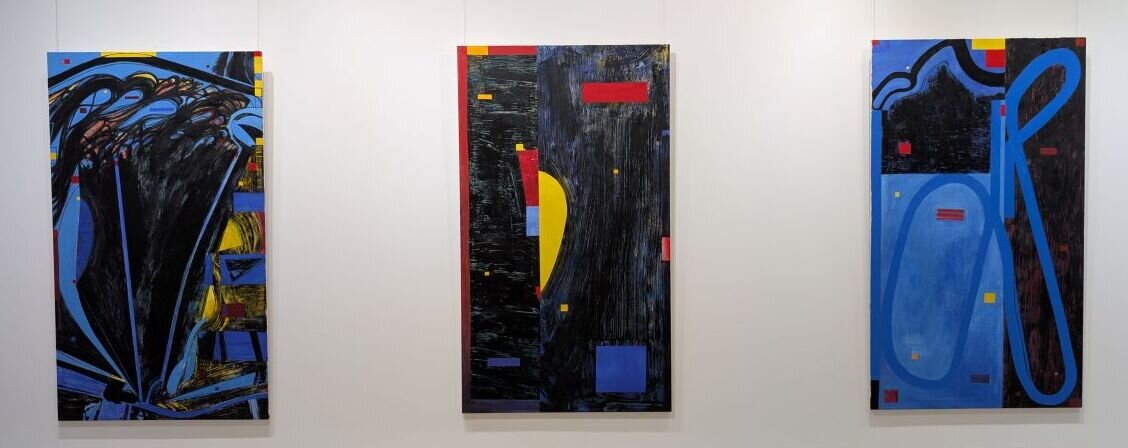
L-R: Ron Shuebrook, Untitled (Contested Territories Series#2), Towards the Light and Black Mountain, Blue Monkeyrope, both 2021, 84 x 48 inches
It would be hard to find a living artist with more of a pedigree that aligns with the modern.toronto’s mission. Born in Virginia Shuebrook studied visual arts and then for an M.Ed in art education at Kutztown University, Pennsylvania. From the mid-1960s to the early 1970s, through scholarships and a teaching assistanceship, he came into contact with many luminaries at the time, including Leon Golub, R.B. Kitaj, Robert Motherwell, Myron Stout and Fritz Bultman.
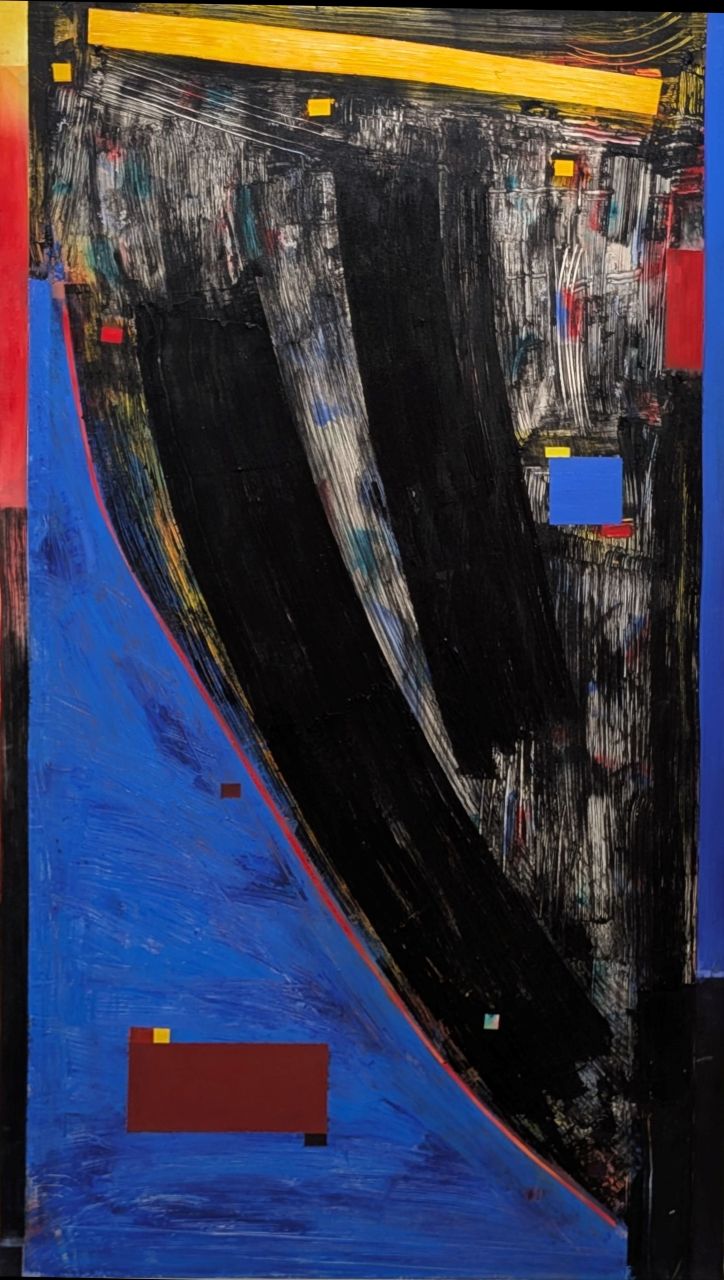
Ron Shuebrook, Untitled, 2021, 84 x 48 inches
Shuebrook’s accomplishments, in terms of where he has taught since moving to Canada and the number of public and private collections that have his work, are too numerous to list here. But what of his paintings themselves? The works on display were done in 2021, bar two works dating from 2015 and 2019 – distinguishable by their slightly smaller scale. Most are large, measuring seven feet high and four feet across. They are acrylic on canvas.
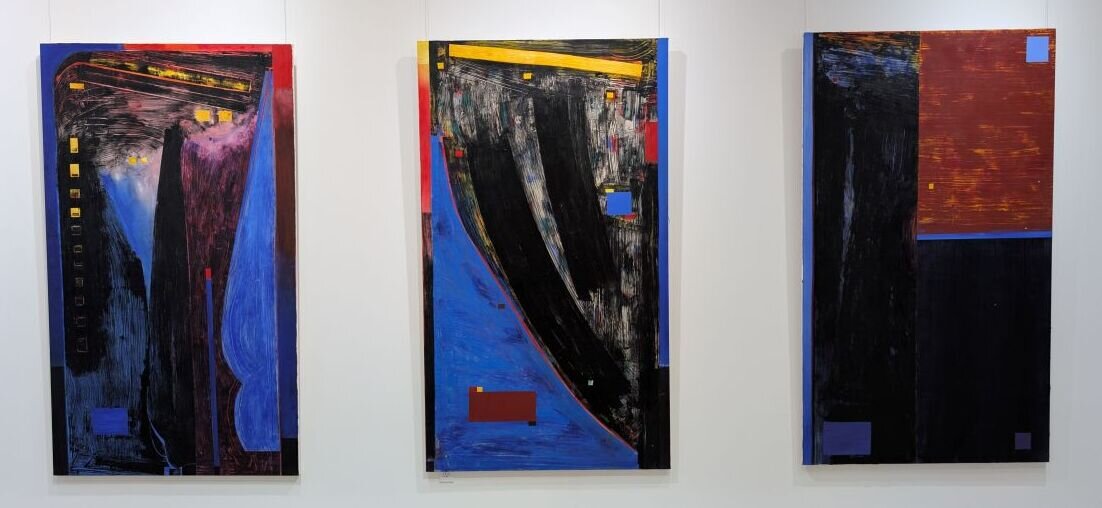
L-R: Ron Shuebrook, Tower, Untitled and Untitled, both 2021, acrylic on canvas, 84 x 48 inches
While all the paintings betray Shuebrook’s preoccupation with the formal qualities, with their emphasis on the division of the picture plane and colour, some appear to possess a narrative element. For example, his Tower (2021) suggests the tragedy of 9/11. Indeed, Shuebrook speaks of being influenced in another painting, for instance, by his reading of Melville’s Moby Dick. These large paintings, predominantly in blue and black, are compositionally complex and remind me in this respect of some of Richard Diebenkorn’s abstracted landscapes.
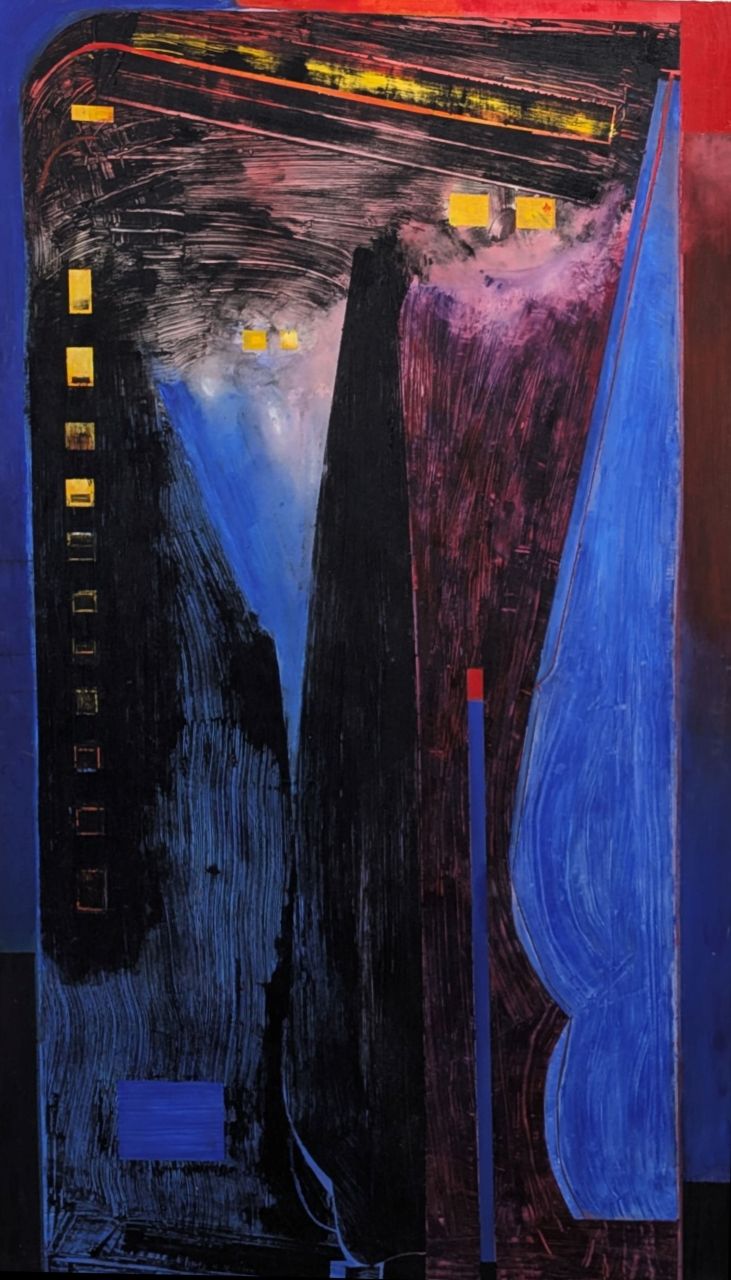
Ron Shuebrook, Tower, 2021, 84 x 48 inches
The tightest and most accomplished works in the show are his three grid paintings. Parsimonious in their palette, the edges become integral to their composition. In this regard, they are entirely self-contained. The combination of geometry and gestural brushwork is masterful. To the extent they are purely abstract they are paradigms of non-objective painting in the way originally championed by Wassily Kandinsky in the early twentieth century. Kandinsky saw reality as divided into two – the external material world and the spiritual inner world. In his theories and through his paintings he aimed to ‘paint music’, which he saw as the epitome of a spiritual artform. What I see in Shuebrook’s work is an attempt to paint, if not consciously or intentionally, music reminiscent of that of minimalists like Philip Glass and Steve Reich, who coincidentally are Americans of the same generation as Shuebrook. The grid paintings are repetitive, restrained and enchanting in the manner of Glass’s and Reich’s music.
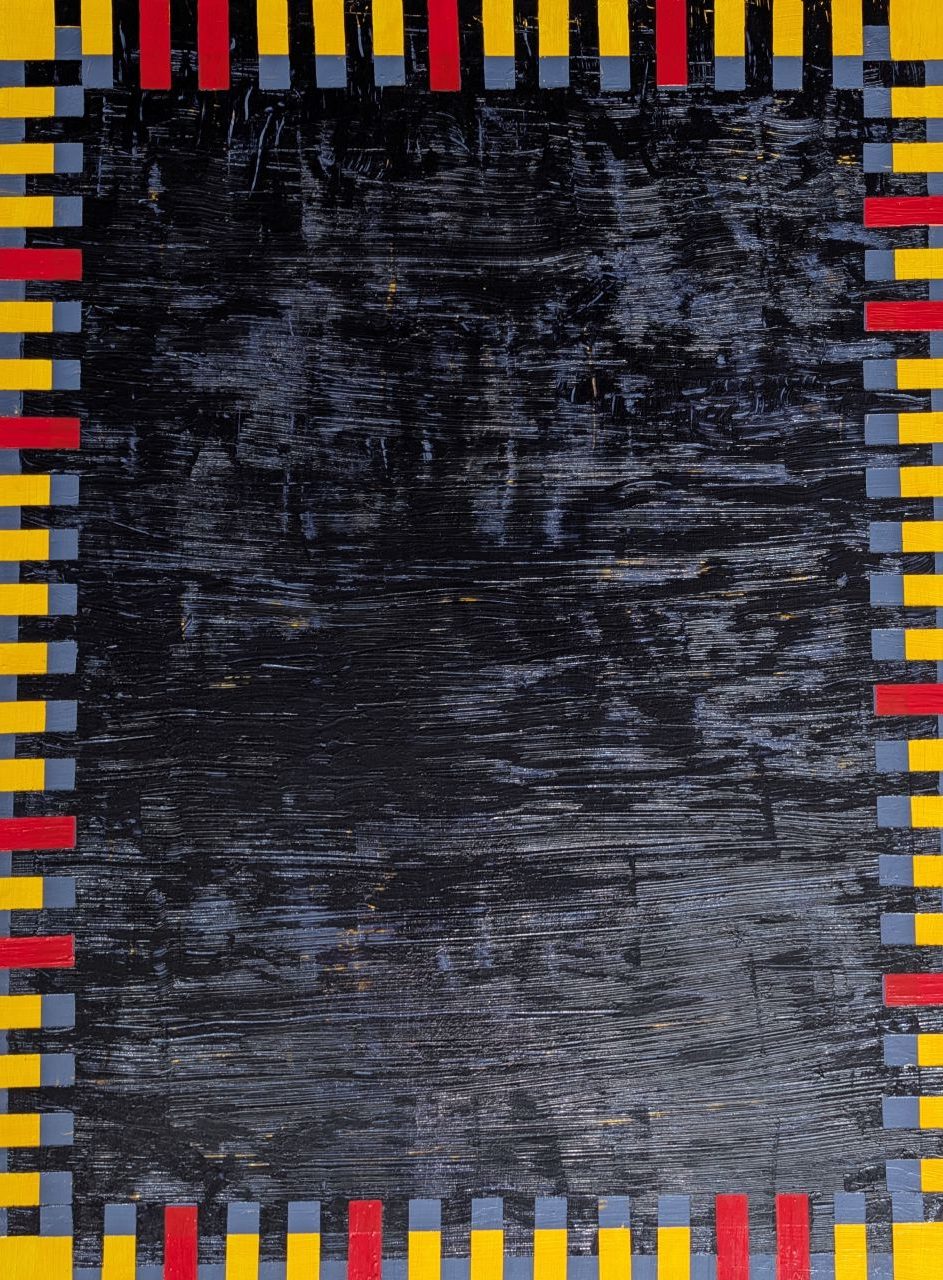
Ron Shuebrook, Untitled (black, grey, red, yellow), 2019. Acrylic on wood panel, 40 x 30 inches
Kandinsky’s division between objective and non-objective art has been stressed in particular by American art theorist and critic Donald Kuspit, who indeed has written a brief endorsement of the modern.toronto and its mission, that appears at the bottom of its website’s homepage. Kuspit lays out his thesis in detail in his book The End of Art. There he essentially argues that commercialism and the growth of the entertainment industry have turned what we call ‘art’ into a consumer product – one that is devoid of spirituality, of any quality that transcends the banal material world. Further, non-objective art is by nature spiritual, and so is a genre that resists what Kuspit sees as the emptying of art, which is now best decribed as ‘postart’. The modern.toronto’s owner, Ben Woolfitt, in agreement with Kuspit, holds that there is an obligation to champion non-objective art, as the works of this genre still have genuine intrinsic worth, independent of any financial considerations.
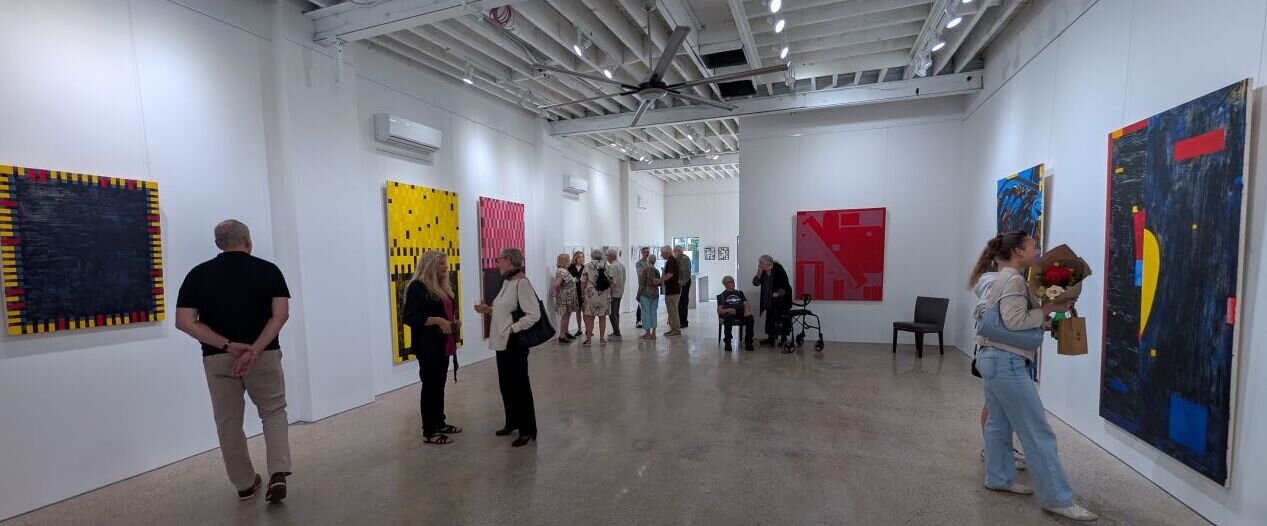
Installation view of Ron Shuebrook, Selected Paintings at the modern.toronto
Finally, we come back to the question of whether the modern.toronto’s mission is anachronistic. In many respects abstract painting in general is flourishing. And abstract expressionism in the broadest sense is still practised by many artists, as the shows at modern.toronto attest. But one cannot help but notice that almost all these artists are senior, belonging to a generation that has grown up with abstract expressionism. It is less clear whether the genre will survive over the decades as these artists die out. Let’s hope it does.
Hugh Alcock
Images are courtesy of the modern.toronto
*Exhibition information: Ron Shuebrook, Selected Paintings, September 12 – 27, 2026, the modern.toronto, 230 Niagara Street, Toronto. Gallery hours: Sat – Sun 12 – 5pm.