
Sara Cwynar’s Baby Blue Benzo Beta does not create an alternate universe so much as reorganize the one we already live in. Sex, beauty, money, technology and power do not appear as abstract mechanisms operating behind contemporary life, but as blunt forces. Across Cwynar’s collaged images, screens, objects and words, the exhibition suggests that the systems governing our standards and desires have become so ordinary that we barely notice them anymore.
Cwynar makes them visible again.
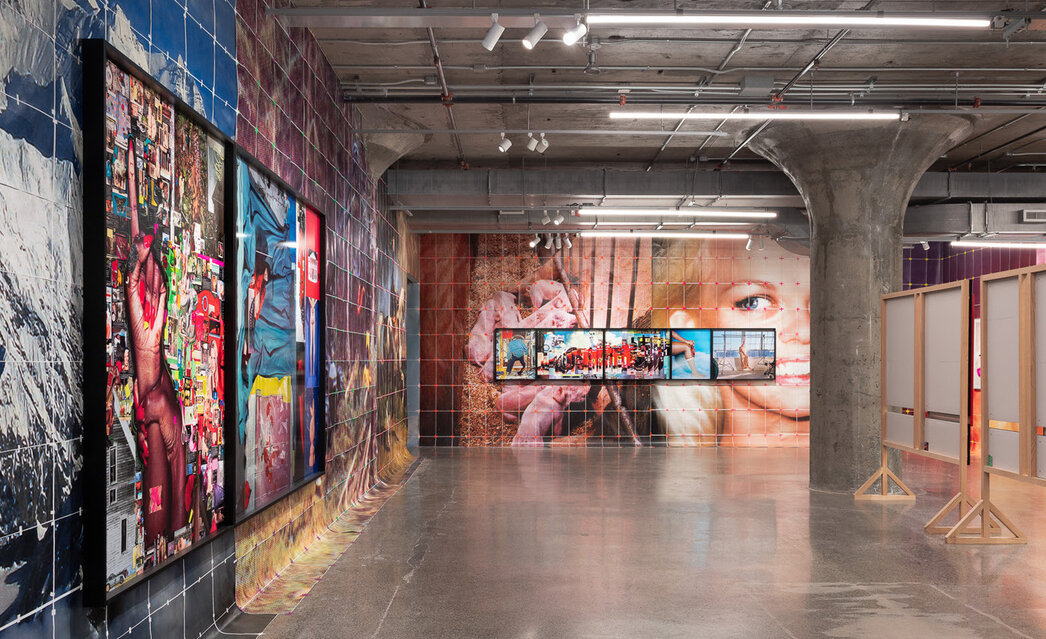
The exhibition operates like an alphabet for contemporary life. Words and phrases drawn from popular online searches and Cwynar’s own browsing history become starting points for sprawling visual associations. Terms such as “disinformation,” “new woman,” “plastic,” “wrestle” and “youth” are translated into images, objects and cultural references. What initially appears arbitrary becomes revealing: our searches form an accidental archive of what preoccupies us, frightens us and, perhaps most importantly, what we have been taught to desire.
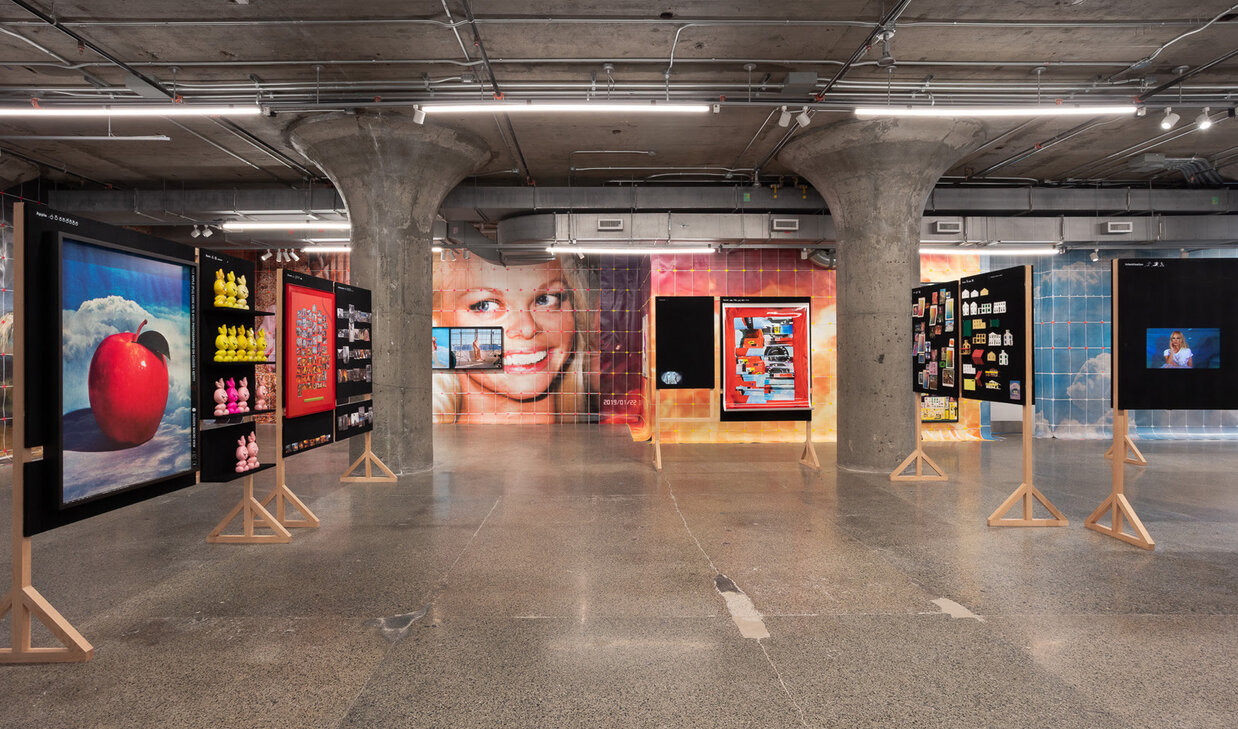
The alphabet is an especially fitting structure because alphabets teach us how to enter the world. In Baby Blue Benzo Beta, Cwynar reverses this process. Rather than teaching the neutral “A is for apple” alphabet of childhood, she asks what an apple might mean after centuries of accumulated religion, advertising, technology and popular culture.
“A” inevitably recalls another beginning: the apple of Adam and Eve. The reference positions Cwynar’s alphabet almost as a contemporary Genesis. The biblical apple introduces knowledge through the distinction between good and evil, establishing one of Western culture’s foundational binaries. Good makes sense because bad exists; innocence because corruption exists. Cwynar similarly builds meaning through contrast, exposing how the categories we inherit determine how we understand the world.
But Cwynar’s Genesis belongs to the age of mass media. Alongside biblical associations are guns, tuxedos, definitions, stock images and corporate imagery. If the Tree of Knowledge once promised an understanding of good and evil, contemporary knowledge arrives through Google searches, advertisements, archives and endlessly circulating images.
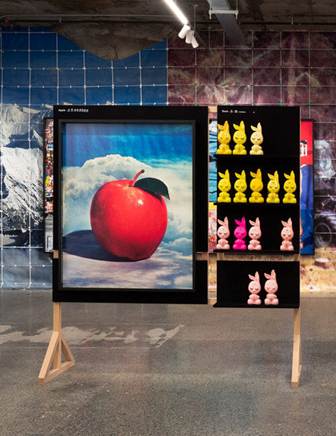
From A for apple, Cwynar moves to B for bunny. The bunny brings with its Playboy, sexuality, femininity and money. Repeated bunny figures appear alongside images of wealth and consumption, connecting sexual desirability to economic value. Some appear wrapped, others exposed, creating associations with availability, possession and ownership. The exhibition repeatedly asks: what is the relationship between desirability and ownership?
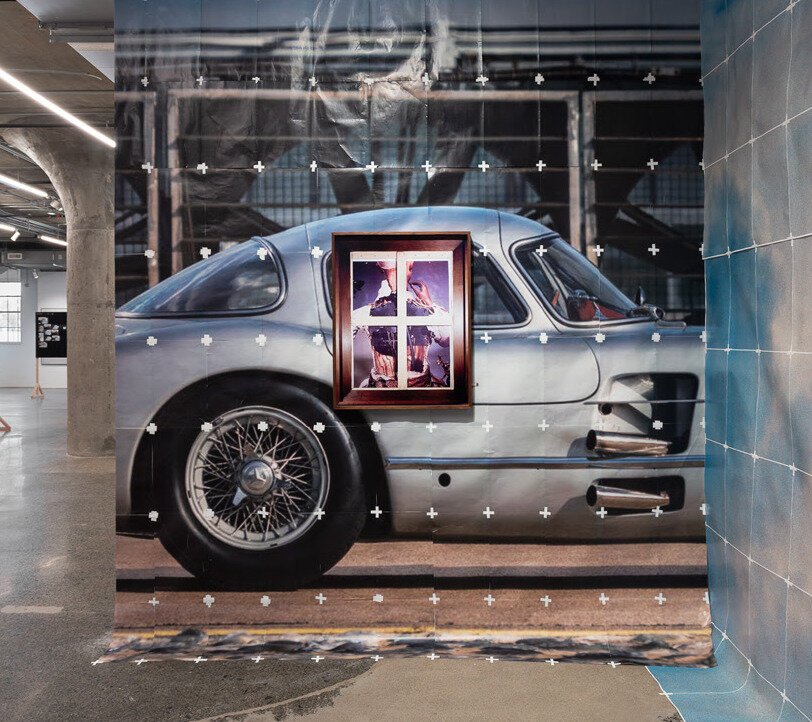
Women occupy the centre of this visual economy. Female wrestlers, supermodels, actresses and sex symbols such as Pamela Anderson and Marilyn Monroe populate the exhibition’s visual ontology. Yet, their power rarely frees them from the gaze surrounding them. Male figures are more readily associated with politics, authority, wealth and command, while women are repeatedly defined through youth, beauty, vulnerability and sexual availability.
The female wrestlers (who visualize “W” being for “Wrestle”) make this contradiction especially clear. Their bodies are strong, trained and capable, yet Cwynar selects images in which those same bodies become intimate spectacles: pinned down, entangled, exposed or rendered vulnerable for the viewer. Through the deliberate curation of their pictures, Cwynar demonstrates that even when a woman becomes powerful, an image can transform that power back into desirability.
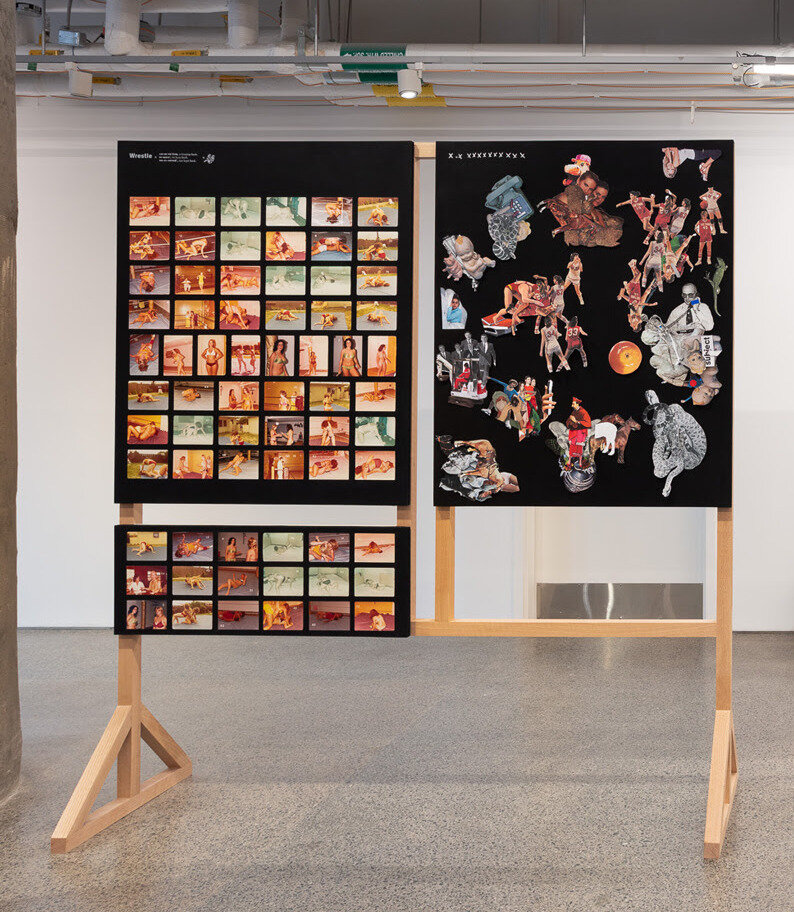
A similar contradiction appears in Cwynar’s images of youthful femininity (ie. “Y” being for “Youth,” or “K” being for “Knowledge,” among many others). Pamela Anderson and other cultural icons exist within a world where the ideal woman must be innocent yet sexual, youthful yet mature, maternal yet childlike.
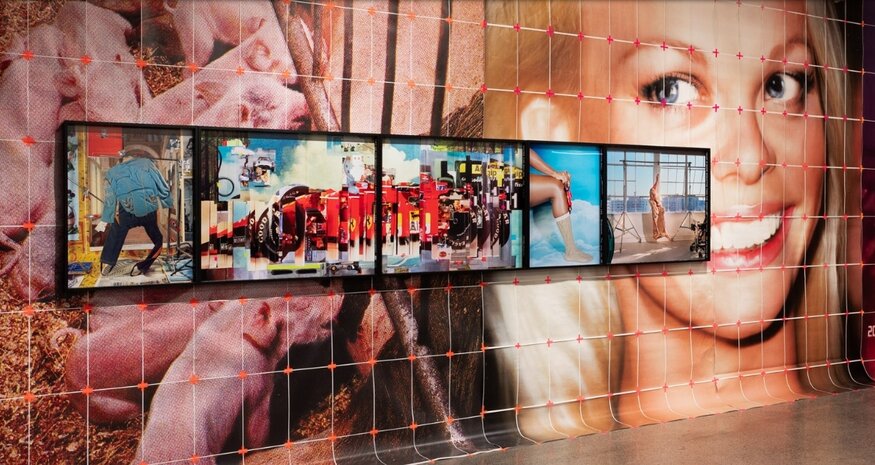
This tension extends into “H” for home, where domesticity and the nuclear family coexist with the images of bikinis, bodies and sex symbols of the exhibition. Woman appears simultaneously as mother and girl, caretaker and object of desire.
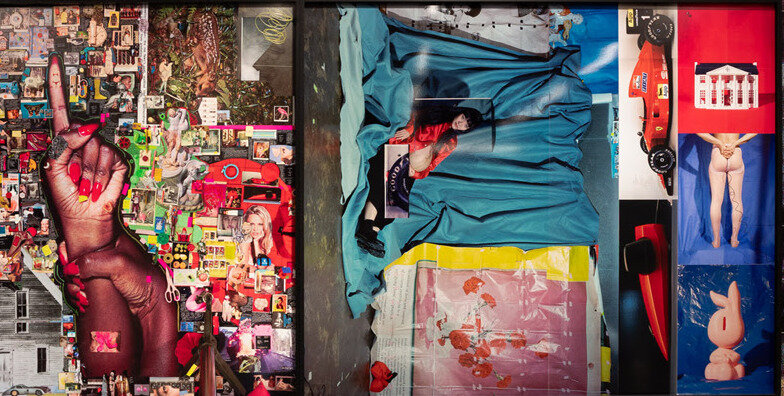
The “T” for time “Time” sharpens this critique. Clocks and references to youth suggest that women experience time differently within this economy of images. Male power is often imagined as something accumulated: money, authority and influence grow with age. Female value, by contrast, is repeatedly represented as something that expires.
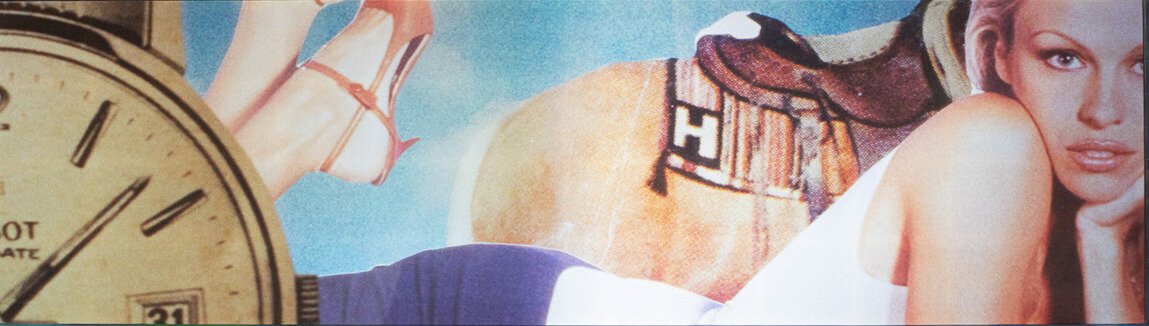
Youth becomes capital. Beauty becomes maintenance.
Cars, women, fashion, houses and luxury objects therefore begin to occupy the same visual vocabulary. A gleaming automobile and an idealized female body appear almost interchangeable as status symbols: desirable objects whose value extends to the person capable of possessing them.
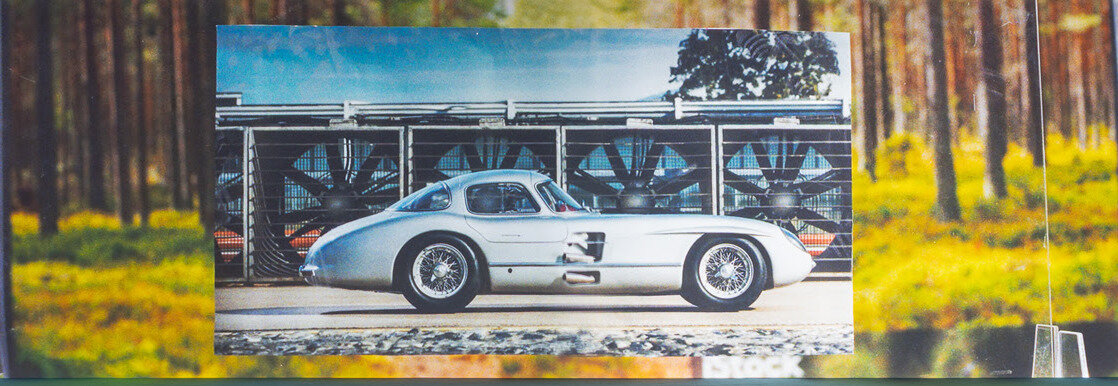
Capitalism promises freedom through choice. You can purchase the right clothes, drive the right car, modify the right body and assemble the right identity. Baby Blue Benzo Beta pushes that promise toward an uncomfortable question: if we are free to become whatever we want, how much of what we want has already been chosen for us?
Yet the exhibition never feels purely bleak. Its romantic soundtrack, saturated imagery and visual abundance are seductive. Cwynar understands why we want to look. Familiar celebrities, commodities and symbols dissolve into one another in a dreamlike visual puzzle, implicating viewers in the very culture they are being asked to question.
Her collage-like logic recalls Surrealism’s ability to create meaning by bringing unrelated objects together, but Cwynar’s unconscious belongs unmistakably to the twenty-first century. It is no longer only the private psyche being mapped, but the algorithm, the search history and the digital archive.
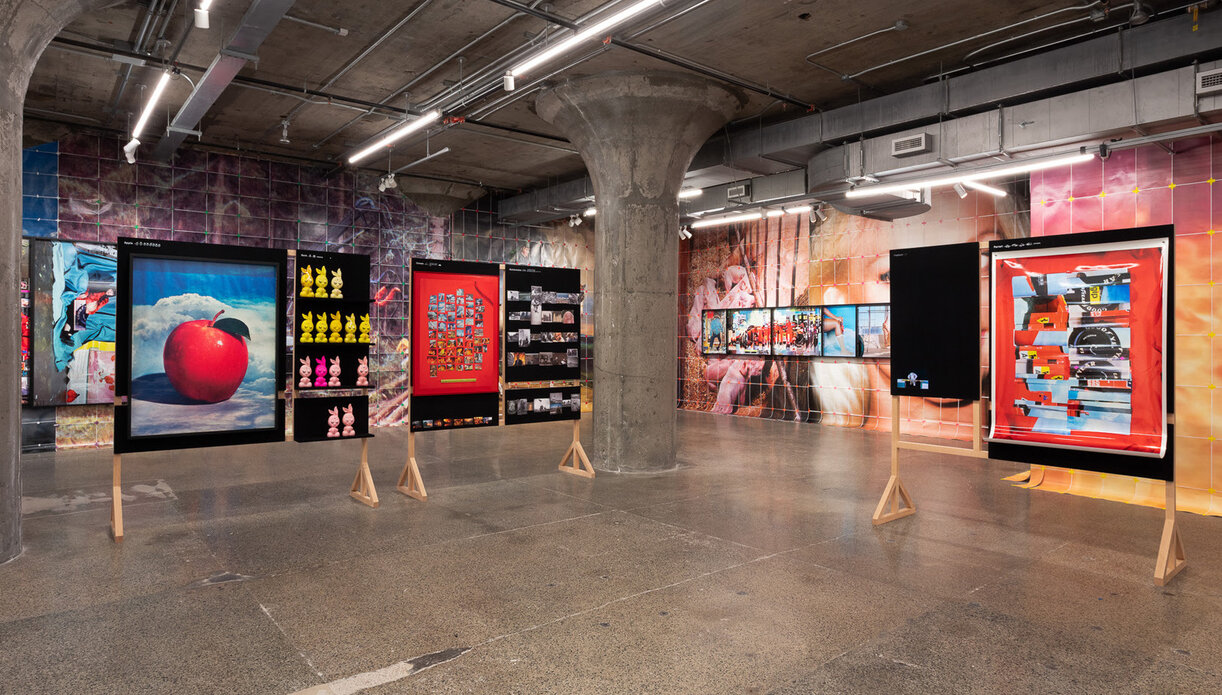
Our subconscious now leaves data behind; and data legitimizes knowledge.
By turning that data into an alphabet, Cwynar teaches us our ABCs again – not because we do not know the world, but because we may know it too well.
Sex. Beauty. Money. Technology. Power. Youth. Ownership.
These are not discoveries within Baby Blue Benzo Beta. They are the vocabulary through which contemporary life has already taught us to understand ourselves.
Cwynar simply makes us read it out loud.
Antonella Pecora Ruiz
Images: Sara Cwynar, Baby Blue Benzo Beta. The Museum of Contemporary Art Toronto installation view, MOCA Toronto, 2026. Courtesy of the artist, Cooper Cole, Toronto, and The Approach, London. Photo: LF Documentation.
*Exhibition information: Sara Cwynar, Baby Blue Benzo Beta, May 15 – August 16, 2026, MOCA Toronto, 158 Sterling Rd., Toronto. Museum hours: Wed – Thurs 11 am – 5 pm, Fri 12 – 9 pm, Sat – Sun 10 am – 5 pm.