
Queer Asynchronies and A Shadow Holds at United Contemporary
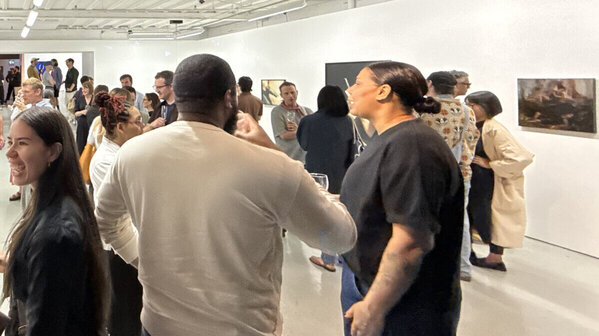
Queer Asynchronies exhibition view
Wandering in from the summer rain into the gallery, the understated white neon of Steven Beckly’s work greets visitors, Forever and Ever (2019). Queer Asynchronies at United Contemporary contemplates how queer and trans lives exist through plurality, the manifold ways of becoming the self: queer ancestry and culture, lived experiences balanced with futurity, and approaches to world-making. Curator Adrien Sun Hall draws upon José Esteban Muñoz’s theories around queer temporality, recognizing the deviations from “straight time” life trajectory and social dynamics. The artists in the exhibition reflect upon queer temporality with a variety of approaches: comforting the inner child in adulthood, disco as a critical part of queer subculture, speculative love in Christian spaces, modes of bodily and spiritual transformation, and more.
Considering the immediate encounter of Forever and Ever, Beckly’s work is an apt fixture of temporal expression. The soft neon glow emanates from the handwritten text containing the title, amplifying the cool tones of the gallery walls. There is a chain hanging from the phrase, with a photograph of a disco ball at the end. The work issubtle enough that people walk past without notice. There is beauty in a work communicating an unending duration, existing and witnessing others independent of reciprocation.
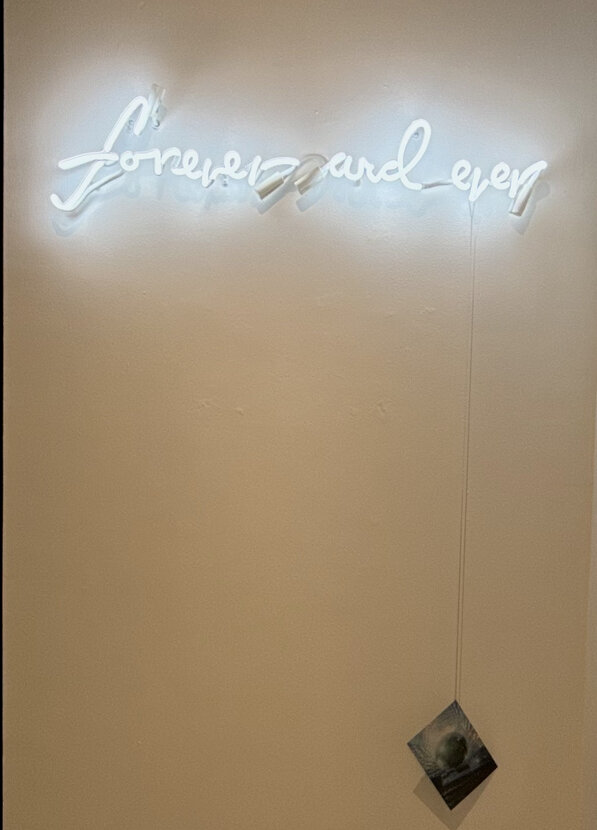
Steven Beckley, Forever and Ever, 2019. Neon, silver chain, and colour transparency. Neon: 10 x 34 x 2.5 inches. Chain: variable
To the immediate left of the work is a black curtain, enclosing the screen that plays Jordan King’s video installation Goodbye Clark (2024). Playing out upon the screen are scenes of a home being cared for: painting the windowsill, a moment sitting on the fire escape. Within the video, King prepares the Greenwich Village home for his departure. King had lived there with Clark Render, a major figure in the underground nightlife scene in New York. These moments of caretaking, reflection, and unbuilding a home take place after Clark’s passing in 2019. The film prompts contemplation of placemaking and how places of belonging shift with the inhabitants, whether through loss or movement.
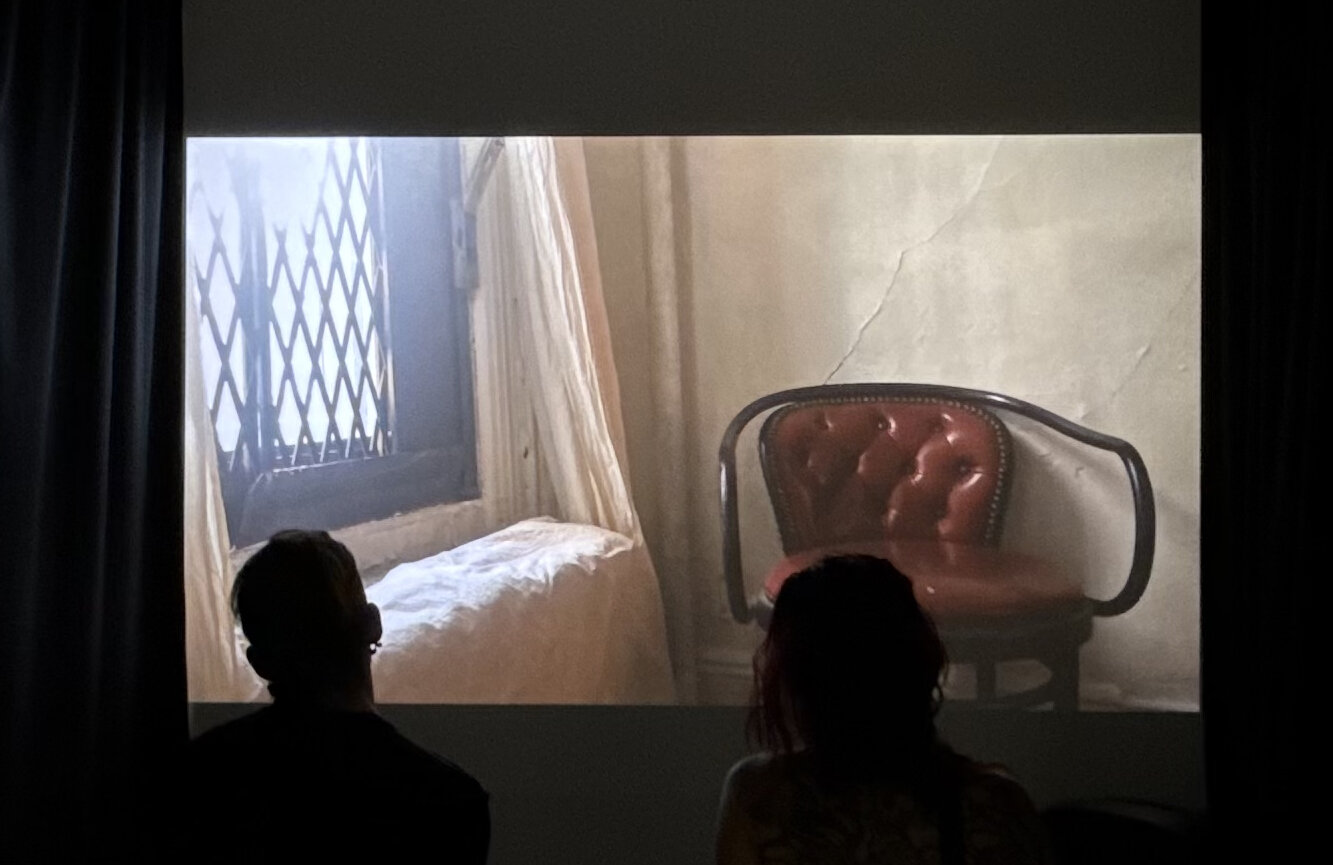
Jordan King, Goodbye Clark, 2024. Digital video, 9:00 minutes
The spirit of belonging and reflection are also found in Natia Lemay’s Held in Different Times (2026), a diptych in oil on canvas. Tones of ochre and umber are built upon the canvases; the layers appear as a soporific haze enveloping the figures in the right panel. The composition of the subjects echoes the pietà, with a seraphic face gazing downwards in devotion. The setting is indiscernible, though an upholstered seat can be identified as segmented across the diptych. Both subjects of Lemay’s pietà are clad in athletic wear, a muscle tee and oversized shorts. As they observe one another, the shared soft features and complexion is noted as a resemblance. The figures are of the same individual at different times. Beholding the self, Lemay displays the desire for comfort while simultaneously being the source.
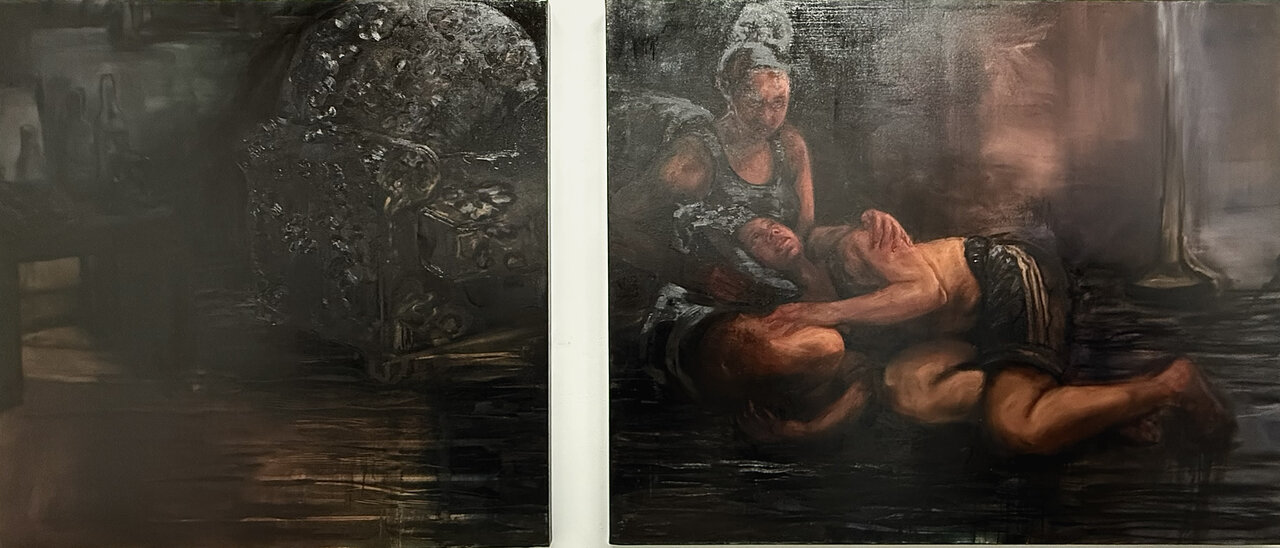
Natia Lemay, Held in Different Times, 2026. Diptych, oil on canvas, 48 x 48 inches, 48 x 60 inches
The gesture of embrace is also found among the towers of white boxes that comprise Camille Charbonneau’s series The House Is a Large Cradle (2023-2026). Within the boxes are miniature figures, each containing a (presumed) same sex couple. The outfits are modest and austere, a palette of white, heather grey, mauve, beige, and olive green. The miniature clothing maintains the volume of the body despite being empty. As such, the boxes are devoid of bodies and brimming with tenderness. The yearning of the embrace is salient, as is the consistent incorporation of the Book of Mormon with each of the pairings. Charbonneau’s work is informed by the artist’s experience in the Mormon Church. The House is a Large Cradle considers speculative love that could form during Church missions, in which pairs of women or pairs of men were sent to spread the gospel. Looking at the couples in the box, I can’t help but think that they’ve been raptured in a divine ascension.
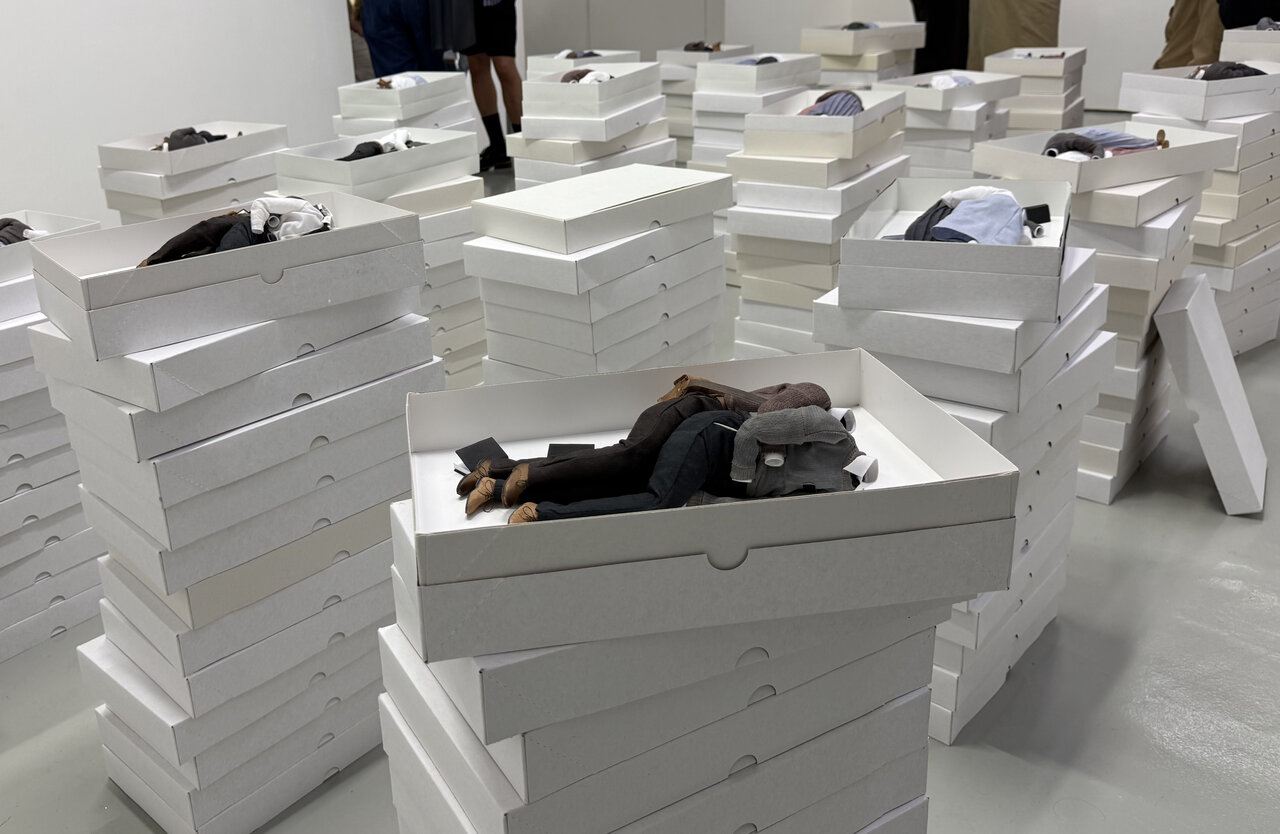
Camille Charbonneau. The House Is a Large Cradle, 2023-2026. Polyester, cotton, leather, faux-leather, steel, brass, polymer clay, and paper, dimensions variable for assembled series. Each box: 14 x 9 x 2 inches. Polyester, cotton, leather, faux-leather, steel, brass, polymer clay, and paper
Functioning as the transition point between the two exhibitions is Van Der Hout’s kinetic sculpture, The Shattering (2026). A mounted light shines on the structure as it steadily rotates within the gallery. The sculpture is made of mirrors, soldered together to form a polyhedron of fractures and fragments. The reflections of light trail along the walls of the gallery. As the sculpture turns, snippets of visitors, the environment, and the self are visible: a shoe of mine, a smile of yours, a hand of theirs. The Shattering is evocative of a disco ball, a critical nod to the queer subculture that was bolstered at the height of the genre’s popularity in the 1970s. This was a transformational period for self-expression and visibility, liberation, and solidarity. The structure does not have a completely spherical shape as there are black gaps between the fragments. This is an acknowledgement of the absences within queer history— spaces lost, absences in the archives, missing pieces from the community. The inclusion of such a compelling symbol within Queer Asynchronies affirms the exhibition space as a venue of transformation.
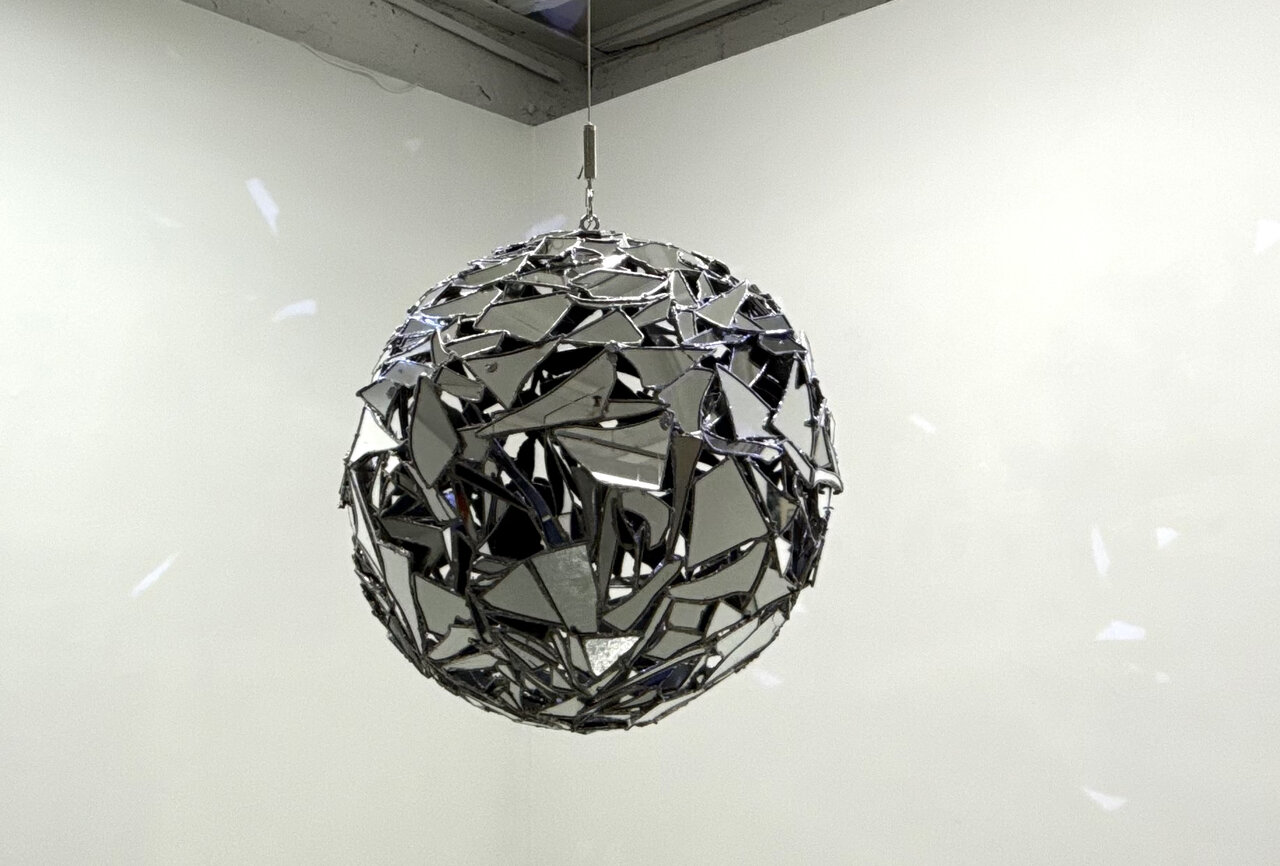
Ry Van Der Hout. The Shattering, 2026. Steel, mirror, solder, copper, disco ball motor, 26 x 26 x 26 inches
Meanwhile, Van Der Hout’s works in the series A Shadow Holds are vibrant and lurid. The colours pool across the glass rather than using a myriad of coloured glass panels. The soldering of the works lacks steadiness of the hand, like an urgency to meld together the pieces. Witnessing the artist’s hand in this way is appealing, in that the process is readily apparent in how the vessels were crafted. The colours upon the glass are incorporated through photography, not through the traditional chemistry of ions added or colloidal particles. By photographing the fragmented glass and using that visual in the creation of a new form, Van Der Hout uses fragments as material, process, and as the conceptual framework of breaking apart to put together again. That line of thinking exists in the same vein of alternate temporalities as the way the creation process can be a non-linear method of both making and existing.
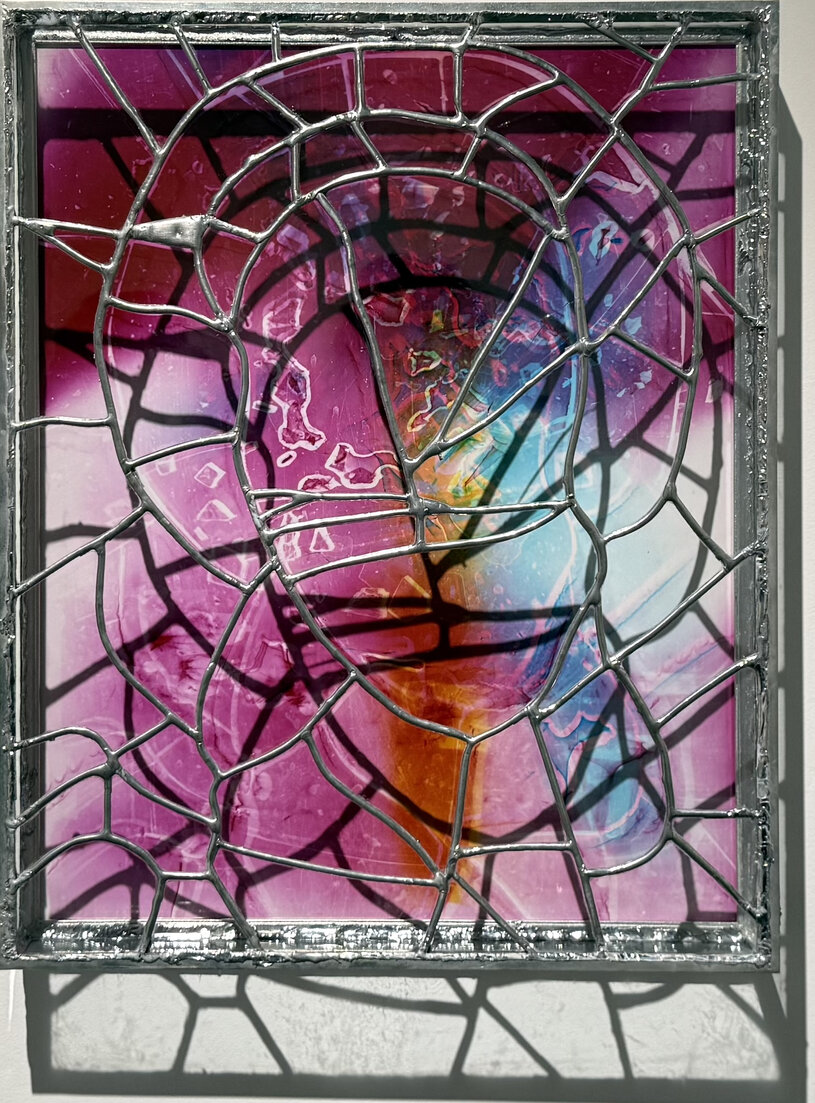
Ry Van Der Hout, a shadow holds 1, 2026. Chromogenic Photogram mounted to dibond, Glass, Solder, Tin, Steel, 20 x 16 x 3 in.
Adrien Sun Hall’s curation of Queer Asynchronies and Ry Van Der Hout’s series A Shadow Holds are a thoughtful display of queer temporality. It highlights the fissures and fractures, reflections and refractions, and the archives and absences within queer history and world-making.
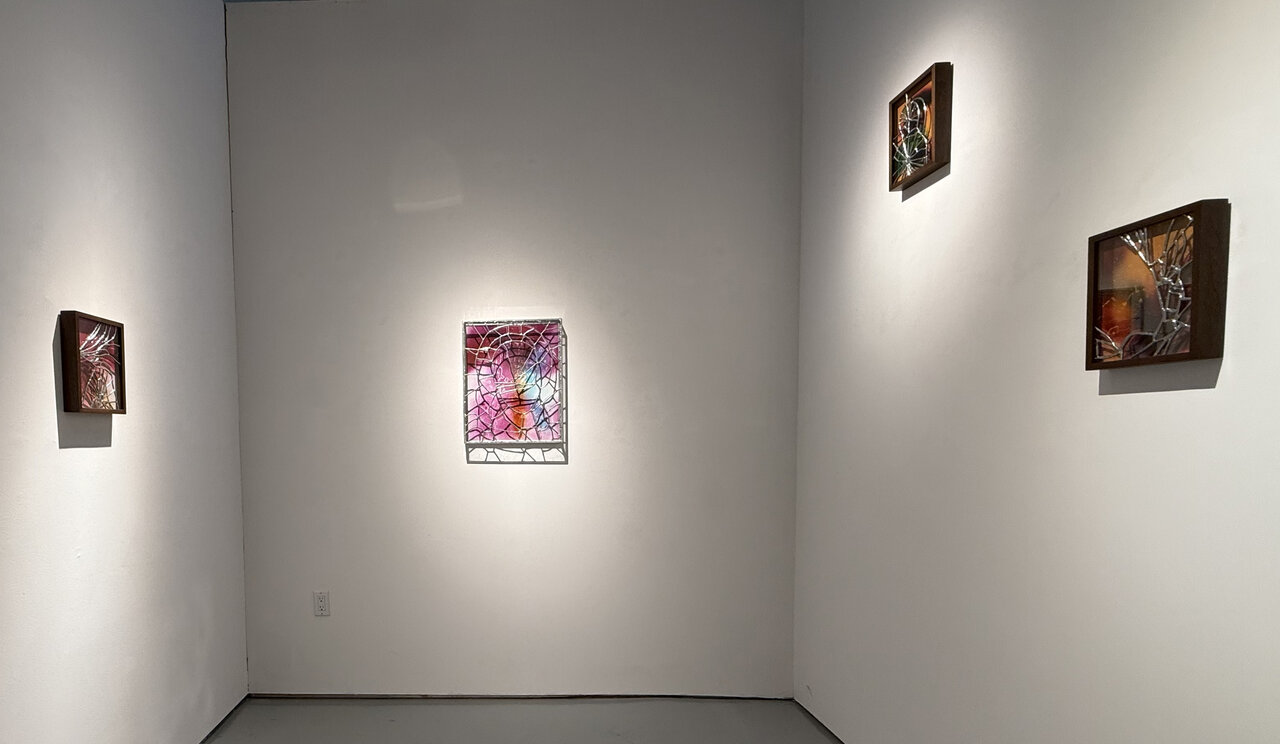
A shadow holds exhibition view
Text and photo: Rashana Youtzy
*Exhibition information: Queer Asynchronies / Group show with Steven Beckly, Camille Charbonneau, Rami George, Dylan Glynn, Jordan King, Natia Lemay, Oluseye, Ry Van Der Hout and Ry Van Der Hout: A Shadow Holds, June 18, 2026 – July 25, 2026, United Contemporary, 129 Tecumseth Street, Toronto. Gallery hours: Wed – Sat 11am – 6 pm.