
On display on the walls of the main gallery is a series of nearly fifty identically sized collages, closely hung together, that effectively enclose the space. In the middle of the room sits an array of dyed canvas tarps, ontop of which are placed a variety of largely, though not exclusively, concrete objects. The floor installation is so spread out that visitors are left with a passage about two metres wide around the perimeter. The whole room has the atmosphere of a temple. But what is being worshipped here is difficult to determine, given that nothing in particular dominates or takes precedence among this disparate set of objects.
Gallery owner, Clint Roenisch, rightly describes Jason de Haan’s works as heterogeneous and impossible to classify. That is an immediate challenge for viewers, who aim to make sense of what they see. Nonetheless, one thing binds the work together, namely, the concept of time. We are told that “de Haan explores the archiving of time in planetary materiality and connects this deep time to that of cultural history.”
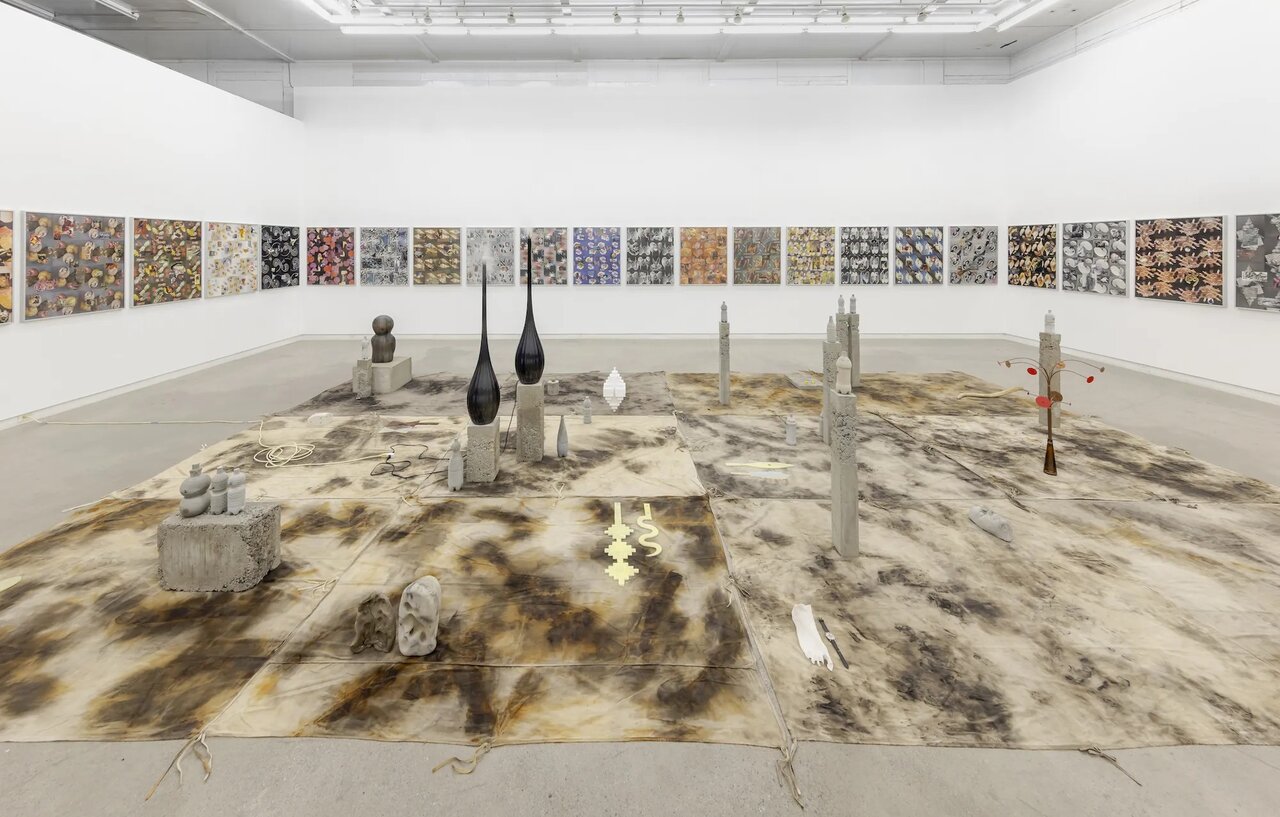
Installation view of Jason de Haan, In the Garden of the Dentist at Clint Roenisch Gallery
One might, more specificially, speak of the erosion of time vis-à-vis de Haan’s work. Atop two tall thin-necked vessels in the middle of the room, for instance, sit tiny fossilised skulls that are continually sprayed by water vapour from below. These ancient fossils are in effect disappearing before our eyes. Of course, we can only registered this erosion intellectually because its rate is too incremental for us to perceive in any tangible way. But even this time scale is short compared to the geological time that de Haan is fascinated by. De Haan and his partner Drăgan have, indeed, chosen to live in the Badlands of southern Alberta because they are enthralled by its sublime geologically ancient landscape.
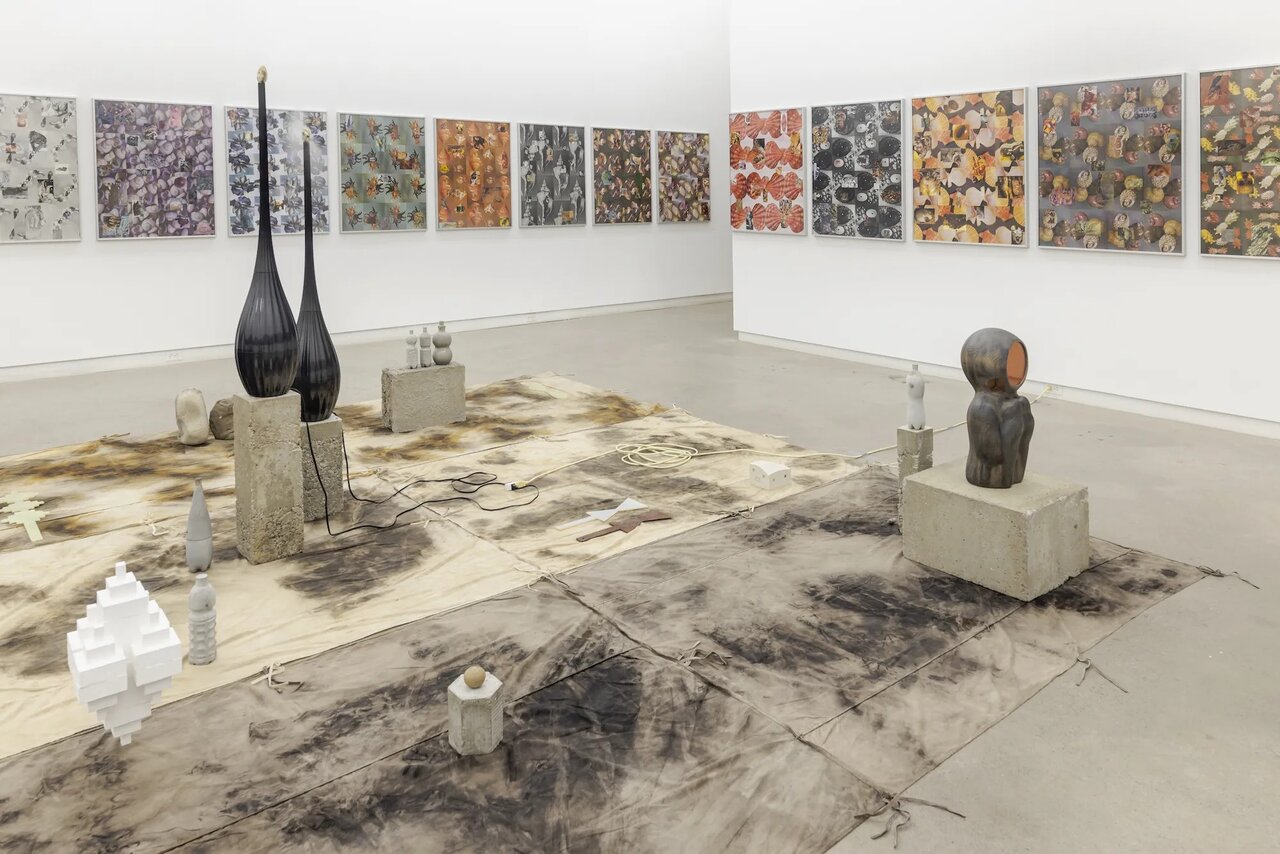
Installation view of Jason de Haan, In the Garden of the Dentist at Clint Roenisch Gallery
The imperceptibility of change at this time scale reminds me of the metaphysics of the ancient Greek philosopher Parmenides. From the very few fragments recorded of his original writings Parmenides claimed that in reality nothing changes; that is to say, according to Parmenides change and motion are an illusion, no less. The Greek philosopher encouraged us to think of the world, i.e., reality, as a unified whole rather than as a collection of disparate things. What we can know is unchanging, fixed, while the fleeting changes around us are merely apparent and are nothing we can grasp in any real sense. Likewise, de Haan emphasises the constancies across time. The Badlands and the fossils stored in them, for instance, will remain long after you and I have fallen into oblivion, so to speak.
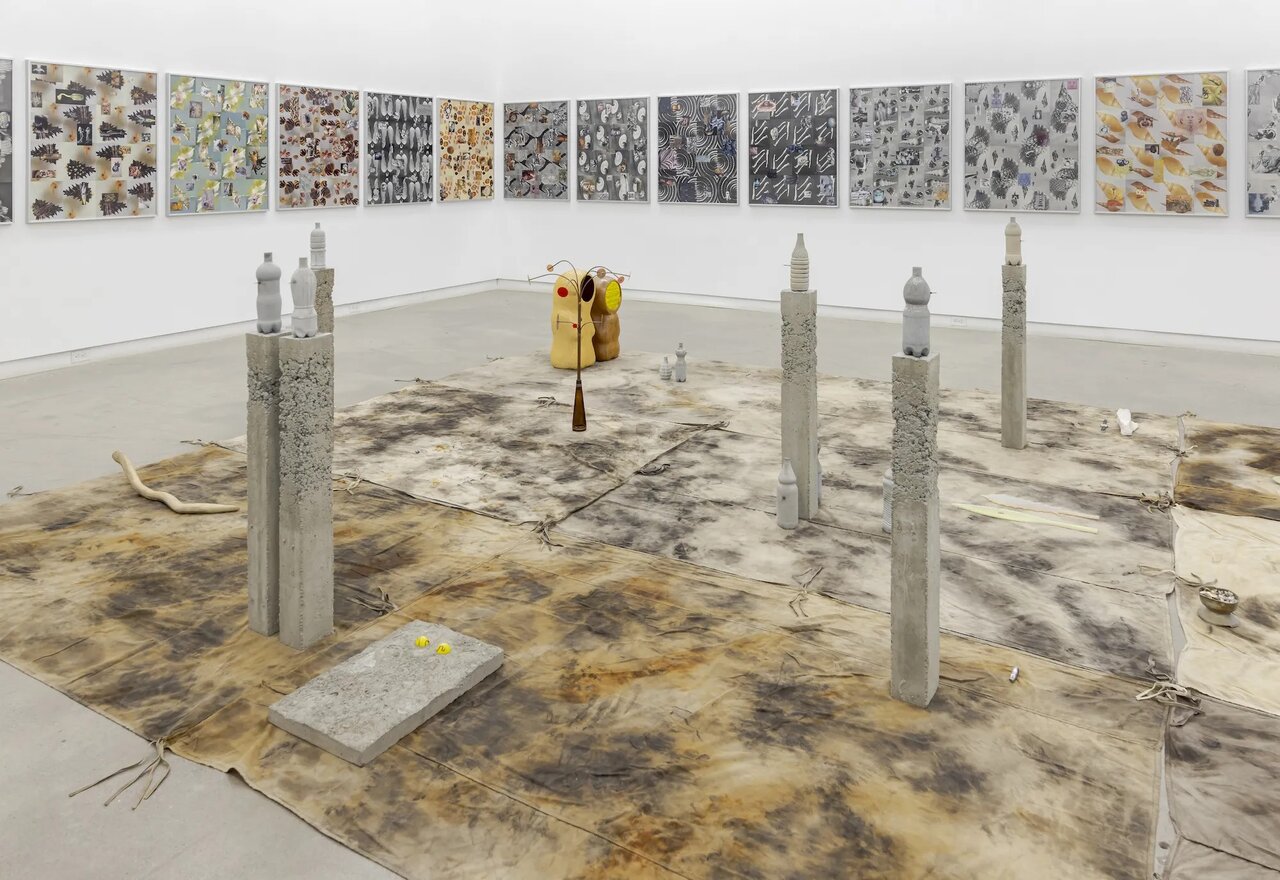
Installation view of Jason de Haan, In the Garden of the Dentist at Clint Roenisch Gallery
That said, de Haan does see things as being in flux, as constantly changing, even on a geological time-scale spanning millions or even billions of years. This contradiction, as I see it, is not irrational. It reflects the enigma underlying our very notion of change that transfixed Parmenides and his peers. Before the materialism of our scientific age the ancient Greeks were puzzled by change. They noted that when something undergoes change, e.g., a man growing a beard, we understand that we think of the same man undergoing this change. The appearance of a beard does no make him another person. But, if that is the case then, paradoxically, there seems to be no limit on how many changes he can undergo and still remain the same person. And that sounds wrong too, since were he to change so radically that he becomes a dolphin, say, we must deny that he is the same person. Parmenides essentially held that insofar as reality is fixed nothing about it changes. What is true is always true, one might say. By contrast his rival Heraclitus argued that everything is in constant flux – the man with the beard is not the same as the man a few days earlier without the beard – hence his famous dictum you can never step in the same river twice.
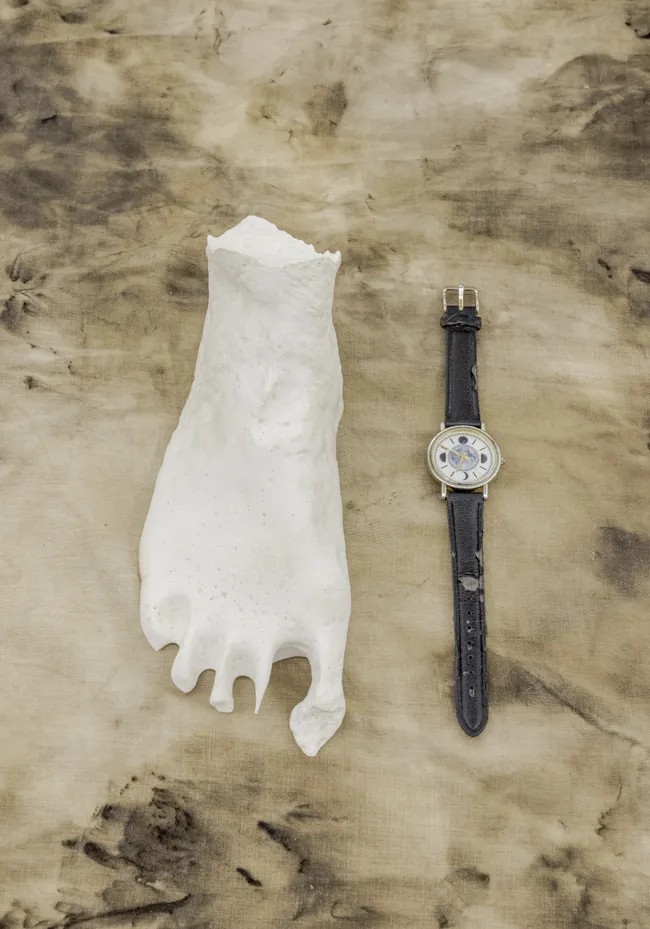
Installation view of Jason de Haan, In the Garden of the Dentist at Clint Roenisch Gallery
All this is to point out that time and its passage is a mysterious phenomenon. Indeed, many have argued that time does not objectively exist, i.e., independent of us, but rather it is something we add to construct reality. The French philosopher Henri Bergson, in the face of this thought, distinguished between mechanical time and what he called ‘duration’, that is perceived time. This notion of time as duration seems central to Drăgan’s accompanying video titled Hummingbird Guided Meditation.
The hummingbird is one of nature’s wonders. This small creature – less than 10 cm long – can neither walk nor hop. Yet in flight its agility is unsurpassed. It wings beat at up to 80 times a second and it can reach speeds of up to 80 kph. Drăgan tries to imagine how the world seems to such a creature. Given its size and speed they appear to us to dart around at a frenetic pace. In order to navigate the world at this pace one must imagine time moves more slowly for them, that is, it has a very different ‘duration’, to borrow Bergson’s term. To illustrate how time would seem to us at this duration Drăgan used a super-8 camera to film the hummingbird’s imagined environment. Then she slowed it down considerably, using software to interpolate between the frames to create a sense of continuity. The result is scenes of a blurred slow-motion world, which Drăgan narrates at a deliberately slow tempo, molto largo one might say.
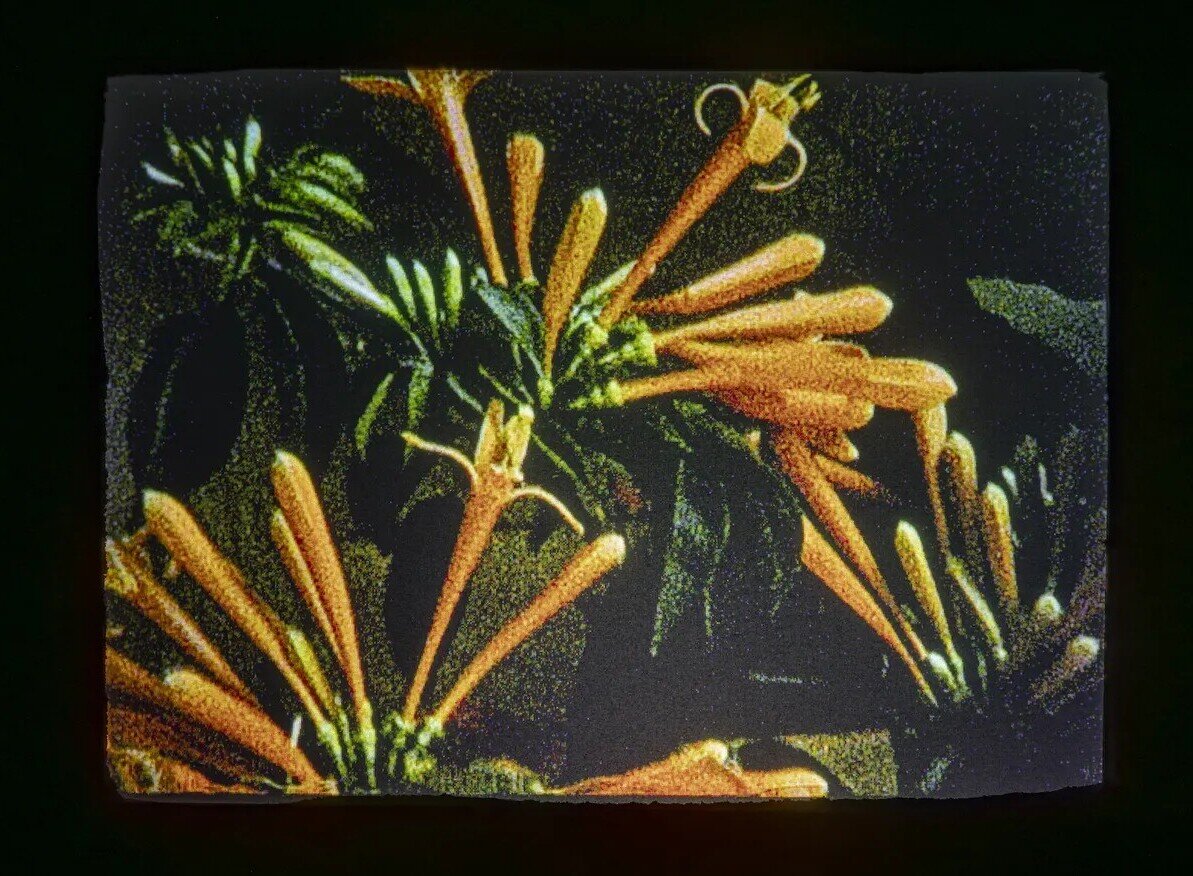
Miruna Drăgan, Hummingbird Guided Meditation, 2021, digitized super 8 film, 54 minutes, video still
In general de Haan has a fascination with the ephemerality of life, reflected by the objects and images he makes – hummingbirds entombed in concrete bottles, shells, bones, fossils – if you like, the residues of life. One is reminded of Shakespeare’s famous lines: “Out, out brief candle! Life’s but a walking shadow…a tale told by an idiot, full of sound and fury, signifying nothing.” Which is to say, in the long arc of time a life is but a stitch in a far larger tapestry. De Haan and Drăgan have a deep love of nature that extends to an appreciation of the miracle of life and creation more generally, beyond nature itself to the ‘supernatural’ on the edge of eternity.
Finally, we must thank gallery owner, Clint Roenisch, for providing a platform for what is challenging art. In a society necessarily preoccupied with economics, it is refreshing to view art that arises out of a genuine need to reflect on life, and not merely to treat it as a commodity ultimately like any other. While de Haan’s show has ended, it has been followed by an exhibition of Drăgan’s own work (June 11 – July 25, 2026). It is a suitable sequel, where again the partner collaborates.

Installation view of Miruna Drăgan’s exhibition
Hugh Alcock
Images are courtesy of Clint Roenisch Gallery.
*Exhibition information: Jason de Haan, in collaboration with Miruna Drăgan, In the Garden of the Dentist, April 23 – June 6, 2026, and Miruna Drăgan’s exhibition, June 11 – July 25, 2026, Clint Roenisch Gallery, 190 St Helens Ave, Toronto. Gallery hours: Gallery hours: Wed – Sat 12 – 5pm.