
Interview with Mackenzie Sinclair (MS), the Executive Director of the ADAC by Antonella Pecora Ruiz (APR)

Mackenzie Sinclair, the Executive Director of the ADAC
The Art Dealers Association of Canada (ADAC) is celebrating its 60th Anniversary with an exhibition featuring 52 member galleries and roughly 100 of the finest works of Canadian visual art. This exhibition will showcase Canadian art from the 1800s to the present day. As Mackenzie Sinclair, the Executive Director of the ADAC, states, its purpose is to underline the interconnected influence, progressive trajectory and variety of creativity in Canadian art history. This exhibition is free to the public and will take place at Bau-Xi Gallery in Dufferin Street, Toronto, running from June 11 to 14, 2026.
I spoke with Mackenzie Sinclair about the ADAC’s approach to the milestone exhibition, what this anniversary means to the ADAC and its member galleries, and the future of Canada’s cultural identity regarding the visual arts.
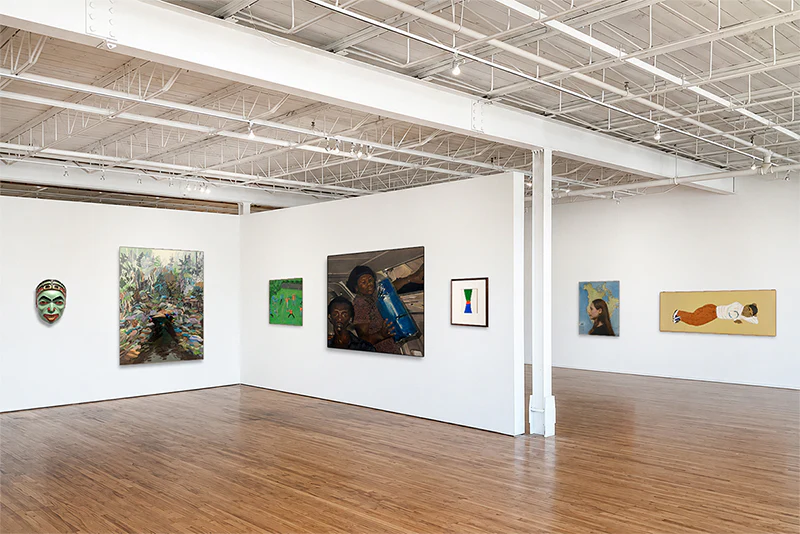
Mock up Installation view of ADAC 60th Anniversary exhibition at Bau-Xi Gallery, Toronto
APR: Take me through the initial vision of the exhibition. What did the ADAC want to communicate with this celebration? And what was the process for choosing the artists and works?
MS: [In planning the exhibition], my colleague Gabby Marcuzzi Herie, who’s our Appraisal Manager, our incredible board, and I dreamt up this exhibition in a pop-up style. This idea came to fruition as we looked at how to celebrate 60 years of our association. And so how do you kind of encapsulate 60 years? Well, there is no better way than to showcase art from our members. The artworks span from the 1800s to the present day, simultaneously reflecting the trajectory of the Canadian art landscape and what is important to our members [regarding which works are significant to Canada’s art history]. Because every member was able to provide a certain amount of art for a jury to consider. And then the jury selected the artworks. And from there, we’ve kind of jointly curated this incredible exhibition that touches on, quite literally, every aspect of the Canadian art scene.
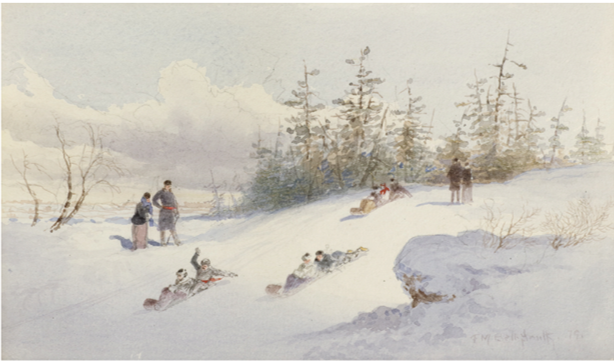
Frederic Marlett Bell-Smith (1846-1923), Sledding, 1879, watercolour on paper, 13 3/4 x 17 1/2 inches (framed), Uno Langmann Gallery, Vancouver
APR: The exhibition focuses on the history and range of Canadian art. What will this timeline look like?
MS: For example, the Uno Langmann Gallery. They’re based in Vancouver and deal primarily with European and Canadian historical art. And so, what was selected from them was a couple of gorgeous mid-1800s paintings from some of Canada’s early settler immigrants, painters, Frederick Bell-Smith is one of them that comes to mind.
For the 1950s, we’ve got a gorgeous Doris McCarthy from Wynick/Tuck Gallery in Toronto. A work from the 90’s; a beautiful Rita Letendre from Gallery Gevik in Toronto. We also have this incredible General Idea print from Simon Bentley Fine Art from the 80s, and an Annie Pootoogook from Feheley Fine Art from the early 2000’s.
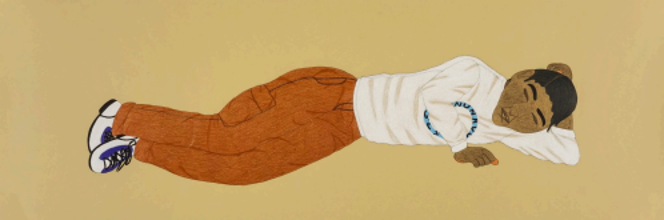
Annie Pootoogook (1969 – 2016), Sleeping Man, 2007, coloured pencil & ink, 15 x 44 1/4 inches, Feheley Fine Arts, Toronto
Looking into the present day, we’ve got a remarkable James Carl sculpture from TrépanierBaer in Calgary and an amazing painting by Rhys Douglas Farrell from Herringer Kiss Gallery, Calgary and photographs from Katherine Takpannie from Olga Korper Gallery, Toronto.
The trajectory, the expansion that people are going to see, is unprecedented. This is a never-before-seen exhibition, unlike anything ever done outside of an institution.
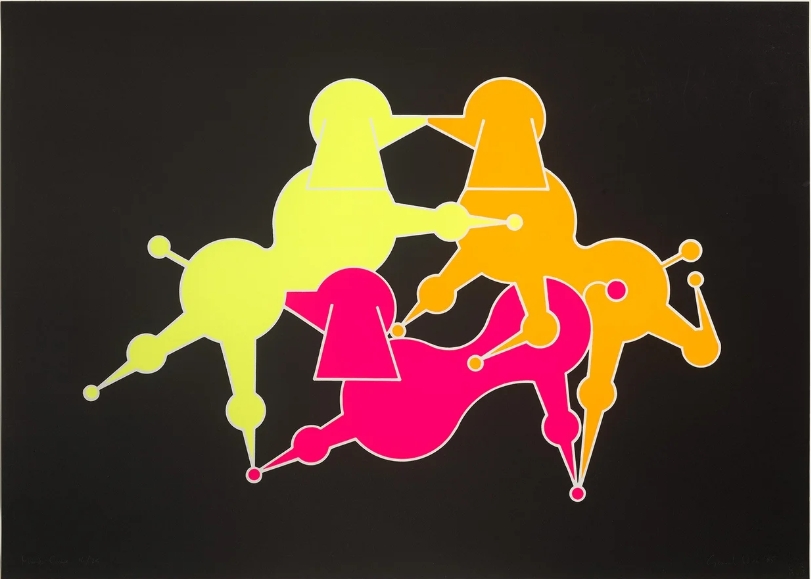
General Idea, Mondo Cane, 1985, screenprint, 29 x 40 inches, Simon Bentley Fine Art, Toronto
APR: How will this exhibition communicate the significance of the ADAC’s accomplishments in the last 60 years?
MS: I think that there’s something to be said about longevity. That’s 60 years of continuing our mandate every year, advancing our presence in the art world, and earning our members’ trust by doing our job of advocating, promoting, and educating not only the public but also the government, as well as helping our member galleries. For instance, when the recent tariffs imposed by the U.S. were announced, our members leaned on us for answers, for advocating to the government, and for pitching ideas to the press. And so that is 60 years of being a trusted source not only for our members but for the public. Trust is also when the public comes to us and asks, “Who’s a good art gallery that we should be going to?” And we have over 64 of those across the country that we know and trust, so we send them to them.
The exhibition as a whole proves of trust, of expertise, and as I was saying before, the artwork that is within the exhibition is top-tier art and it’s shown because our dealers have, again, decades-long expertise as well as refined aesthetic, to bring in artists that not only sell but do really stand out within what could be argued a saturated visual landscape, especially between social media and varied ways of seeing art.
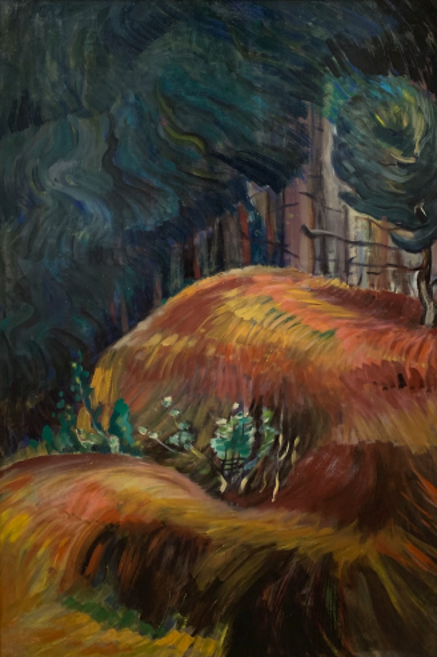
Emily Carr (1871 – 1945), Surging Sea of Undergrowth, 1935, oil on paper on canvas, 35.875 x 23.75 inches, Madrona Gallery, Victoria
APR: The ADAC’s mission emphasizes support for UNDRIP and Indigenous artists. How will the 60th anniversary celebration highlights Indigenous talent and rights? And what are some examples of recent initiatives that actively contribute to supporting emerging and Indigenous artists?
MS: [The 60th anniversary exhibition] will highlight Indigenous and Inuit artists from the Arctic, North West Coast, as well as the rest of Canada. We have Shaman Mask by Cole Speck and a gorgeous tapestry Small Chief Blanket by Chief Janice George, both from Fazakas Gallery, Vancouver. These works are reflective of Indigenous culture, practices, and community; their art keeps these traditions alive. What will also be nice to see are these works in conversation with those by Emily Carr, who is so indebted to the Indigenous peoples of Vancouver. And so, thinking about those connections is, again, what we will communicate through the curation of this exhibition.
We support galleries representing and working with Indigenous artists. Within our organization, we try and strive to be knowledgeable, to be respectful and to help our members in any way, shape, or form that we can.
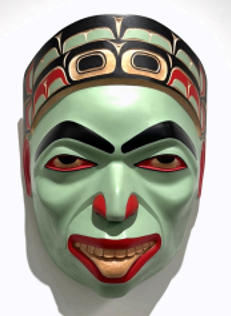
Cole Speck, Shaman Mask, 2025, Alder and acrylic paint, 16 1/2 x 13 x 9 inches, Fazakas Gallery, Vancouver
APR: How does the ADAC contribute to fostering cultural pride within Canadians, at home and internationally?
MS: So, in terms of international, we’ve got a great working relationship with the Art Dealers Association of America. In years past, we were able to go to The Armory [Show] and to L.A. for a pop-up exhibition organized by the Canadian Consulate. At both, we had members able to present and support Canadian art. We have members who participate in U.S., Mexico, European and Asian art fairs. Our members are going out and advancing Canadian arts on an international stage by participating in art fairs and trade missions in the visual arts. For example, we have one member, LL Contemporary, based in Markham, [which has presented] in Paris, China, and the U.S. So, our members are always trying to advance their artists on a world stage.
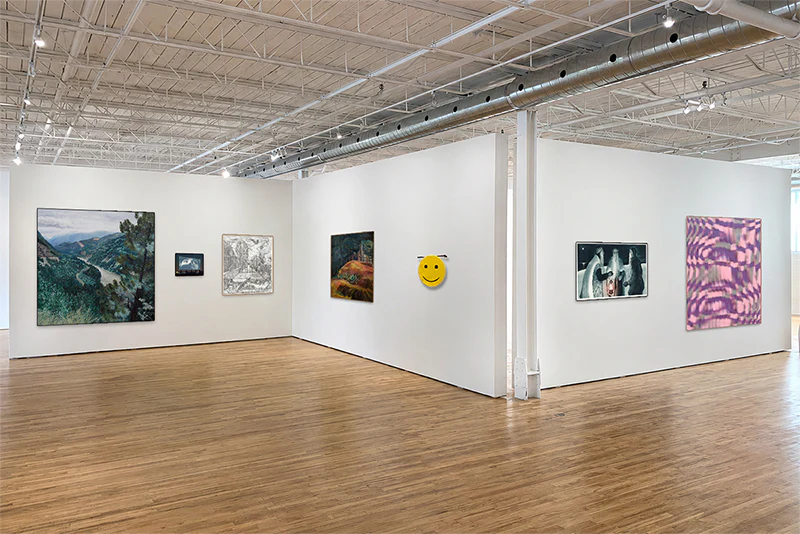
Mock Up Installation view of ADAC 60th Anniversary exhibition at Bau-Xi Gallery, Toronto
APR: What do you think we can expect the ADAC to have done before its 70th anniversary?
MS: You can probably expect us to continue outreach and bridge relationships, both internally, meaning within our own ecosystem of art dealers, and externally, by bringing more people who are not in the arts into the arts. We will aim to achieve this in a couple of ways, including engagement, tours, and panels, as well as being more present with our members at art fairs and international spaces. We are focused on expanding and helping bring more galleries into our organization. Additionally, the ADAC looks forward to fostering dialogue, creating opportunities, and collaborating with our international counterparts. Through these efforts, we strive to place our members in the best possible position to support them and, in tandem, support Canadian art and artists.
We will continue to celebrate Canadian art, advance the Canadian art landscape, and collaborate to foster community. So, the next decade will not be so much about establishing our roots, but about branching out and growing larger.
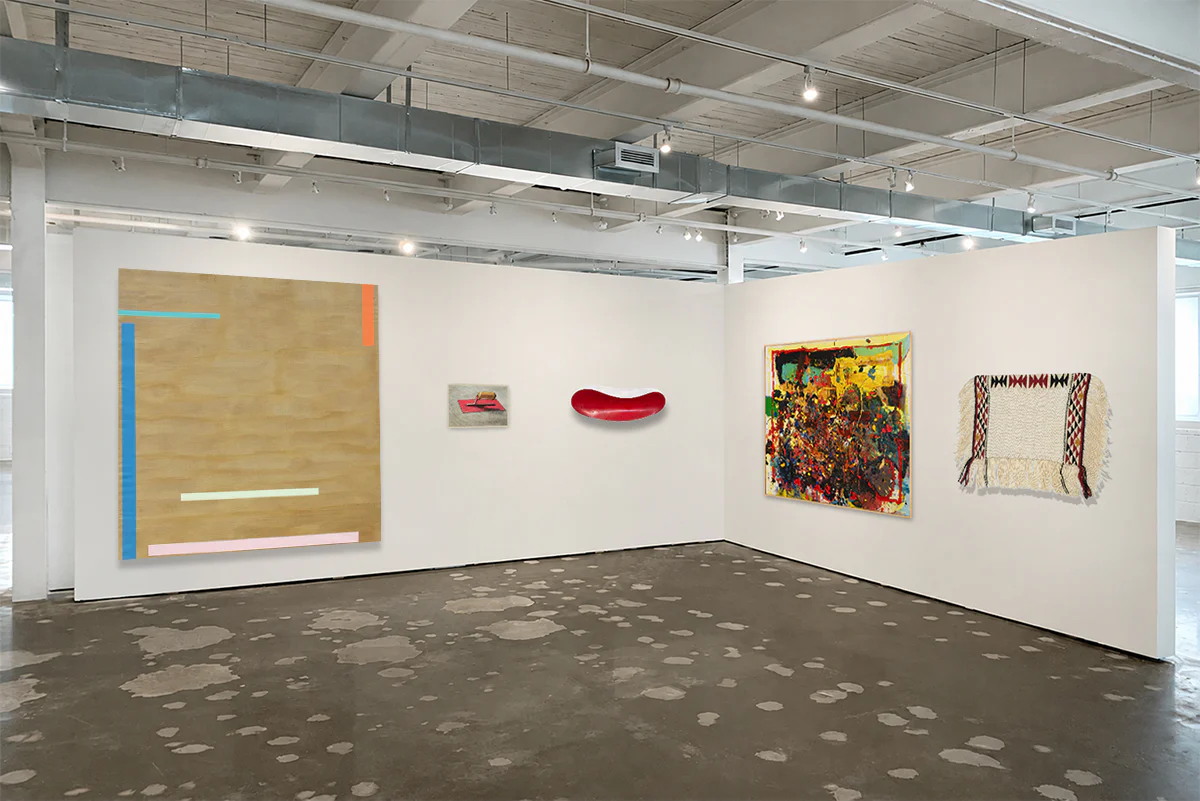
Mock Up Installation view of ADAC 60th Anniversary exhibition at Bau-Xi Gallery, Toronto
Mackenzie Sinclair also told ARTORONTO.ca that the ADAC will be selling a limited-edition catalogue at the exhibition, with a print run of approximately 200 copies. This catalogue will provide a comprehensive and visually curated narrative of the Canadian art dealer’s perspective on the country’s art history. Additionally, Mary Simon, the former governor general, has written the foreword to the catalogue.
I encourage the reader to join in the celebration of ADAC’s 60th anniversary, as free access to top-level Canadian art is an opportunity not to be missed! The show will be on display at the Bau-Xi Gallery on Dufferin, June 11 – 14, 2026, 1384 Dufferin St, Toronto. Gallery hours: Mon – Sun 10 am – 5:30 pm.