
At first glance Thompson’s paintings appear to fit the genre known as photorealism. Like Richard Estes and Ralph Goings, for instance, he has a penchant for painting everyday objects in a way that makes them indiscernible from photographs. But on closer inspection the viewer notices something distinctive about these paintings on display on the white walls of Franz Kaka; something that suggests they are not in fact photorealist works at all.
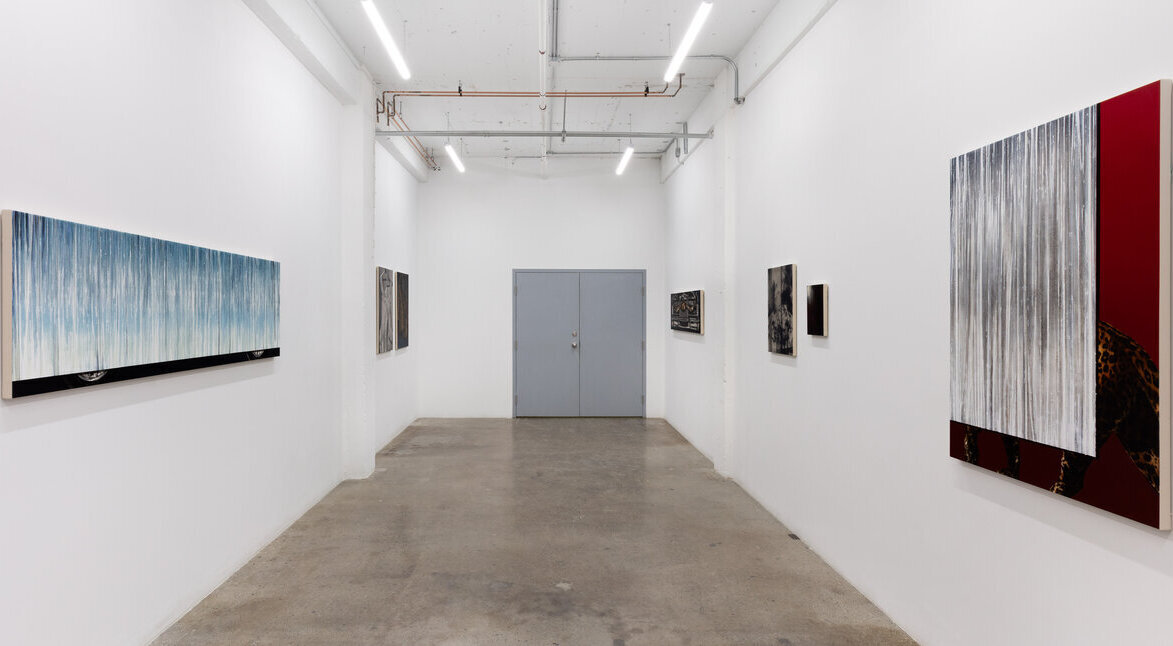
Installation view of Michael Thompson, Panther Platform at Franz Kaka
The history of Thompson’s own family – several generations of Ford car plant productions workers in London, Ontario – has taught him that the workers have become increasingly alienated from their labour. More precisely, they have become distanced from their efforts through the growing automation of production processes. This alienation, and consequent nostalgia for a more meaningful past, Thompson expresses by means of the parallel evolution of image technology – from film and photography through to digital technologies such as photoshop.
It is interesting that Thompson depicts the images produced by these various technologies through old-fashioned oil paint. Why does he choose to paint this imagery when it is qualitatively indistinguishable from digital printing? Clearly it is a deliberate decision, albeit informed by the precedence of his practice as a painter. One supposes that as his works are a commentary on these image technologies this works best when the medium he uses is not itself one of them.
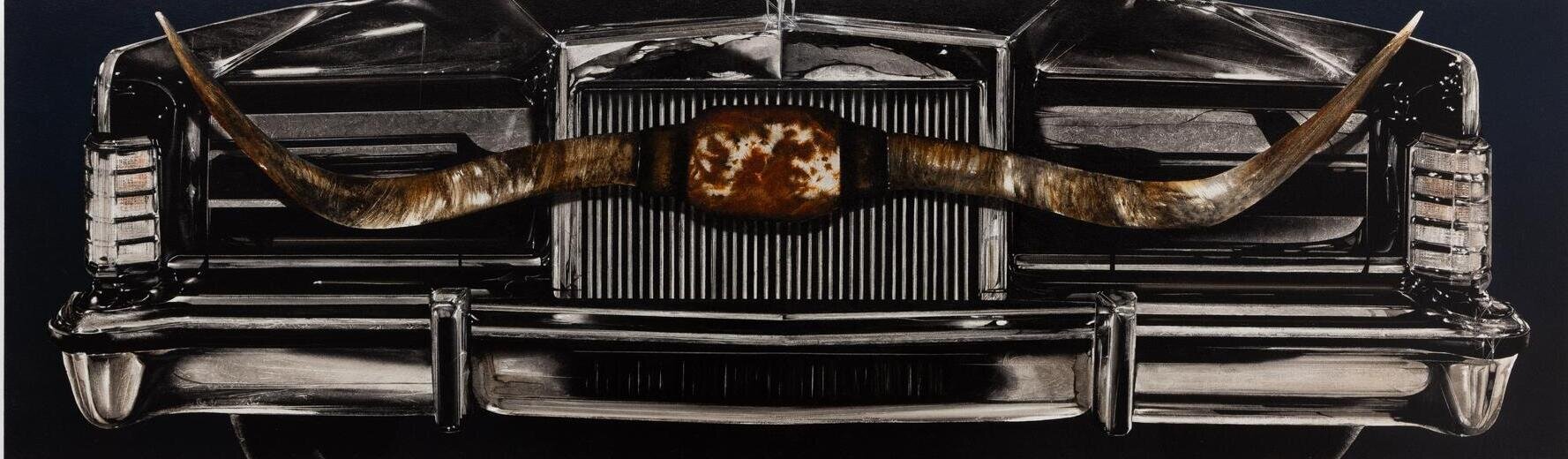
Continental, 2026, oil on canvas, 18 x 60 inches
It is also notable that the images he chooses to paint are ‘found’, that is to say, he takes them from the internet, rather than making them himself. This is another form of removal or distancing mentioned earlier with regards to automotive production processes. The objects he paints – articles of clothing, cars, big cats, industrial buildings – are not themselves the focus of his work. That sounds odd insofar as what imagery he selects is nonetheless important. What I mean is that in essence is paintings are about images – how they are produced, how we relate to them and so on – and not straightforwardly about the things they depict.
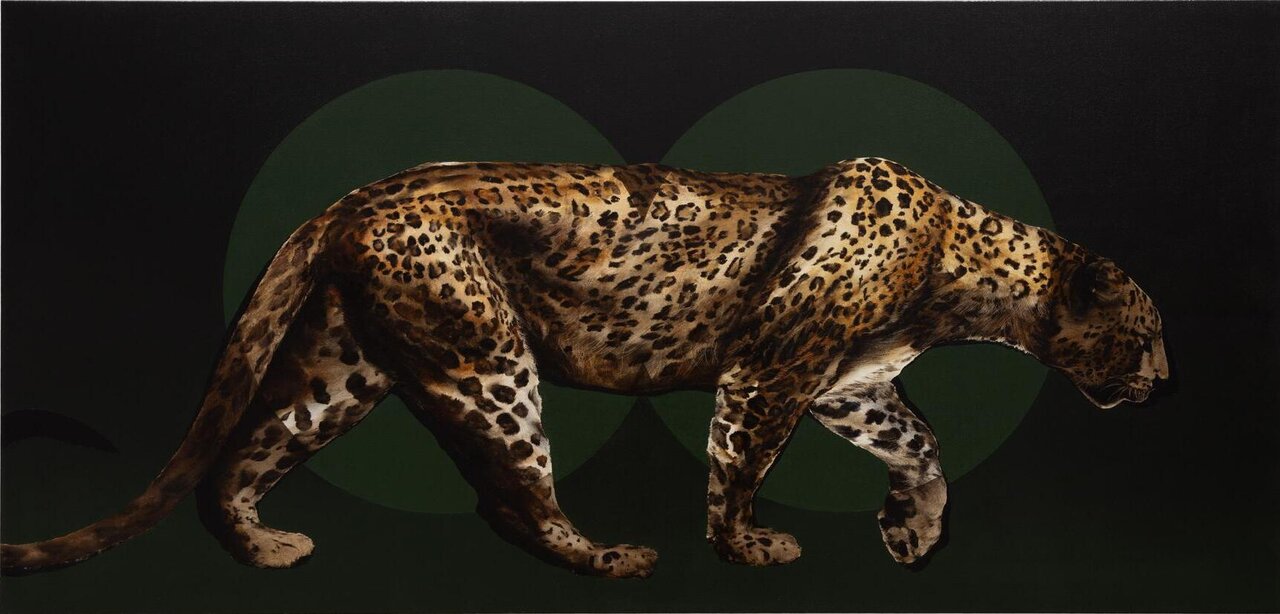
Prowler, 2025, oil on canvas, 36 x 75 inches
This fact immediately led me to think about Thompson’s work in terms of what French sociologist and philosopher Jean Baudrillard called hyperreality. This is not a term mentioned in the short essay accompanying the exhibition. So I don’t know if Thompson consciously has the notion in mind, but it certainly helps us to make sense of his work.
Baudrillard claimed that while social order, in what he refers to as the modernist era, was determined by labour and production, today in the postmodernist era labour itself is a sign of one’s social status. This is reflected in the fact that wages are no longer a measure of one’s productivity, but rather are a measure of one’s place or status in society more generally. That is the fate of the Ford car plant workers in Thompson’s own family no less. In this postmodern world, according to Baudrillard, our experiences are primarily received through communication technology – social media, television, the internet – in other words, largely as simulations of reality. Our experiences are increasingly mediated by the screen, rather than the outside world. These simulations, or simulacra, cease to be based on an independent reality, but instead become that which constitutes our ‘reality’. We have come to live in a hyperreality, wherein entertainment and media technologies provide more intense experiences, and replace the banal experiences of the outside world, i.e., the real.
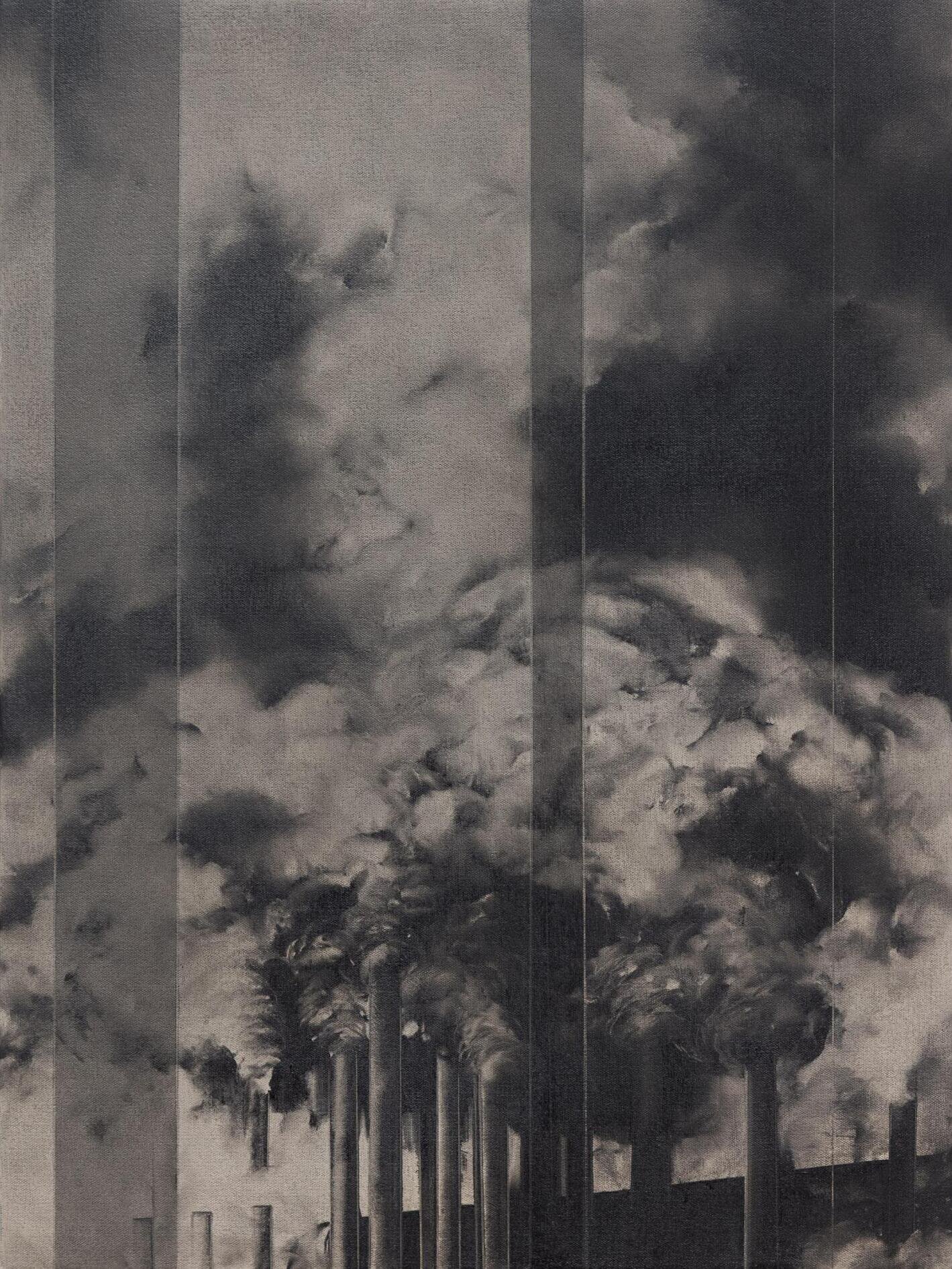
Mist, Might, 2026, oil on canvas, 24 x 20 inches
It is surely within this hyperreality that Thompson’s practices are located. The images he selects from the internet interest him as images, simulations, and not as referents to the real. He is not simply depicting, for instance, the dress or overalls in Double Over, but rather he is focussed on construction of the image itself. Here he pushes cellophane onto the painted surface to simulate digital techniques, e.g., effects created in photoshop. His painting, therefore, makes visible the images as images. Were he to have used digital techniques directly, of course, their digitalness, so to speak, would be invisible to us, taken for granted.
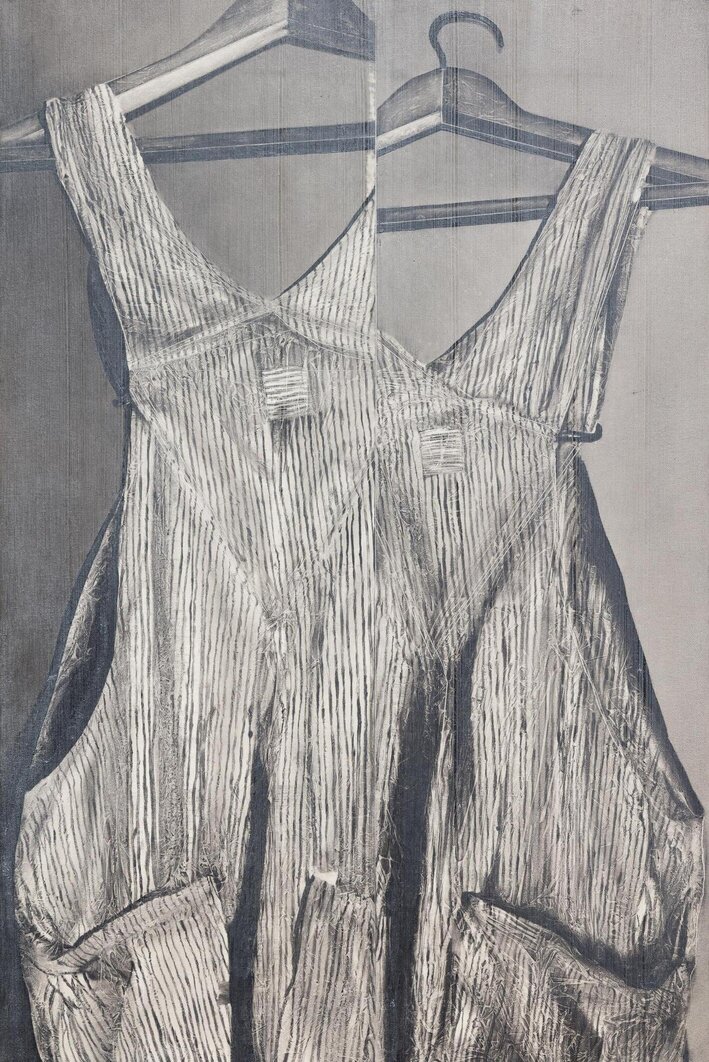
Double Over, 2026, oil on canvas, 36 x 24 inches
Hence I would call his paintings hyperrealist and not photorealist. While the photorealist uses paint to simulate the photographic image, the hyperrealist uses paint to highlight the images as simulations per se. And these simulations are not representations of the real, but are images as signifiers that gain their meanings in relation to other signifiers.

Steeling, 2026, oil on canvas, 6 x 36 inches
Thompson’s work is technically dazzling and conceptually rich; so much so it is difficult for the viewer to make sense of it all at first glance, unaided. It is cerebral work in this sense but visually rewarding nonetheless. Indeed, the exhibition’s venue, Franz Kaka, consistently shows work that challenges the viewer, but in a way that is exciting. The gallery is a true gem in the city, one of the very best venues displaying the works of talented artists, many of whom live in Canada.
Hugh Alcock
Photo credit: LF Documentation.
*Exhibition information: Michael Thompson, Panther Platform, March 13 – April 25, 2026, Franz Kaka, 208-1485 Dupont St, Toronto. Gallery hours: Thursday – Saturday 12 – 5pm.