
“The end of the world as we know it seems continually imminent. Yet we live in the debris of many ended worlds, whose inhabitants continue to live on.” by Alexis Lothian, Old Futures, p. 2
At a historical moment marked by intensifying instability, the language of endings circulates with unusual frequency. Ecological collapse and global violence appear less as distant possibilities than as conditions already unfolding. Within this atmosphere of uncertainty, the exhibition Proof of Life, curated by Chloe Gordon-Chow, approaches the question of dystopia with an attentiveness to what remains after systems falter. Presented by the Art Museum at the University of Toronto at the Jackman Humanities Institute in Toronto, the exhibition is on view till June 19, 2026. Developed in relation to the institute’s annual research theme “Dystopia and Trust,” the project situates the gallery as a site where the material traces of the present are considered alongside speculative visions of what might follow.
Gordon-Chow, a Chinese Canadian curator and researcher pursuing graduate work at the University of Toronto, approaches exhibition-making as a form of inquiry into possible worlds. Her curatorial framework attends closely to fragments and residues. The works gathered in Proof of Life evoke an archaeology of the present, suggesting how objects circulating today may one day appear as the artifacts of what has vanished. Each contribution inhabits a temporality in which the contemporary moment appears sedimented within an imagined future.
Upon entering the exhibition, visitors encounter Shannon Garden-Smith’s Alluvial Fan, a long sequence of marbled prints resting along a narrow shelf that traces the corridor. Thousands of sheets form a continuous sweep of colour. Their surfaces bear intricate patterns created through a process in which pigments are combed across a thickened bath of water before transferring onto paper. The resulting forms resemble geological strata or mineral veins, showing the slow processes through which landscapes take shape across vast stretches of time.
The installation carries within it a deliberate vulnerability. Each visitor receives an invitation to remove a page from the arrangement and take it away. Over the duration of the exhibition, the field of prints gradually diminishes, and what begins as an abundant visual becomes progressively thinned through audience participation. In geological language, an alluvial fan forms through the accumulation of sediment carried by water. Garden-Smith’s installation recreates that slow deposition while simultaneously staging its dispersal. The removal of each sheet registers the cumulative weight of shared gestures.
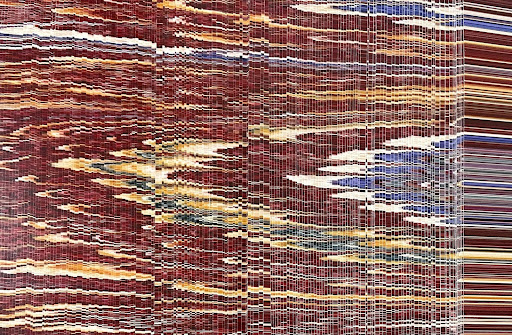
Shannon Garden-Smith, Alluvial Fan, detail, 2025, digital prints on paper, shelf, installation begins as approximately 2400 pages, 6” x 110” (approximately the length of the wall), each page 4.5” x 6”
Elsewhere in the institute’s communal space, two sculptural lamps from Garden-Smith’s series In a hare’s form emit a beautiful glow of colours. Their forms consist of hardened gelatin shells containing delicate botanical clippings. Leaves and stems remain suspended within the translucent material, preserved in flattened silhouettes that recall the pages of an herbarium. Gelatin carries a layered set of associations. Within culinary practice, it belongs to the domain of consumption and within photographic history, it participates in the chemical stabilization of images. In these works, the material holds organic matter in a fragile suspension. Light filtering through the surface reveals the preserved plants as though they have entered a state of fossilization.
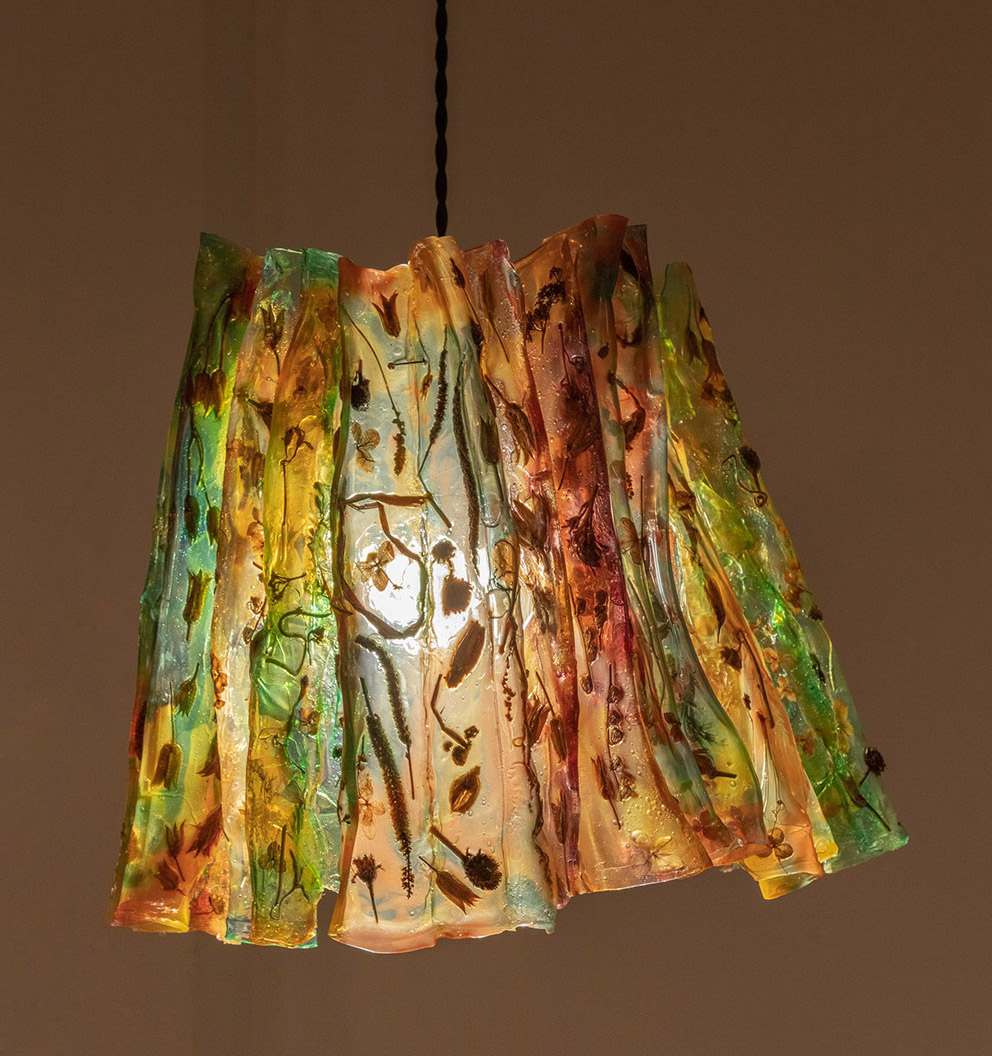
Shannon Garden-Smith, In a hare’s form III, 2021, pigmented gelatin, plant clippings, lamp cord, approximately 15” x 10” x 13.5”
The exhibition continues with a series of sculptural shells by the collective boring earth, whose works appear dispersed throughout the gallery. Each form contains assemblages of found and foraged materials gathered from the surrounding environment. Stones, fragments, and industrial remnants share a single enclosure, the objects resembling ritual deposits uncovered through archaeological excavation. Their surfaces suggest offerings left for unseen presences whose existence exceeds the boundaries of human perception.
Within these works, discarded matter acquires a renewed significance. Objects once treated as waste enter into unfamiliar constellations of meaning. Organic and inorganic bodies remain intertwined within the same sculptural container. The gesture thus presents relationships that extend across material systems, inviting reflection on the entanglements between human activity and the wider ecological field.
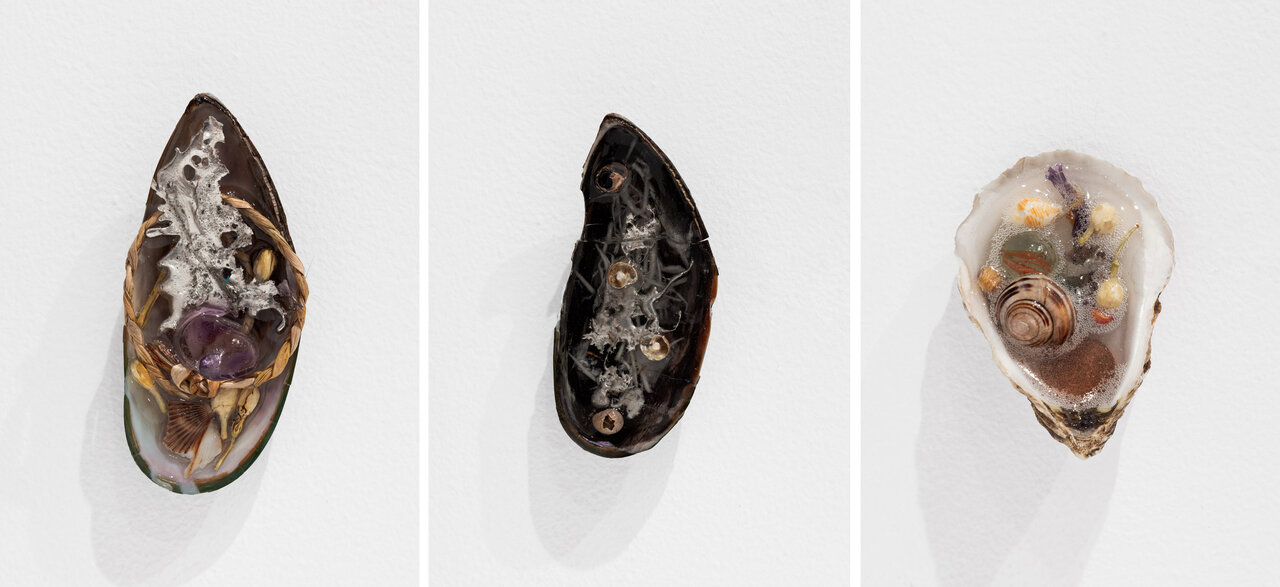
L-R: boring earth, Offering 21, Offering 25, and Offering 33 from the Offerings Series, 2024 – ongoing, acrylic resin, shell, pewter, bottle caps, pyrite, amethyst, image transfer, paper shavings, micro plastics, bells, key fobs, bird’s nest, marbles, pistachio shells, acorn, candle wax, copper coin, wood, silver wire, white sugar, glass beads, steel nut, fish bone, cat fur, cottonwood pod, acrylic, fossils, fire, orchid stem, orach and Ontario pollinator seed, sea grass, dehydrated iris, jasmine, rose, and tulip, neodymium magnets
Questions surrounding value and transformation emerge within the sculptures of Jenine Marsh. Her work incorporates altered coins that support delicate botanical forms. In In buildings and bridges, vessels and elements, borrowing and spending, greetings and solidarity (2022), the coin appears melted and punctured, its surface bearing the marks of deliberate alteration. The metal disc supports a flower mounted upon a thin wire stem and sealed within a synthetic membrane. The bloom carries a hybrid presence shaped through the interaction of organic growth and manufactured material.
Marsh’s intervention draws attention to the symbolic authority historically invested in currency. Coins circulate as instruments of exchange, yet their material composition remains grounded in metal shaped through industrial processes. By altering their form, Marsh returns attention to the substance underlying the abstraction of economic value. The emergence of a botanical form from this altered foundation points to the shifting relationships between ecological systems and financial structures that organize our contemporary life.
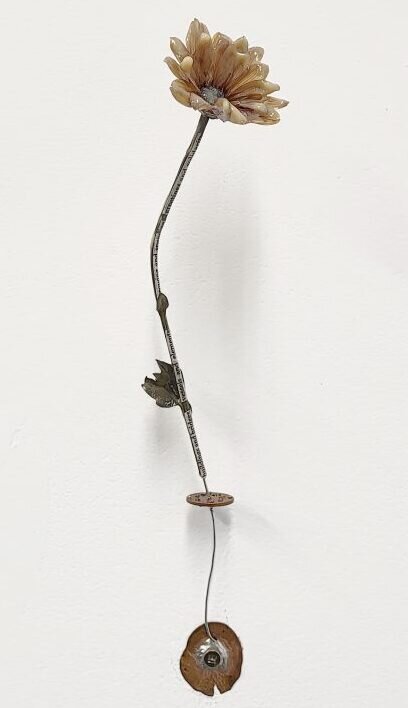
Jenine Marsh, buildings and bridges, vessels and elements, borrowing and spending, greetings and solidarity, 2022, flower, wire, altered coins, newspaper clippings, hardware, solder, synthetic rubber, acrylic UV varnish, 11 ¼” x 2 1⁄4” x 4”
Finally, in Trocitos de Memoria (2025), Ernesto Cabral de Luna engages with the fragility of memory. Archival family photographs appear transferred onto fragments of coloured glass arranged upon a luminous table. The shards recall a familiar architectural movement present across parts of Latin America, where broken bottle glass is embedded along the tops of walls as a protective barrier. Within the gallery these fragments undergo a transformation as their sharp edges remain, yet the surfaces now carry traces of personal histories.
Faces and domestic scenes emerge partially within the glass. The process of image transfer leaves certain details obscured, allowing only fragments of the original photograph to remain legible. Light passing upward through the glass produces an atmosphere of reverence as the fragments resemble small relics preserved through time. Memory appears dispersed across the field of glass, suggesting how recollection survives even through incomplete and shifting forms.
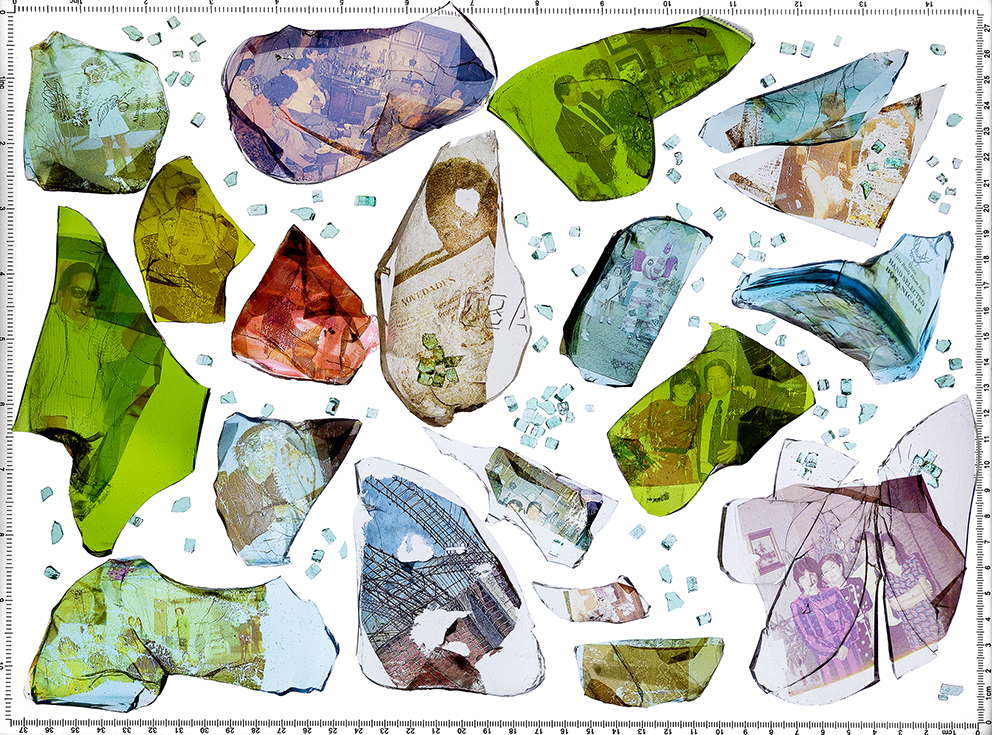
Ernesto Cabral de Luna, Trocitos de Memoria, 2025, wooden plinth, light table, emulsion lifts onto various pieces of broken colored glass, shattered windshield, 36” x 15” x 3”
Across the exhibition, material remnants function as points of entry into broader reflections on survival and futurity. The works assembled by Gordon-Chow create the persistence of life within environments shaped by instability. For many communities whose histories bear the marks of colonial violence and economic dispossession, the conditions often described as dystopian already structure everyday experience. Within this context the question of what follows the end of a world acquires an immediate urgency. Proof of Life offers a space for contemplating these questions through attention to matter itself. Archival debris, altered currency, preserved plants, and fragments of glass circulate through the gallery as carriers of memory and speculation. Each object appears suspended between the present moment and an imagined future in which these materials might remain as evidence of lives once lived. Through this careful gathering of remnants, the exhibition invites reflection on how survival continues within landscapes marked by cracks and transformation as proof of our existences.
Yehyun Lee
Images are courtesy of the Art Museum at the University of Toronto.
*Exhibition information: Existence as Evidence: “Proof of Life” September 10, 2025 – June 19, 2026. Presented by the Art Museum at the University of Toronto at the Jackman Humanities Institute in Toronto, 170 St. George Street, 10th Floor. Museum hours: Tue & Thu – Sat 12 – 5 pm, Wed 12 – 8 pm.