
United Contemporary presents two powerful exhibitions that confront the enduring legacies of World War II and its devastating impact on Japanese Canadian communities. These concurrent shows feature four artists—Emma Nishimura and Mitchell Akiyama in the collaborative multimedia installation Paradise, and Norman Takeuchi and Akira Yoshikawa in Selected Works—each offering distinct yet complementary perspectives on displacement, memory, and intergenerational trauma. Together, these exhibitions create a comprehensive artistic reckoning with a pivotal moment in Canadian history, while celebrating the resilience of those who endured forced internment and its reverberating consequences.
The exhibition Paradise opens with a striking wall installation of paper-printed works that immediately evokes the Japanese Byobu—the traditional folding screen. This architectural reference frames the entire experience, welcoming visitors into a contemplative space rooted in Japanese aesthetic traditions. Both artists’ grandparents were forcibly relocated to British Columbia during World War II, and Akiyama and Nishimura have traced these displacement routes together, visiting the sites of their family histories.
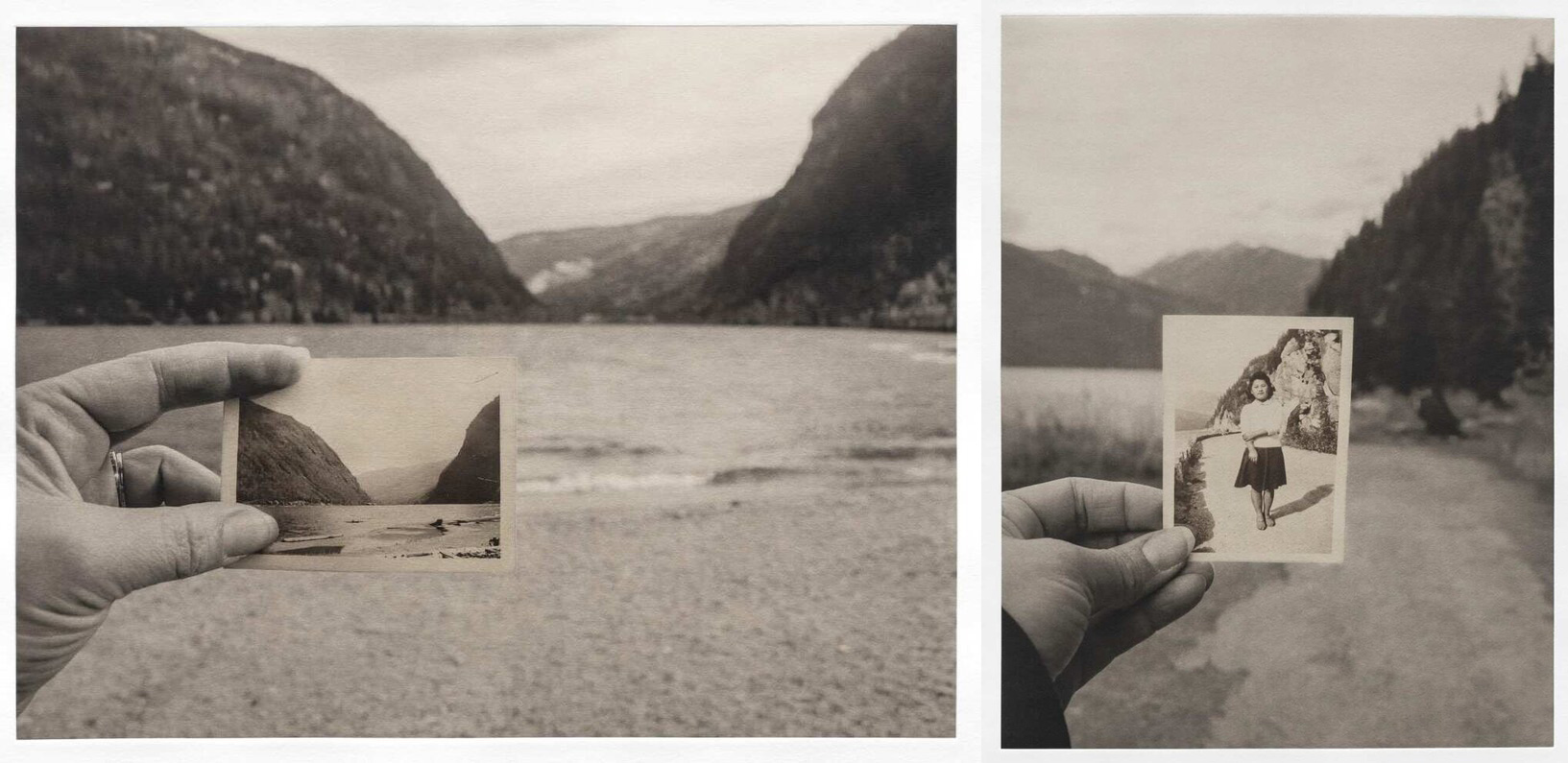
Emma Nishimura, In Between: Rutherford Beach, (left) and In Between: Slocan City, (right), both 2025, Photopolymer gravure with gampi chine collé, Edition of 5, Framed in stained maple with AGUV glass, 22 x 27.5 inches
Within the installation, fragile walls create a memorial space filled with meaningful objects. Nishimura’s prints overlay family photographs from internment with today’s landscapes, creating temporal collisions that reveal how past and present coexist. A series of hand-carved woodblock prints reproduce the grain patterns of cedar exteriors from internment shacks transforming architectural markers of confinement into delicate, contemplative works.
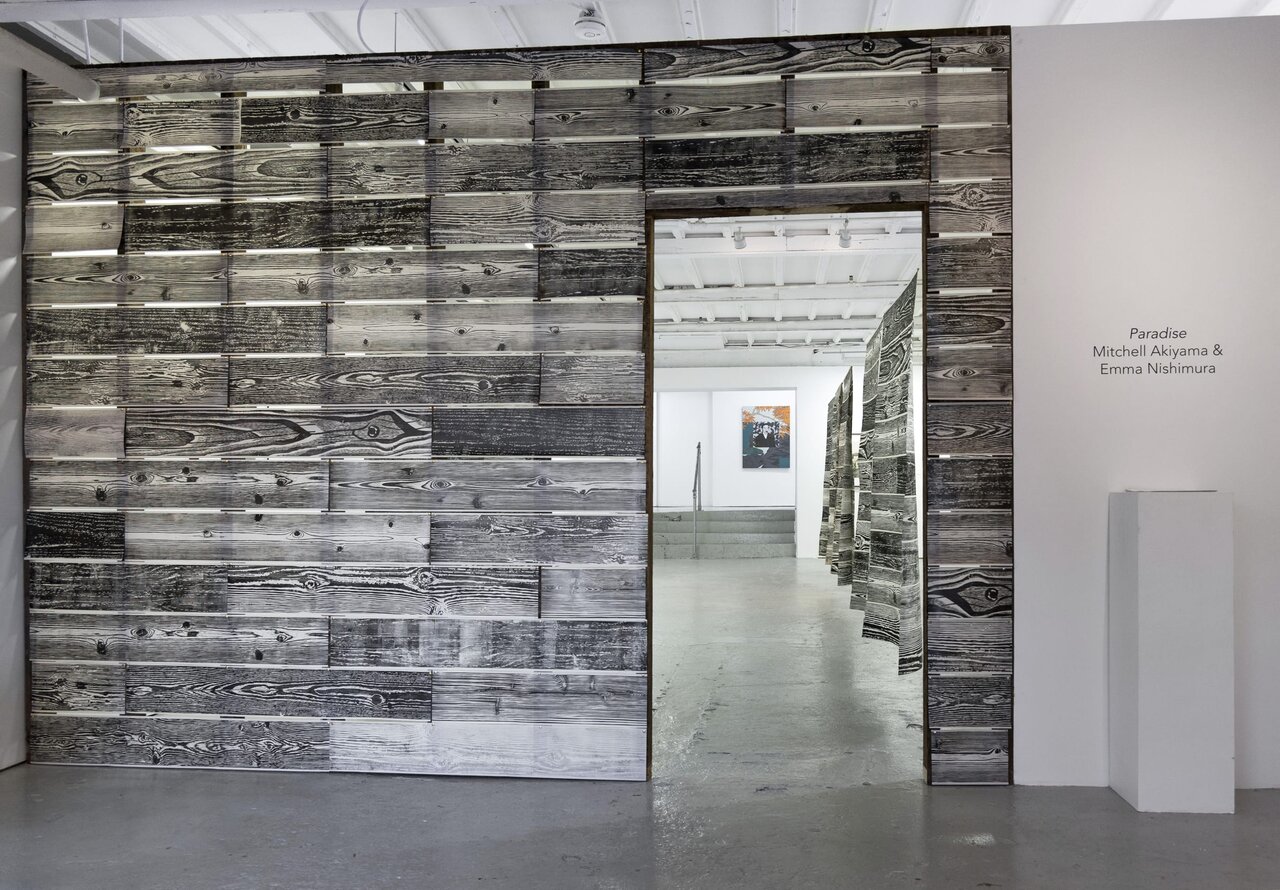
Entrance view of Mitchell Akiyama & Emma Nishimura, Paradise
Akiyama crafts a stand for a temple bell from reclaimed wood, while a handcrafted table reworked from a Western-style piece given by Akiyama’s grandmother into a Japanese-style low table displays a film on a vintage television. This blending of forms and cultures becomes the visual language through which the artists examine how history and memory shift across generations.
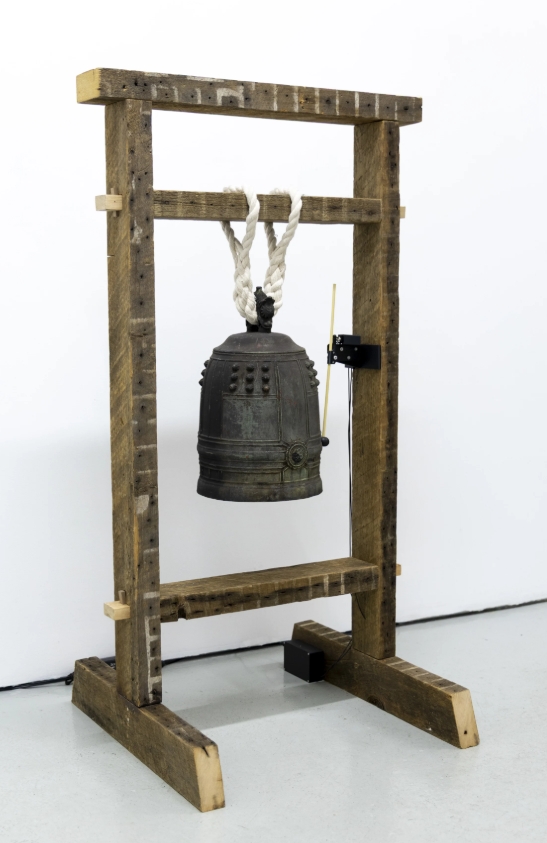
Mitchell Akiyama, Temple Bell
Akira Yoshikawa’s artistic vision emerges directly from displacement and historical consciousness. Born in Hiroshima in 1949, he inherited both the aftermath of the atomic bomb and his mother’s legacy of peace advocacy after she fled her family’s British Columbia farm. This dual inheritance shaped an artistic sensibility centered on restraint, mindfulness, and contemplative space. Yoshikawa’s works are profoundly descriptive in their material subtlety. His Botan series uses charcoal powder creating luminous gradients from darkness to light, represents the contribution to contemporary minimalism.
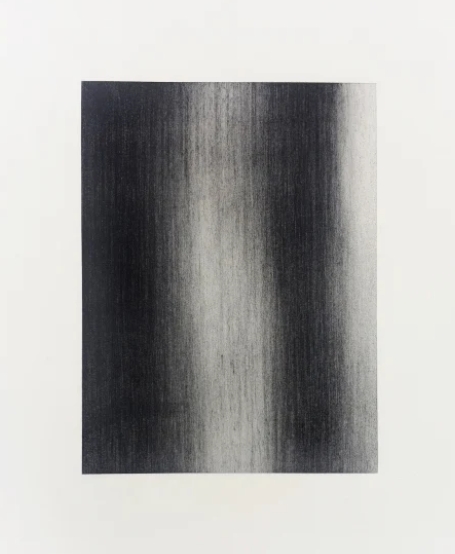
Akira Yoshikawa, Botan #3, 1996, Charcoal powder on paper, framed in black with AGUV glass, 26 x 19.75 inches
Let go presents a weathered stone, thin vertical lines, and white sculptural forms in spatial dialogue—inviting viewers to contemplate physical and emotional weight. The stark white backgrounds amplify meditative quietness. Through these works, Yoshikawa cultivates presence in the “now,” creating visual sanctuaries where his spare aesthetic offers profound contemporary resistance, demonstrating that simplicity generates deep resonance through silence and stillness.

Akira Yoshikawa, Let go, 2024, rock, plaster, string, Dimensions variable
Norman Takeuchi’s work merges bold abstraction with figurative motifs that speak to Japanese heritage, cultural duality, and the complexities of memory. His paintings, rooted in the wartime period, translate personal and collective histories into thought-provoking visual narratives. In this exhibition, Lumber Camp is shown for the first time, directly linking to Takeuchi’s family history of forced removal from Vancouver. The painting depicts the train platform at the Devine lumber camp, the final site his family inhabited before returning home after the war, honoring this place while paying tribute to his parents’ resilience.
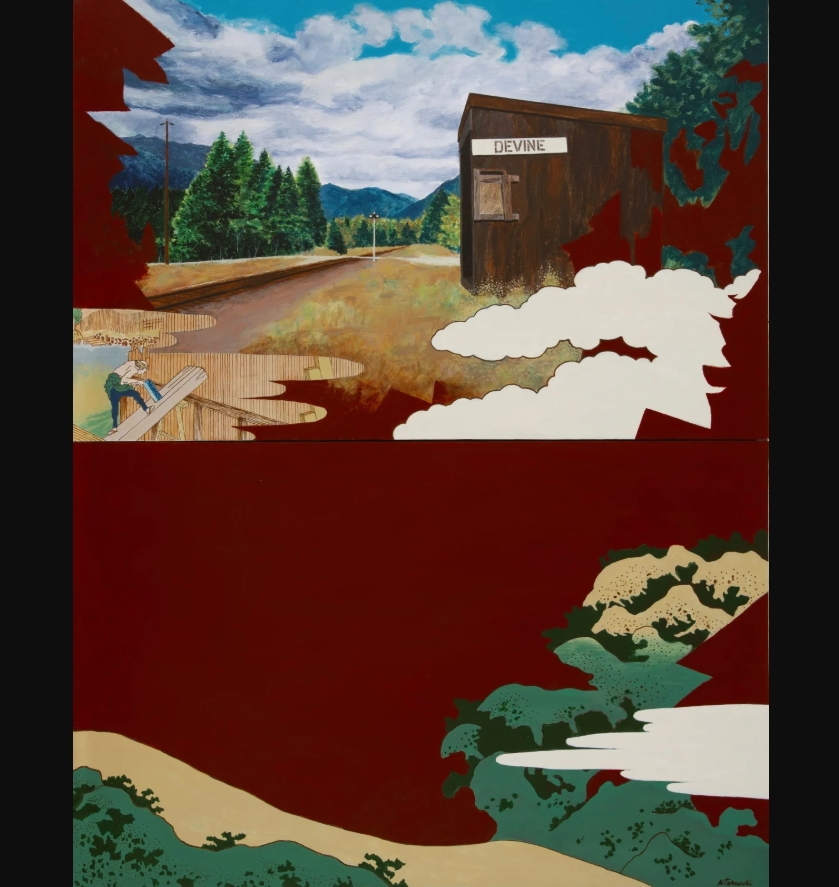
Norman Takeuchi, Lumber Camp, 2020, Acrylic on canvas, 42 1/8 x 33 1/8 inches
Two large-scale diptychs, Immigrant and Veteran from the Long Division series, extend this exploration. The left canvas portrays historical events while the right expresses intangible emotions of displacement, confusion, and loss through abstraction. The physical space between canvases symbolizes misunderstanding and intolerance, yet the compositions remain visually linked, emphasizing that despite division, human beings remain inherently connected. Through this interplay of history and abstraction, Takeuchi confronts trauma while asserting determined movement toward understanding and healing.
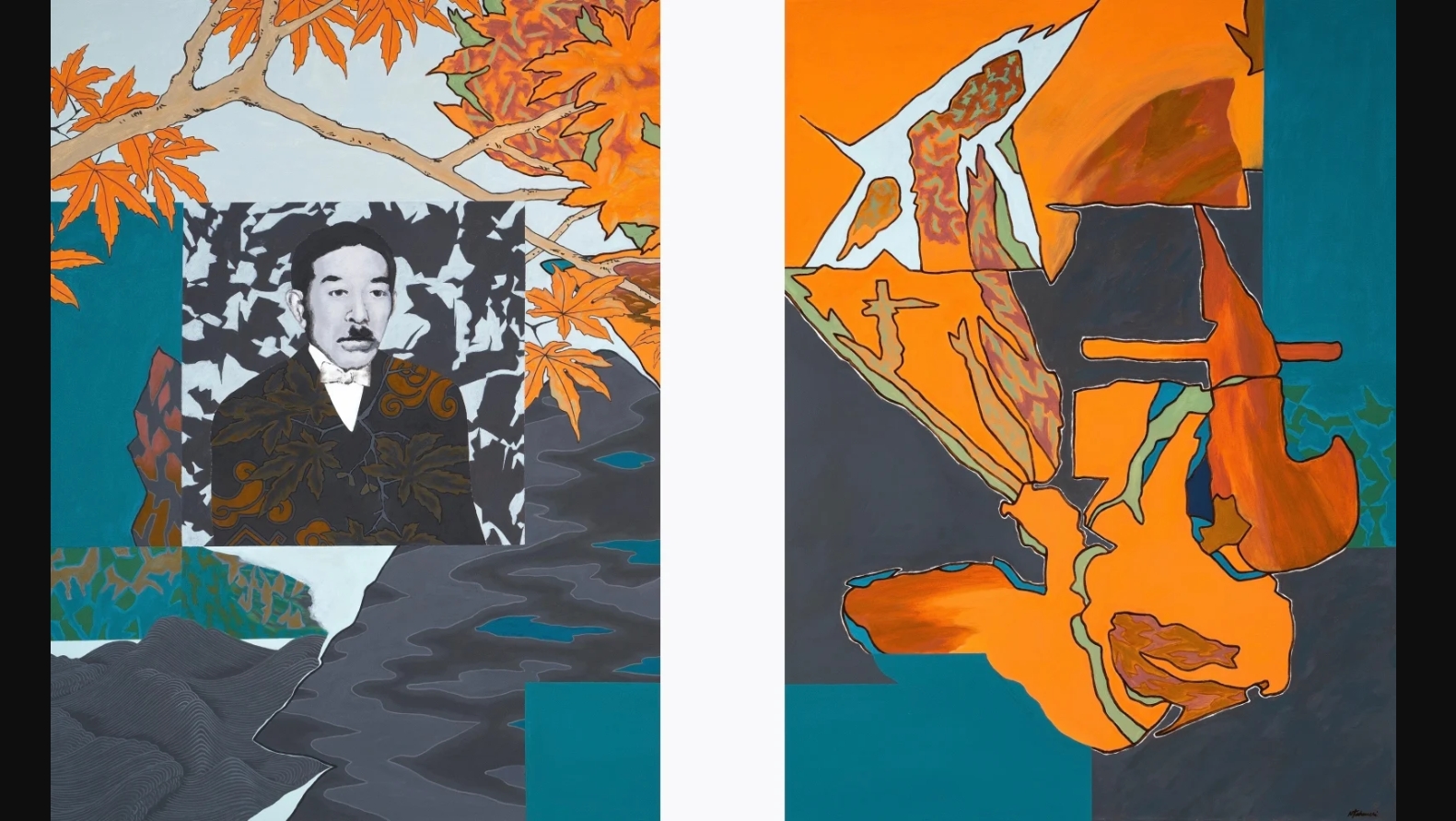
Norman Takeuchi, Immigrant, 2021, Acrylic on canvas, diptych, 48 x 79 inches

Norman Takeuchi, Veteran, 2022, Acrylic on canvas, diptych, 48 x 79 inches
These exhibitions represent a crucial opportunity for visitors to engage with wartime history, honor those affected, and recognize the profound resilience of Japanese Canadian communities across generations. Whether directly or indirectly impacted, all visitors encounter a momentous artistic testament to survival, memory, and the enduring human capacity for healing and connection.
Nusrat Papia
Images are courtesy of United Contemporary
*Exhibition information: Mitchell Akiyama & Emma Nishimura, Paradise and Norman Takeuchi & Akira Yoshikawa, Selected Works, November 27, 2025 – January 24, 2026, United Contemporary, 129 Tecumseth Street, Toronto. Gallery hours: Wed – Sat 11am – 6pm.