
When Toronto artist and curator Jinyan Zhao relocated to London to pursue her MFA at Goldsmiths, she entered a city where artistic production moves at a faster and more fractured pace. Yet even within this expanded environment, her approach remains rooted in the sensibilities she cultivated during her years in Toronto: an attentiveness to emotional nuance, a belief in perception as an embodied experience, and a curatorial language built around atmosphere rather than spectacle. Her recent collaboration with artist Kai offers a rich articulation of these concerns, using the frame of a London exhibition titled 10+1, Is it just Cake to explore questions at the heart of both of their practices.
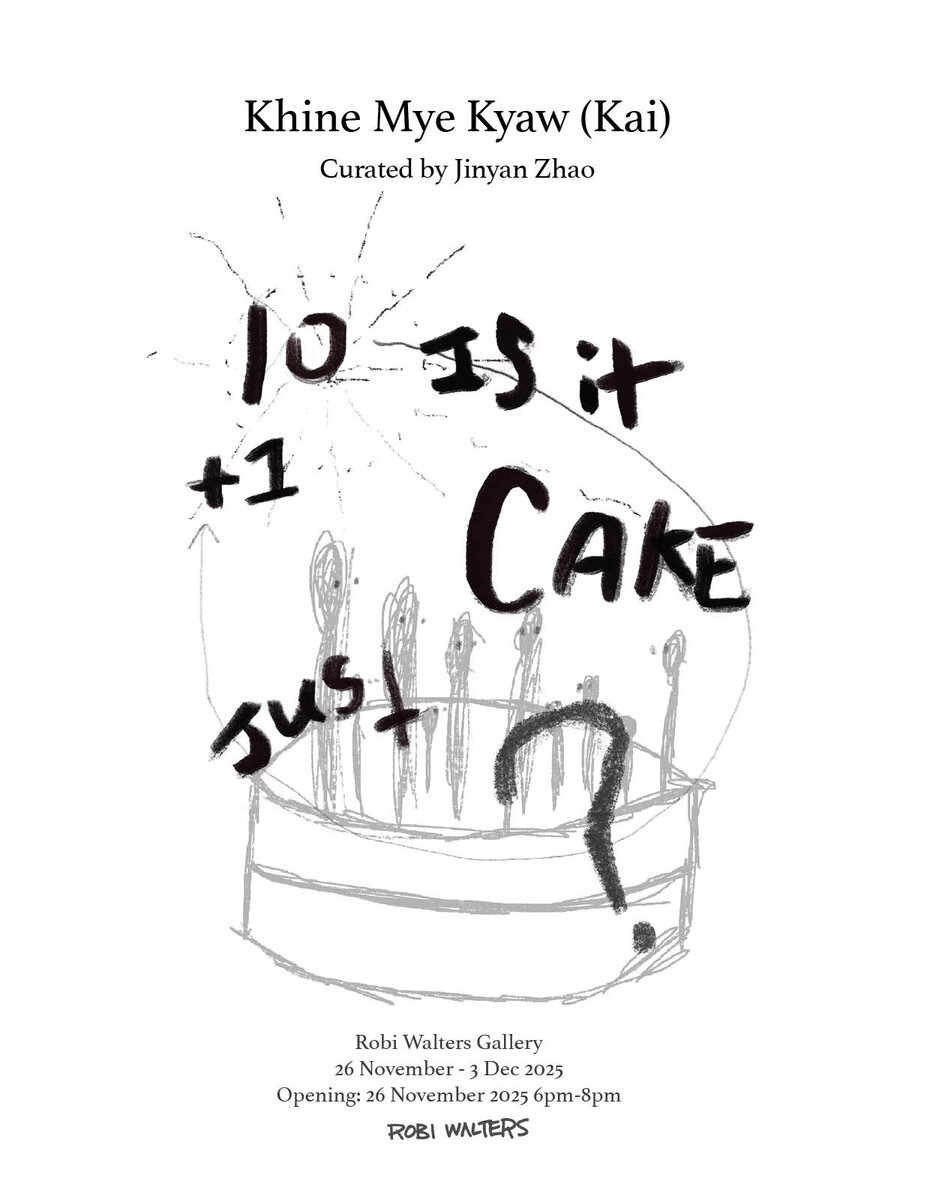
10+1, Is it just Cake at the Robi Walters Gallery in London, UK
The project began with a gesture that could not be more ordinary. In the video Eating a Cake in Front of a Camera, Kai records himself consuming a slice of cake. The action is simple, even unremarkable. But the presence of the camera destabilizes the act. His hands grow carefully. His mouth behaves as if it is being evaluated. The body tries to behave naturally and yet becomes increasingly self-conscious. Nothing dramatic occurs, yet tension gathers in the small adjustments of posture, gaze, and restraint. The video does not present a performance so much as the subtle production of performance through observation itself.
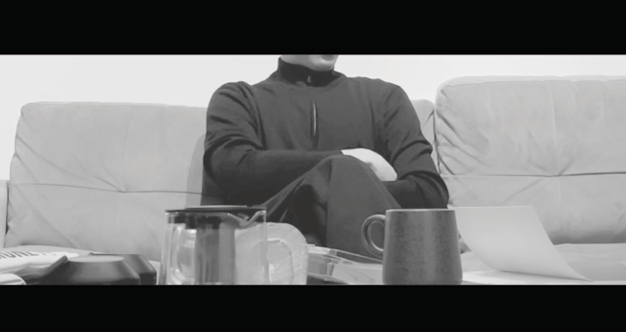
Eating a Cake in Front of a Camera, 2023, video still
For Zhao, this quietly strained gesture became an entry point into a much broader conversation about visibility, interiority, and the pressures that shape contemporary subjecthood. Her curatorial framing extended the gesture across multiple mediums, allowing it to refract through painting, language, sound, and even participation. Rather than situating the works within a rigid thematic structure, she created a space where viewers could sense the emotional negotiations underlying each piece.
Kai’s paintings operate as the internal counterparts to the video. While the camera captures the body performing outwardly, the paintings document what remains unspoken. Works such as To Cassandra and Architecture of a First Human are built through cycles of layering, erasure, and sealing. Charcoal marks are laid down and sanded away. Gestures are expressed and then withdrawn. Text appears faintly before being submerged under skins of diluted wood glue, a process Kai describes as a kind of “epidermal closure.” The surfaces behave like psychological membranes, carrying residues of impulse and hesitation.
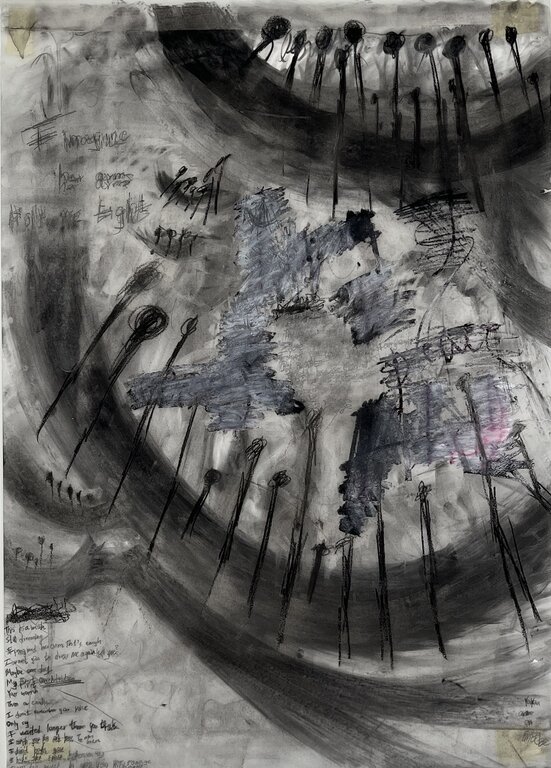
Architecture of a First Human, 2025, charcoal, oil pastel, graphite on tracing paper, 84 x 59cm
In To Cassandra, the composition is split along an invisible divide, staging a dialogue between two conflicting impulses: the desire to reveal and the need to protect. One side tremble with exposed marks, while the other withdraws into a dense, texture barrier. The painting refuses resolution. Instead, it lingers in a suspended state, articulating what it means to speak without assurance of being heard. Architecture of a First Human similarly visualizes early emotional distance, building an atmospheric structure out of arcs, fragments, and lingering traces of text. The works do not seek catharsis; they embody endurance in their most intimate form.

To Cassandra, 2025, Charcoal, oil pastel, graphite, wood glue on tracing paper, 84 x 59cm
Zhao’s curatorial approach resonates strongly with these layers of contradiction. Her work has long explored the fragility of the present moment and the instability of sensation. In previous projects, she has activated subtle shifts in perspective, gesture, and touch to create what might be described as emotional environments. In London, these concerns sharpen as she navigates a city defined by speed, competition, and density. Her attention to the smallest inflections of experience becomes a way of resisting the overwhelming pace surrounding her.
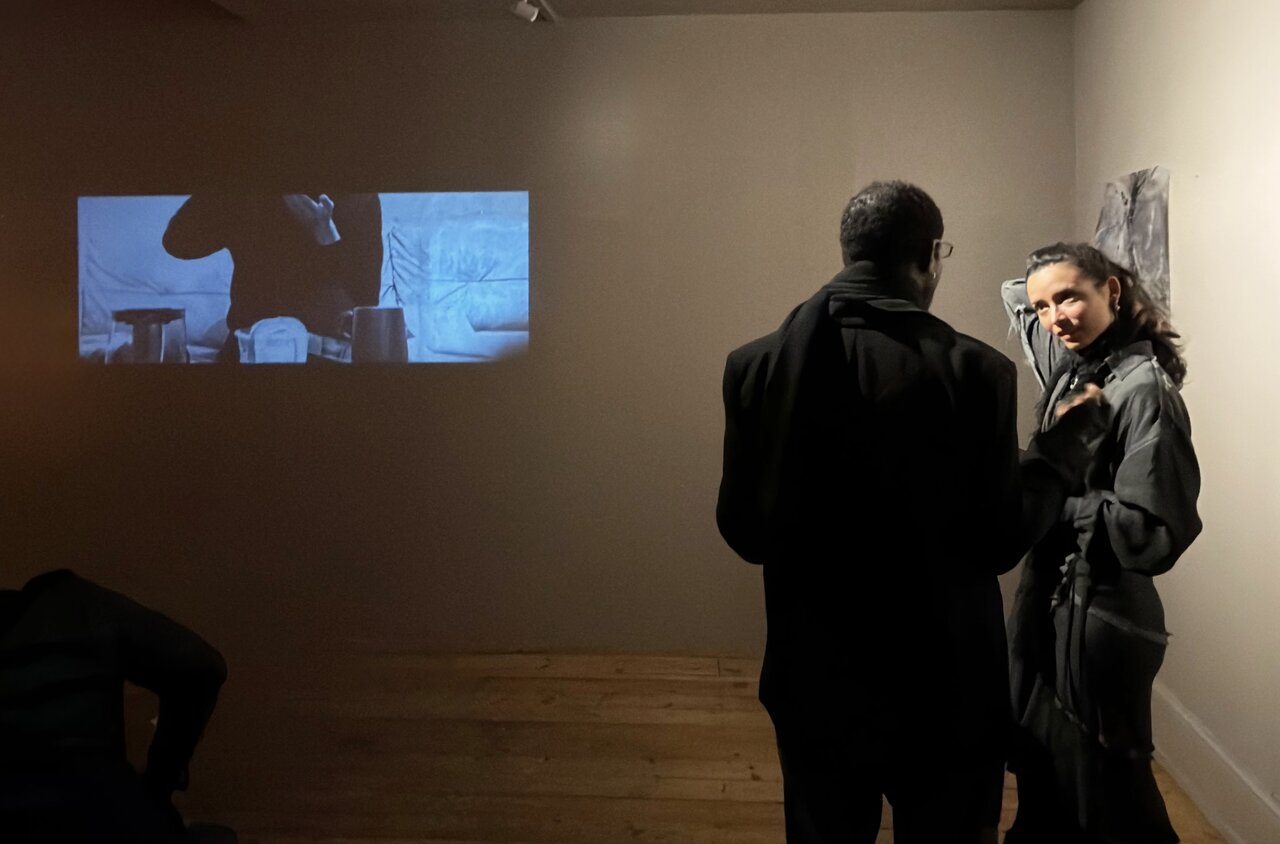
Installation view with Eating a Cake in Front of a Camera at the opening reception
In this collaboration, she allowed the artworks to unfold slowly. The exhibition space was quiet, shaped subtly by the looping repetition of William Basinski’s Disintegration Loops, a sonic layer that mirrors the erosion and persistence present in Kai’s surfaces. Even the opening’s invitation for visitors to eat slices of cake was more than a playful gesture. It folded the audience into the work’s fundamental tension. Eating, normally a private and unthinking act, becomes public. The visitors’ gestures echoed the artist’s own negotiation with visibility, turning the room into a shared performance of self-management.
Yet beyond the specific artworks, what is most compelling about this collaboration is how it reveals the evolving trajectory of young Toronto-trained practitioners working internationally. Zhao’s curatorial sensibility carries with it an ethos shaped by Toronto’s culture of thoughtful slowness and attention to emotional detail. Her move to London does not overwrite this foundation; instead, it places her in a dynamic exchange where local formations meet global pressures. Kai’s practice, with its profound attention to the psychological negotiations of being seen, offers a powerful complement.
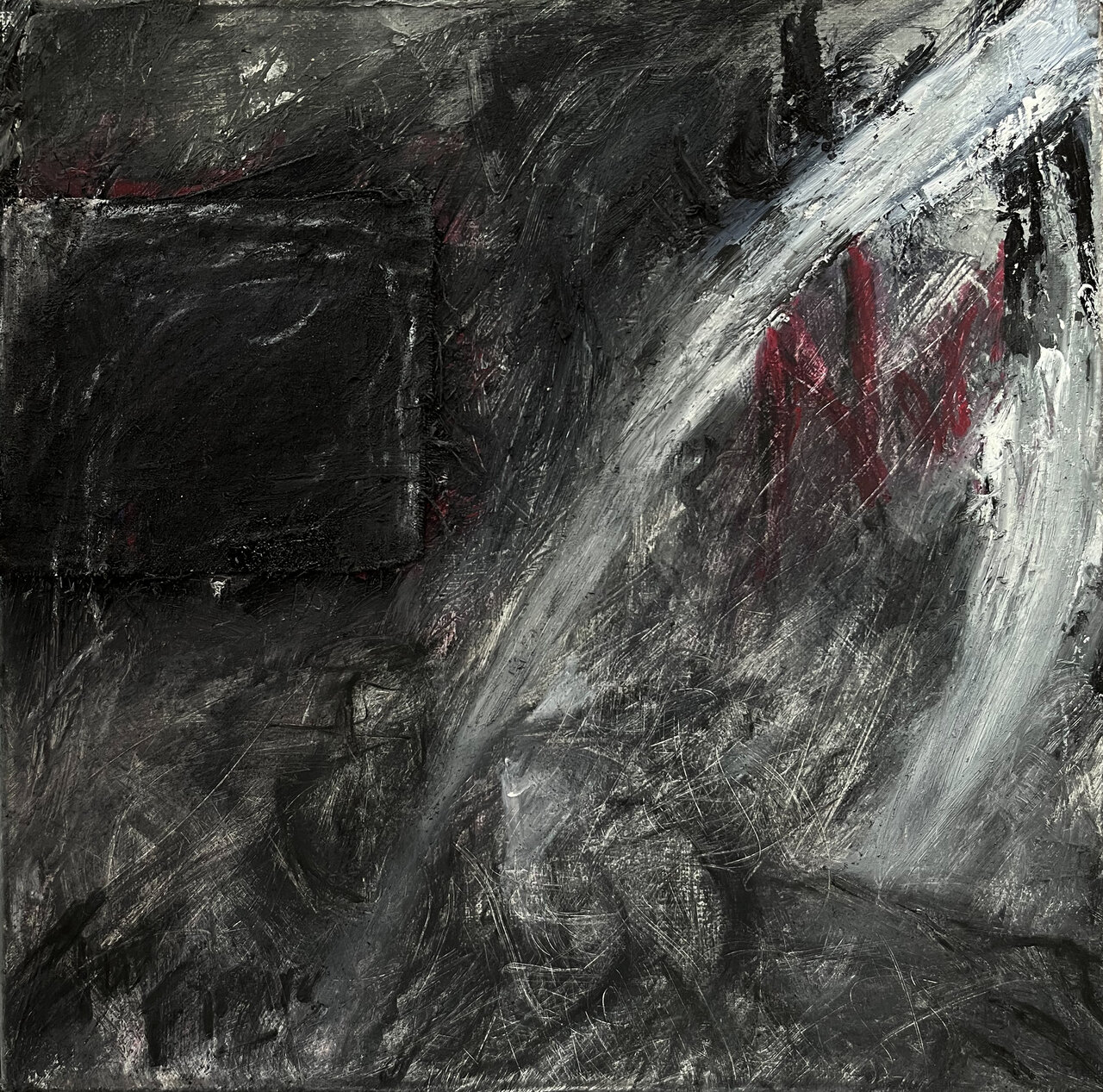
Aporia I, 2025, oil, charcoal, ash, linen on canvas, 40 x 40cm
Their collaboration suggests that resilience today is not a heroic feat but a continuous negotiation. It is expressed in erased marks, in withheld gestures, in the pressure of a camera, in the small adjustments a body makes in response to another’s gaze. It appears in the quiet ways artists navigate displacement, uncertainty, and the shifting landscapes of art worlds across cities.
While the London exhibition serves as the initial point of encounter, the significance of their work extends beyond it. Zhao’s evolving curatorial thinking reflects the shifting conditions of perception in a globalized art context, while Kai’s multidisciplinary practice continues to probe the emotional architectures that shape everyday life. Together, they create a space where interior worlds become perceptible, not through grand gestures but through careful articulation of tension.
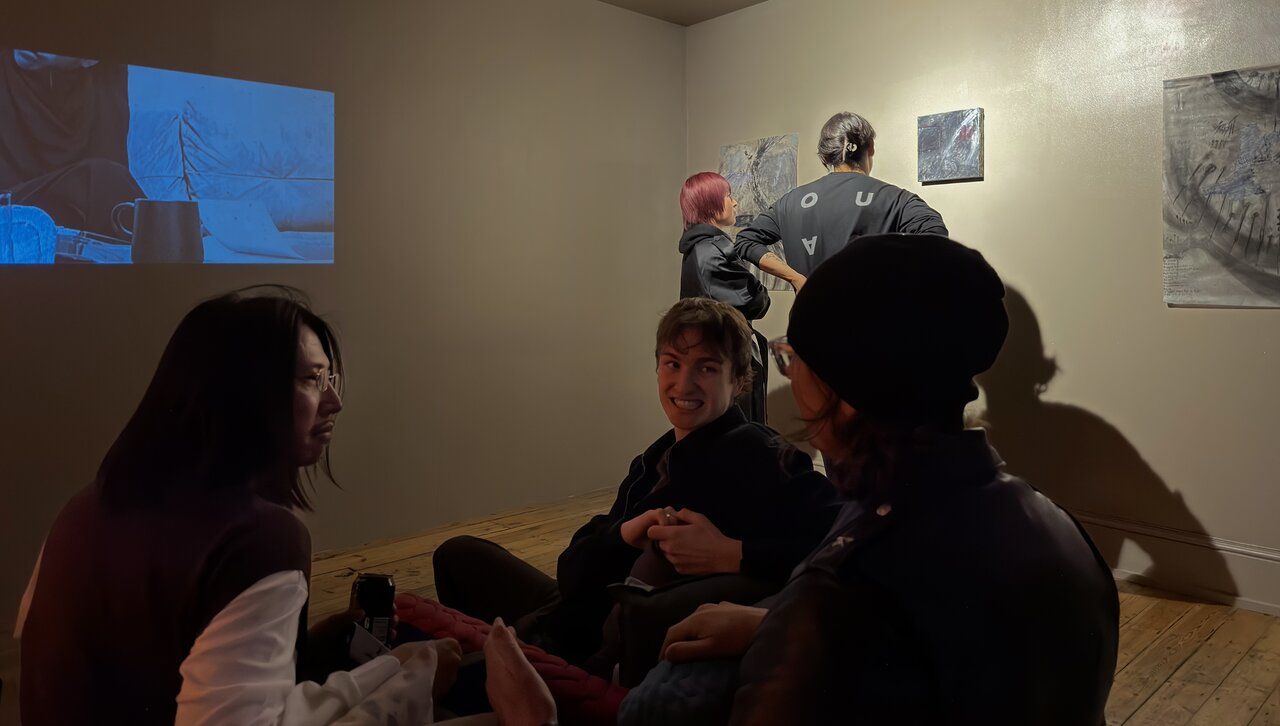
Installation view with guests at the opening reception
What remains after experiencing their collaboration is not a single image or moment, but a sense of standing inside a delicate threshold. It is a space where seeing and being seen blur into each other, where the body negotiates its own visibility, and where the interior world persists, quietly but insistently, beneath every gesture.
Sherry Chunqing Liu