
The focus of this article will be on the work of Viz Saraby in the members’ showing space known as the Cell Gallery, but first let me say something about the exhibition in the Main Gallery at Gallery 1313. It consists of the drawings, preparatory maquettes, and various ephemera concerning, the late Miho Sawada, who died in 2023. The exhibition is essentially a celebration of her distinguished career. Sawada was born 1944 in Osaka, Japan. She studied Fine Arts in Kyoto, and then moved to Canada where she soon enrolled at Toronto’s New School of Art in 1969. During her long career she taught at various institutions including the Ontario College of Art and The University of Guelph. Little of her artwork is on display, largely because she was a public sculptor, so her work must necessarily remain elsewhere. They can be found in Canada, United States and Japan in particular.
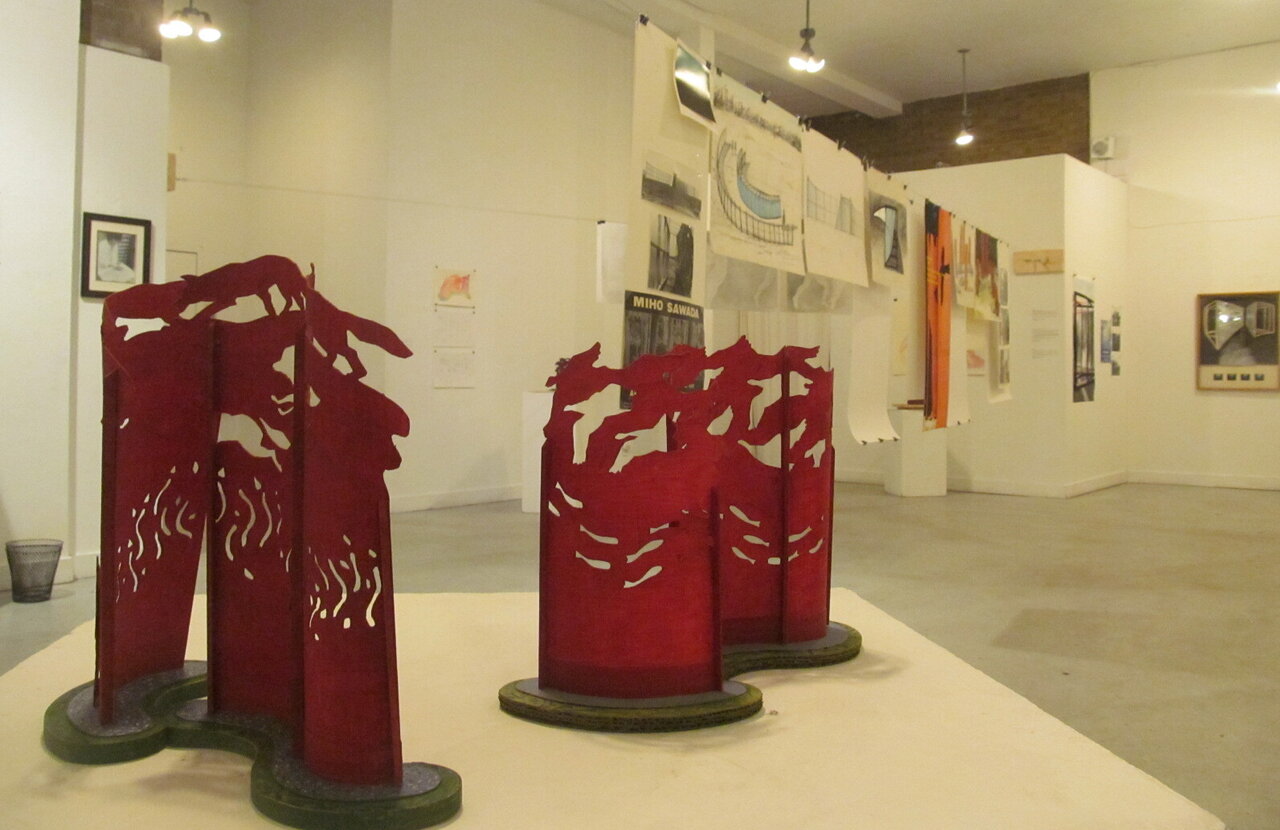
Installation view of Miho Sawada, Exhibition of Works. Courtesy of Gallery 1313
Saraby’s exhibition in the Cell Gallery is comprised of small sculptures of boats modelled from vintage domestic irons, and ten, what we shall calls ‘paintings’ on boards. She has had a decades long career in interior design and as a professor. Consequently she is very familiar with a variety of industrial processes employed in the craft of art and design. She does not constrain herself to one medium as many traditional artists do. Instead Saraby explores many production techniques and materials. Her paintings are testament to this fact.
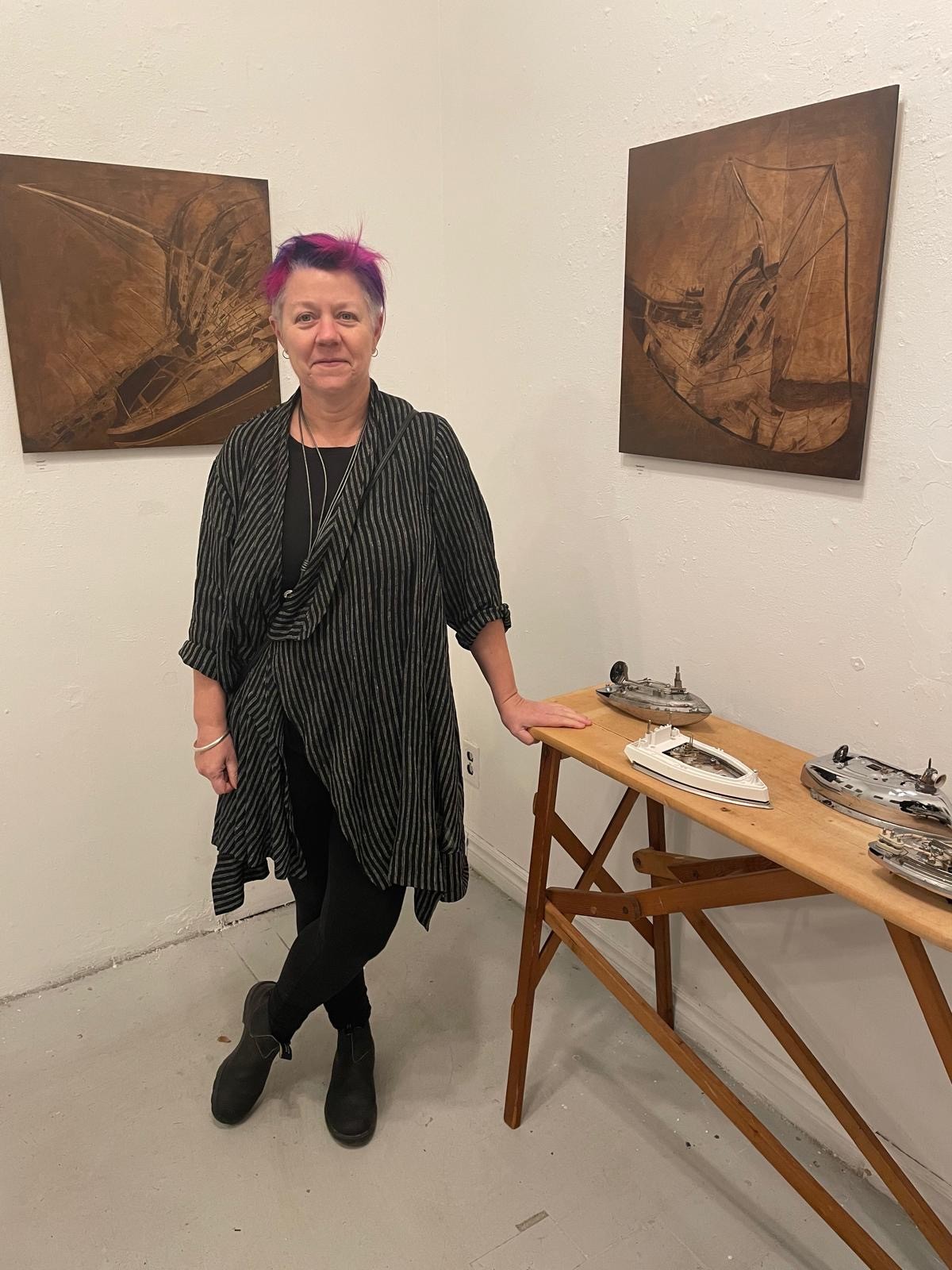
Viz Saraby with her works at the Cell Gallery
There are several stages in the production of her paintings – hence my reluctance to describe them as paintings as such. First, she has shot a series of photos of the quayside and boats located in the Georgian Bay town of Meaford where she resides. The images are digitally distorted. Next she uses a laser printer to etch an image onto a piece of birch veneered plywood. Then she paints the board to bring back the image. Finally the surface is treated in order to give it a uniform lustre. The pallette – ochres, sepia and other earthy colours, – Saraby tells us in her artist’s statement, is deliberately reminiscent of old master paintings, or at least how we imagine them.
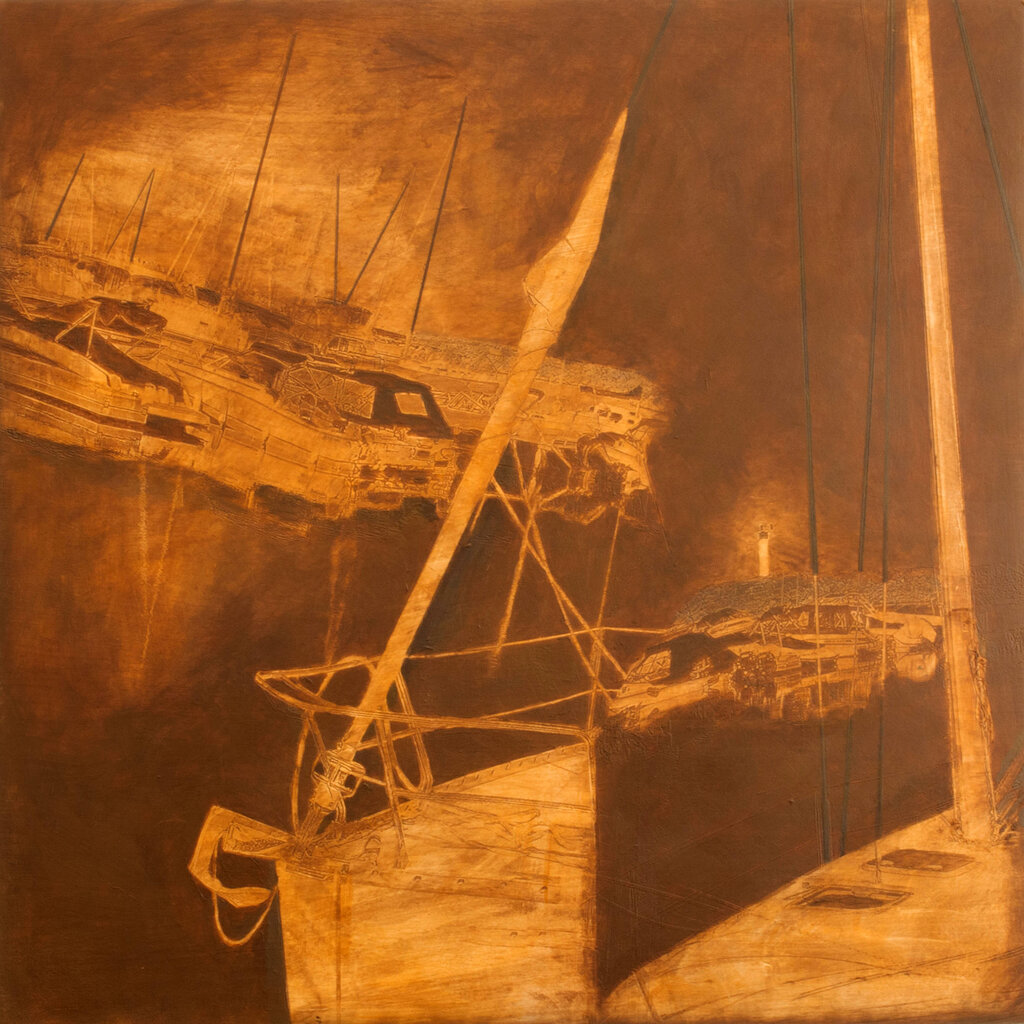
Viz Saraby, Boats 07, Docked, painting on birch veneered plywood, 23 x 23 inches
But the final look of these works is not wholly deliberative. Rather what ultimately comes out is informed by the materials and techniques she uses. Birch plywood, for instance, has a naturally warm tone that is accentuated by the the pallette she chooses. Also, the distortion she applies to the imagery is encouraged by the digital software Saraby employs. That is not to suggest she produces the work unreflectingly, but instead it is to point out that she enters into a dialogue with her chosen materials and techniques.
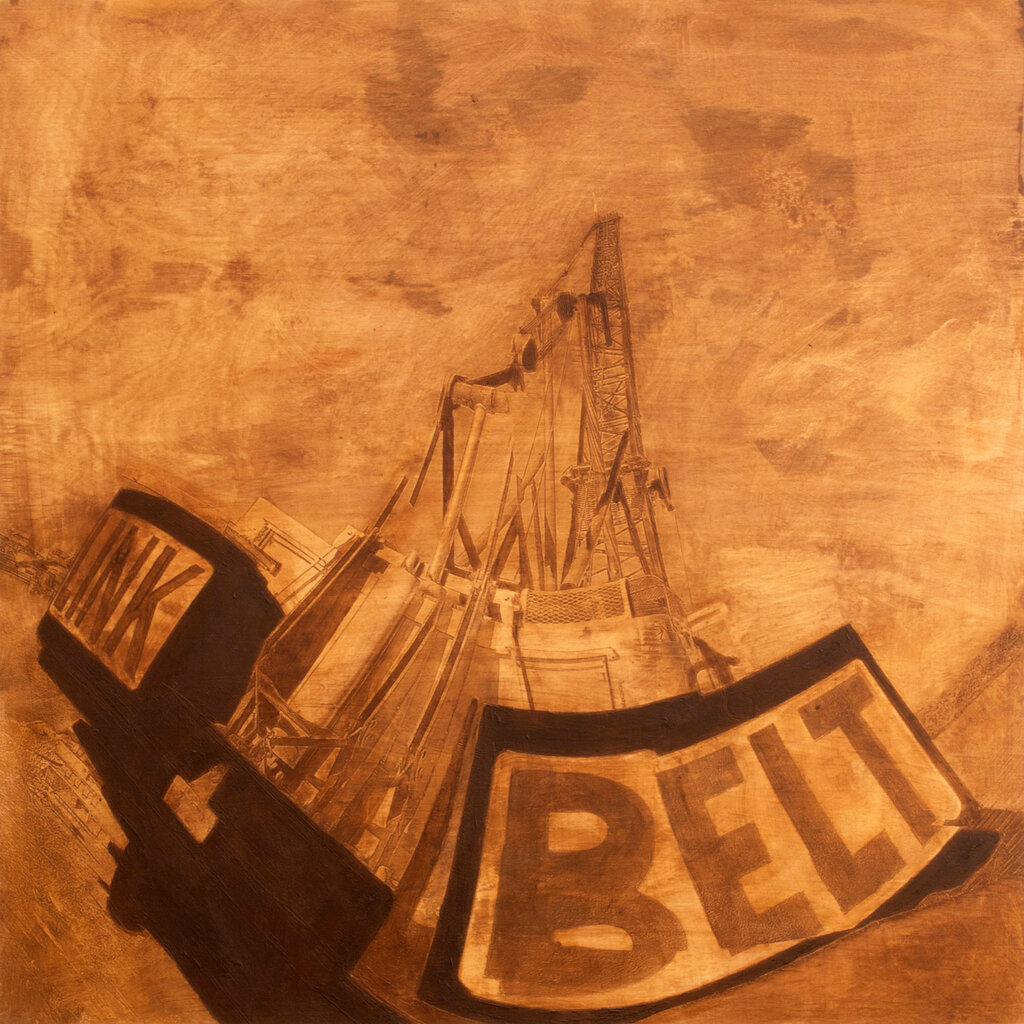
Viz Saraby, Boats 02, Heavy Weight, painting on birch veneered plywood, 23 x 23 inches
These images remind me of David Hockney’s photomontages, where he took a series of close up photos of a subject – a person, a landscape etc., – and created a collage from them. In Hockney’s case, very often there is a temporal element to the photomontages given that the subject is taken over a period of time. This adds to the distortion of the finished overall image, giving it a cubistic quality. For Saraby, on the other hand, each image originates from a single photo, so there is a unique point of view in each. The distortion she creates digitally is therefore wholly perspectival – the boats and landscape are bent and warped until the viewer is disorientated. The everyday becomes slightly grotesque, disturbing. But all the time the image is integral or continuous.
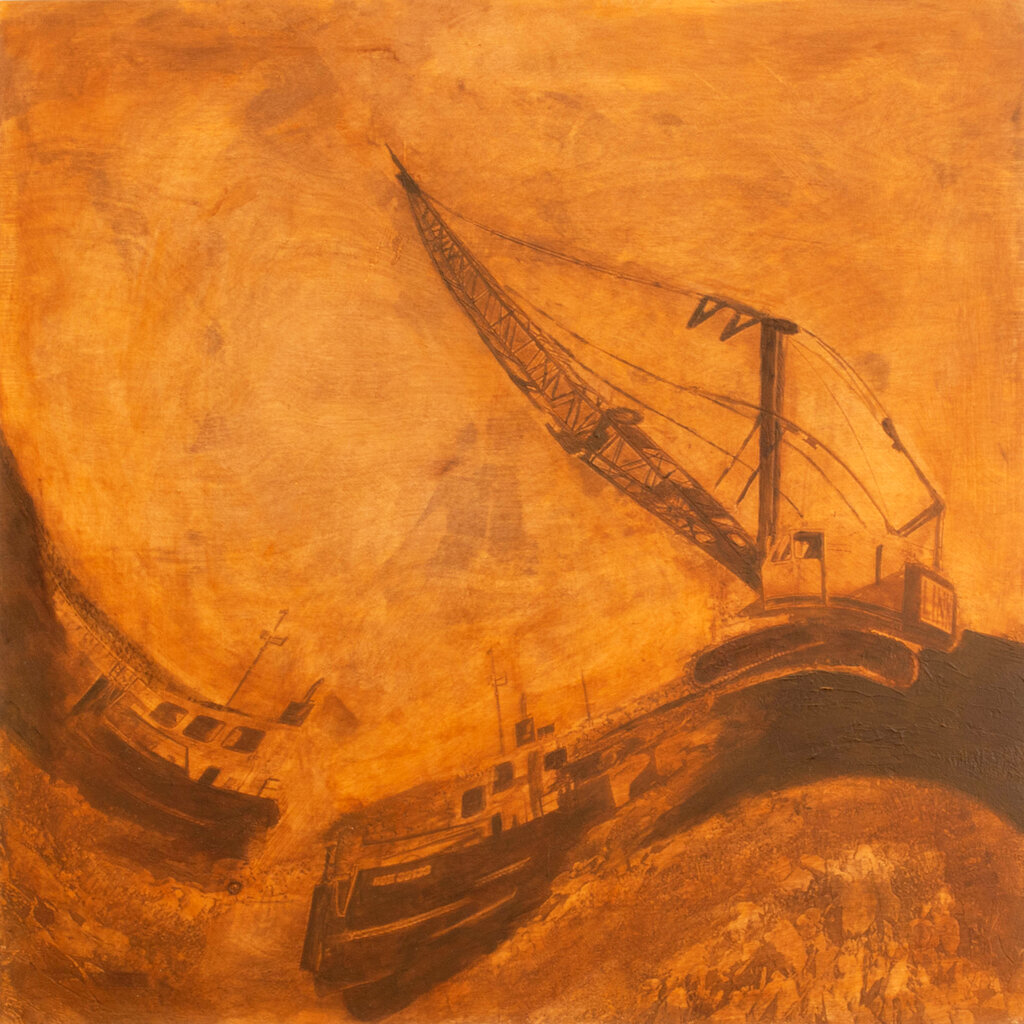
Viz Saraby, Boats 01, Teeter, painting on birch veneered plywood, 23 x 23 inches
I noted how Saraby works by entering into a dialogue with the materials and techniques she chooses. This essentially experimental approach is not confined to pictures. In this show she also presents seven boats modelled out of old clothing irons. Indeed, there is an affinity between the overall shape of an iron and a boat that she exploits here. Nonetheless, there is a child-like quality to these sculptures, given that the irons are only minimally altered, so that the viewer must fill in the gap between these two otherwise disparate items, i.e., imagine the irons as boats – just as a child, for instance, might imagine a large pile of dirt as a mountain. This imaginative dimension, combined with the toy-sized scale of the sculptures, makes them quite charming and playful pieces.
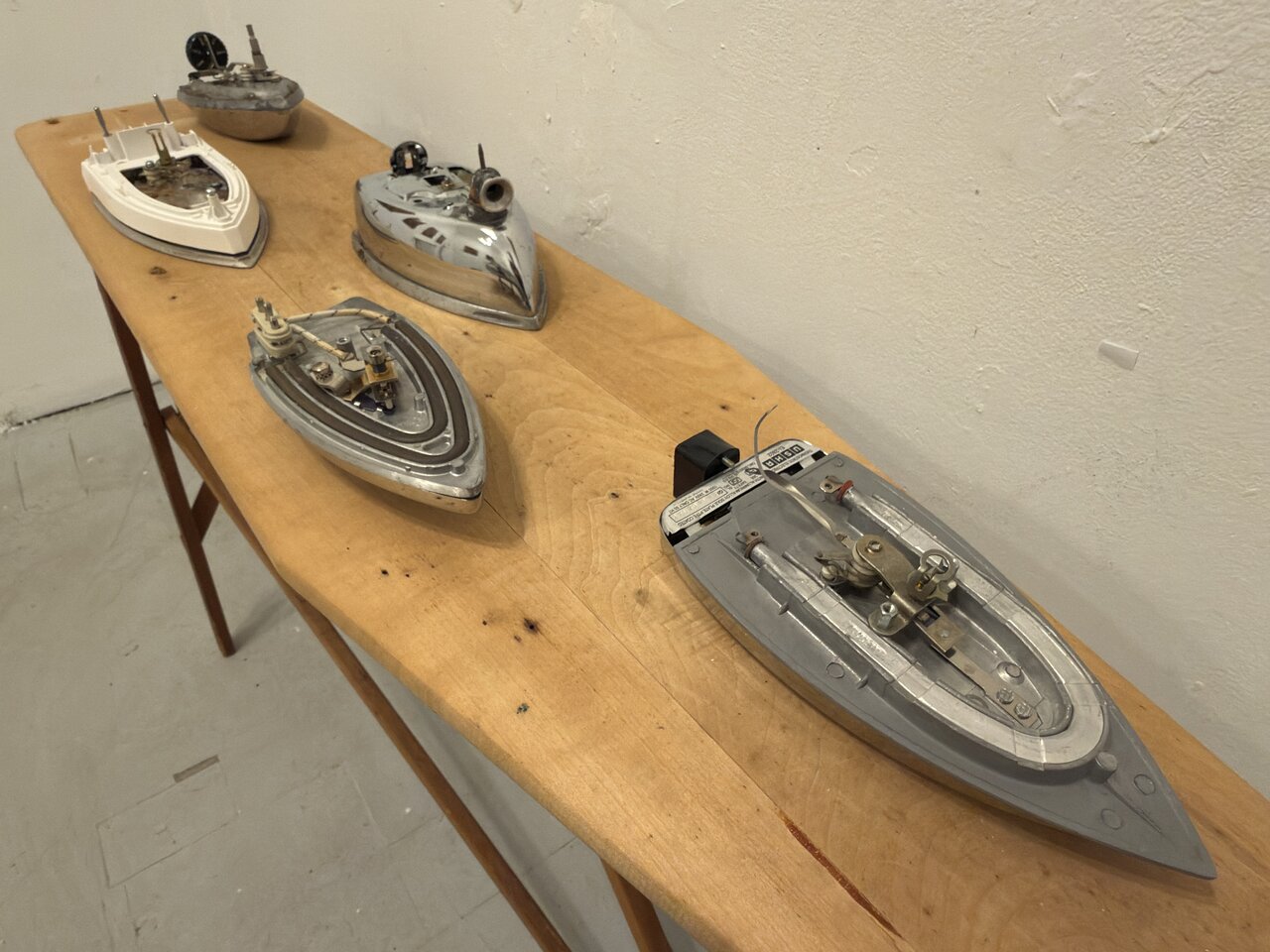
Installation view with Viz Saraby’s boats
Saraby points to a parallel between her transformed irons and the boats she photographs in the harbour, namely the shift from work to leisure. Historically boats have been working vessels, transporting goods in particular. Now, in Meaford at least, boats are primarily leisure vehicles, things for recreation. Likewise, her irons, once dismantled and reassembled, become playful objects. In addition, I detect a nostalgia to the work, pointing to a way of life lost to time. These works have a quiet beauty to them.
Hugh Alcock
Images are courtesy of the artist.
*Exhibition information: Miho Sawada, Exhibition of Works and Viz Saraby, Ship Happens, November 26 – December 7, 2025, Gallery 1313, 1313 Queen St West, Toronto. Gallery hours: Wednesday – Saturday, 1 – 5 pm, Sunday 1 – 4 pm.