
The Blouin Division Gallery is like the tardis, Doctor Who’s spacebending time travelling machine. On the outside it is a nondescript modest industrial building. Inside the visitor is surprised by a collection of high-ceiling rooms. Almost anything would look good on these pristine white walls. I can imagine a banal everyday object from around the house, e.g., my tattered thesaurus, artfully displayed on the wall. How handsome and precious it would appear, – uncluttered and effulgent under the soft spotlights. This is one’s experience in any high-end gallery of course. But it reminds me how manipulated our experience of looking at artwork is in such an environment.

Installation view of Simon Hughes, The Fire, The Flood and All the Feelings, 2025 at Blouin Division Gallery
Currently on display are the paintings of Simon Hughes, a resident of Winnipeg, where he was born, and who has been trained at the University of Manitoba and the University of California, Irvine. He presents twelve large watercolour paintings, with elements of collage, on paper, eight of which comprise panels of two works, that are referred to as quadraptychs (or tetraptychs). These are on the theme of environmental disaster, – titled Flood Plain and Evacuation. The remaining four paintings, collectively titled Suburban Thought-Forms, are inspired rather by theosophy (a spiritual movement dating back to the fin de siècle period).
The two tetraptychs are each, according to the press release, ‘a statement on the environmental chaos, both terrible and beautiful, that is western North America’ – this being the region of the world where Hughes has lived and worked. I must admit that looking at these works, neither communicates a sense of terror in particular.
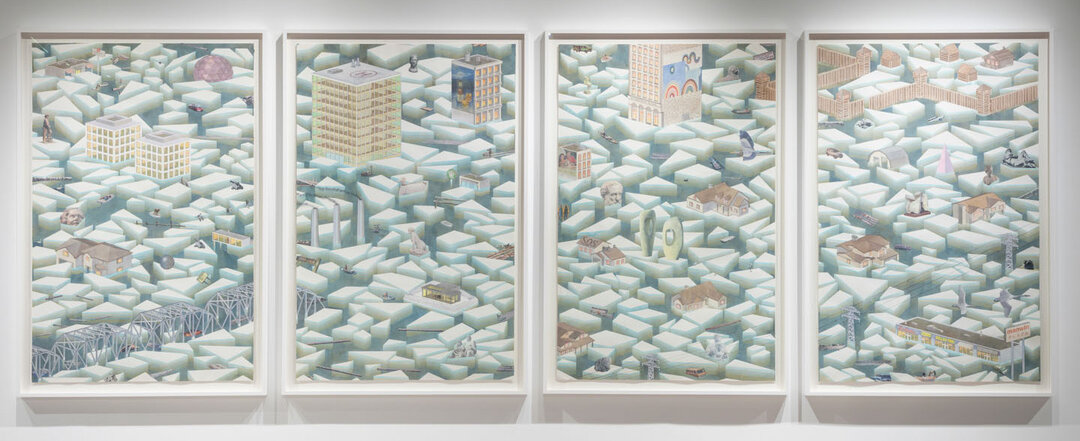
Simon Hughes, Flood Plain 1-4, 2024, watercolor, graphite and collage on paper, 65 x 168 inches
In the case of Flood Plain, for instance, one observes a legoland-like landscape in isometric perspective, where everything on the picture plane is at the same scale, creating a sense of naivety. Granted the picture shows a devastated urban landscape that includes various Ozymandias-like elements, – fragments of statues that suggest the collapse of a civilization. But above all I was entertained by the picture. Its beautiful design and palette are simply delightful.
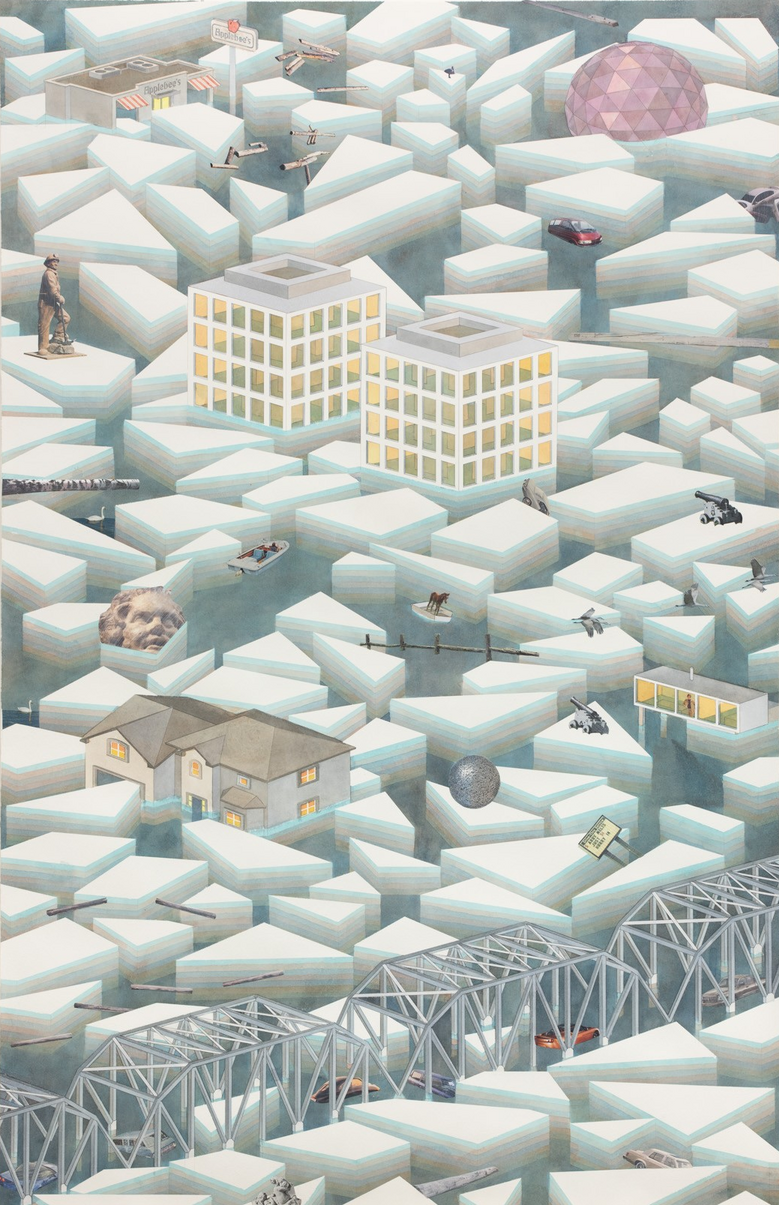
Simon Hughes, Flood Plain #1, 2024, watercolor, graphite and collage on paper, 65 x 42 inches
Of course, there is an undeniable beauty often to be found in environmentally ruined landscapes, that these two works perhaps allude to. Edward Burtynsky’s photographs are testament to this fact, for instance. Hughes’ second tetraptych, Evacuation, is on the surface more violent. He depicts the scene of an inferno on the edge of town in pumpkin orange, and with layers of buildings and hills rendered in two-dimensions. But this treatment is so comic book that its difficult to see past the picture. Here, I think, Hughes betrays an aesthetic that is commonplace among artists today, namely, the depiction of a simulacrum of nature rather than nature itself. It is as if what he intends to paint is not the world, i.e., that which we experience directly, but a screen-image whose content alludes to the world. More precisely, the mediated world of the screen has become so ubiquitous that many experience it as the world period. And this tendency has infected art.
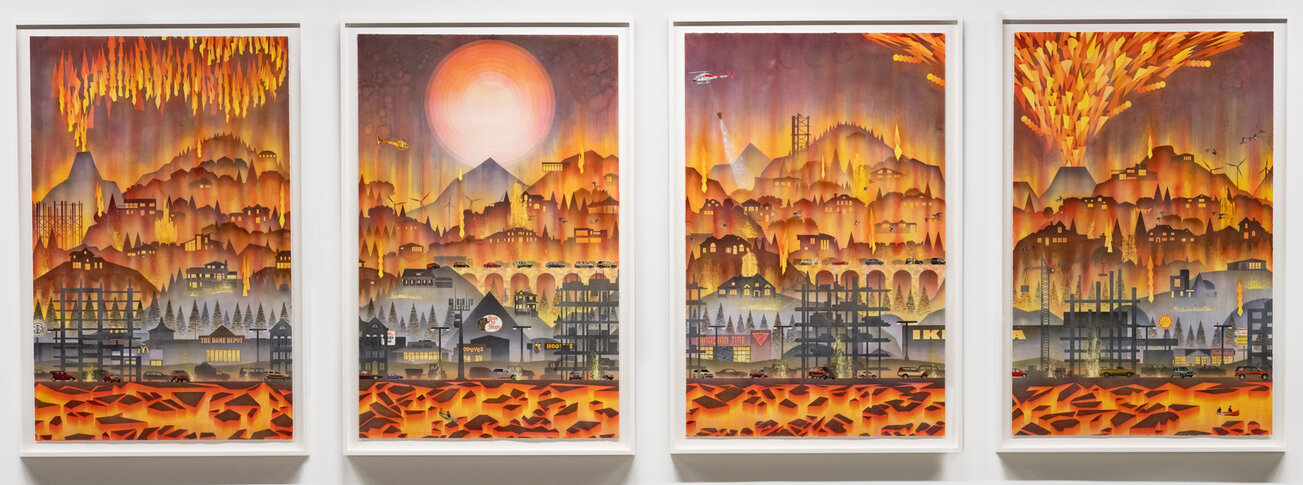
Simon Hughes, Evacuation 1-4, 2024, watercolour and mixed media on paper, 65 x 168 inches
But it would be unfair to judge Hughes’ work simply in terms of his putative intentions. In and of themselves these are beautiful paintings. All told his Flood Plain displays a mastery of colour and composition, and a refreshing playfulness. In purely aesthetic terms my favourite in the show is Suburban Thought-Forms. The original idea for these paintings Hughes took from a book titled Thought-Forms: A Clairvoyant Investigation (1905), by theosophists Charles Leadbeater and Annie Besant.

Simon Hughes, Suburban Thought-Form 1-4, each 2024, watercolor and collage on paper, 55 x 35 inches
Indeed, Hughes’ paintings are very similar to some of the illustrations in the book, e.g., Suburban Thought-Form #4 is remarkably like one illustration titled The Music of Gounod – A thought-Form (p. 80), showing a church spewing out, like a volcano, a cloud-like flourish of colourful shapes. According to theosophy, thoughts, as entities on a mental plane, have underlying shapes and colours, but these are only apprehensible by the properly trained clairvoyant. They are invisible to mere ‘muggles’ like us, so to speak.
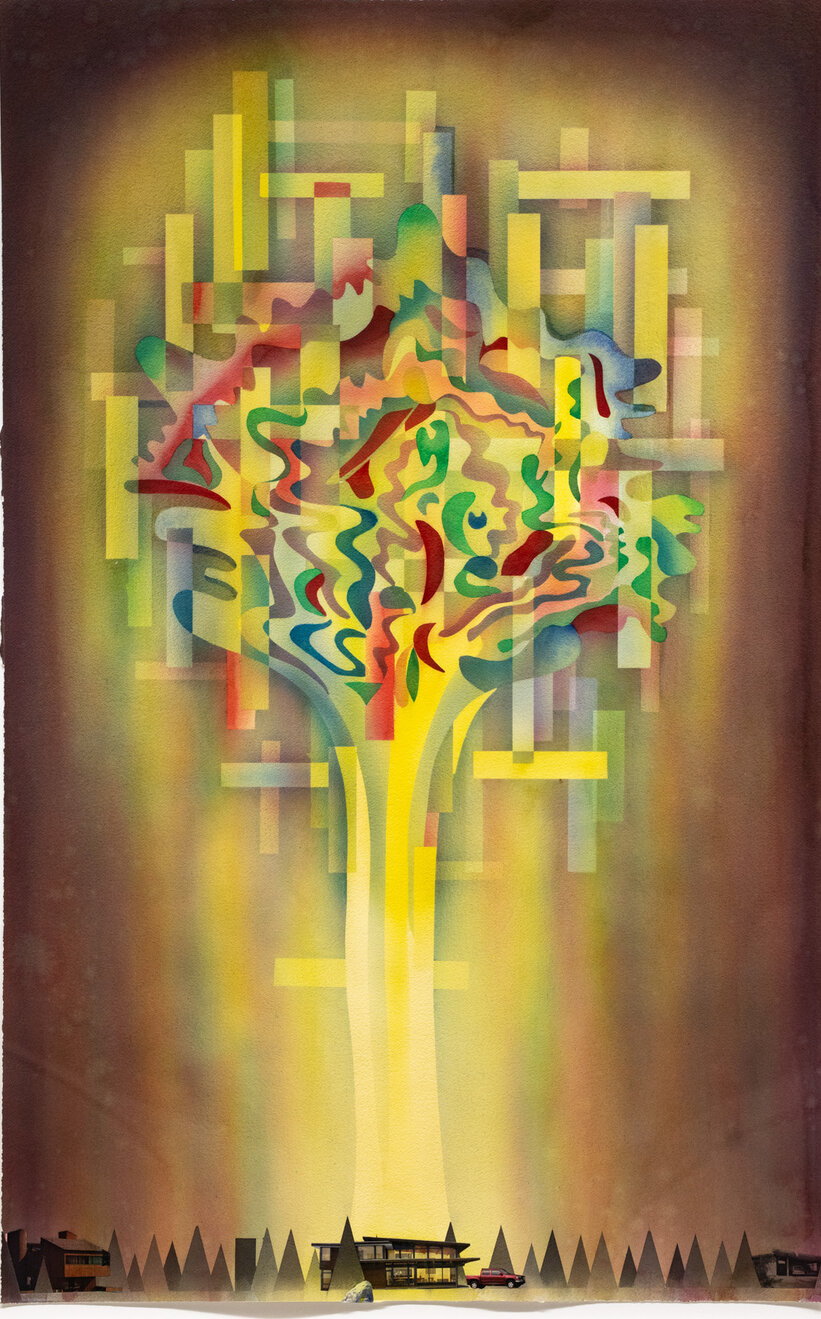
Simon Hughes, Suburban Thought-Form #4, 2024, watercolor and collage on paper, 55 x 35 inches
This notion of clairvoyance was central to Paul Klee’s work – an artist who has influenced Hughes. Klee once remarked: ‘Art does not reproduce the visible, it makes visible’. In other words, he saw the role of the artist as someone who makes visible an underlying reality, as opposed to mere appearance. It seems that these four watercolours by Hughes attempt to do just that. Like Klee, Hughes has developed a geometry of form and colour which he uses to express, i.e., make visible, the poetic, or spiritual if you prefer.
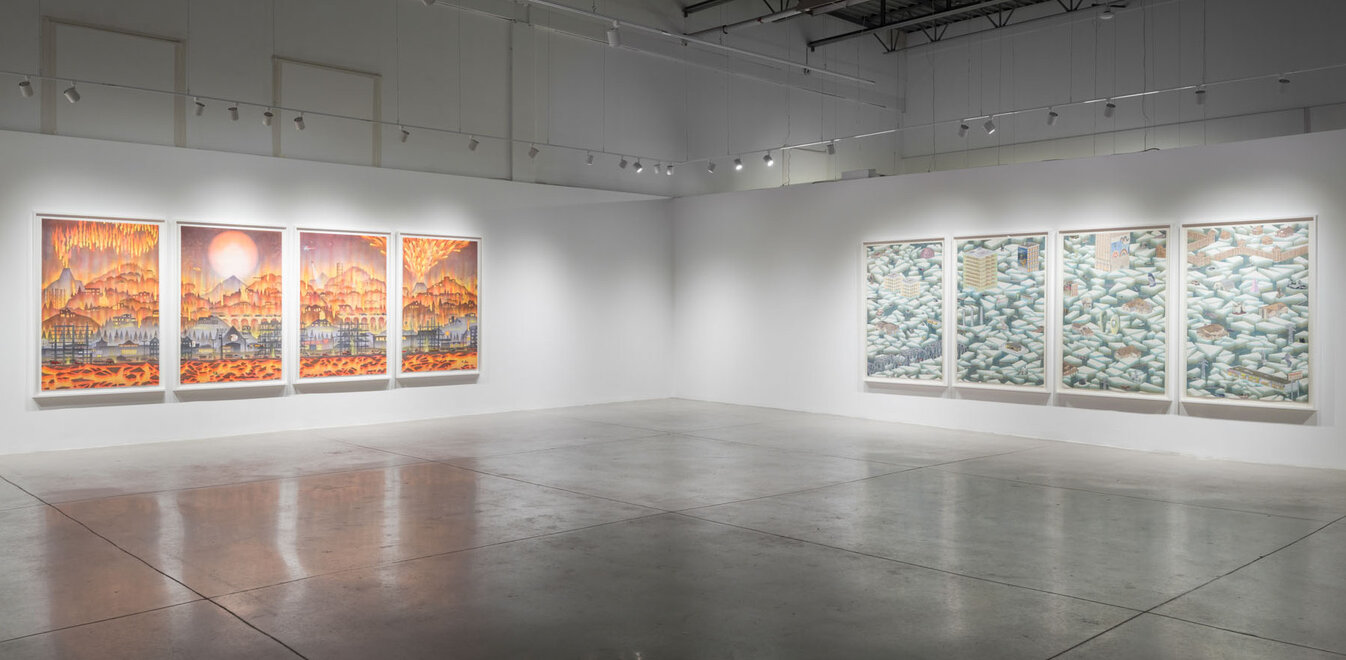
Installation view of Simon Hughes, The Fire, The Flood and All the Feelings, 2025 at Blouin Division Gallery
As I noted at the beginning, a gallery setting like that of Blouin Division is manipulative. It is designed to entice someone to buy the work. That is a truism, but worth reiterating. It works by creating a sense of exclusivity vis-à-vis the work on display, and hence making it more desirable. The perceived exclusivity, – specialness, – of the work seduces the viewer to see it as intrinsically virtuous in artistic terms, namely, that quality, whatever it is, that Klee’s work often has, – call it poetic. But these two things are not the same. And the confounding of exclusivity with the poetic vexes the artist as well as the viewer like myself. Is Hughes making a luxury good, something that in the end is just slick and alluring? Or is he, as I hope and suspect, making art that is of intrinsic worth. The question, I fear, is unanswerable, – that it makes no sense in today’s art market.
Hugh Alcock
Images are courtesy of Blouin Division Gallery.
*Exhibition information: Simon Hughes, The Fire, the Flood and All the Feelings, September 11 – October 18, 2025, Blouin Division Gallery, 45 Ernest Ave, Toronto. Gallery hours: Wed – Sat 11am – 6pm.