
Liminal Spaces at Ignite Gallery brings together Callum Donovan-Grujicich, Firouzeh Saremi Far, Ro Dalzell, and Wang Zi, four emerging artists whose works resonate through themes of alienation, fragility, and identity. Ro Dalzell’s In Between Skins (2024) immediately set the tone: a torn silicone surface marked like tiled walls, suggesting both the vulnerability and resilience of the body. Installed nearby, Wang Zi’s Inside Travel Land (2024) and Cancanvan (2025) added their own dialogue on migration and belonging—two works that bridge the deeply personal with the profoundly communal.
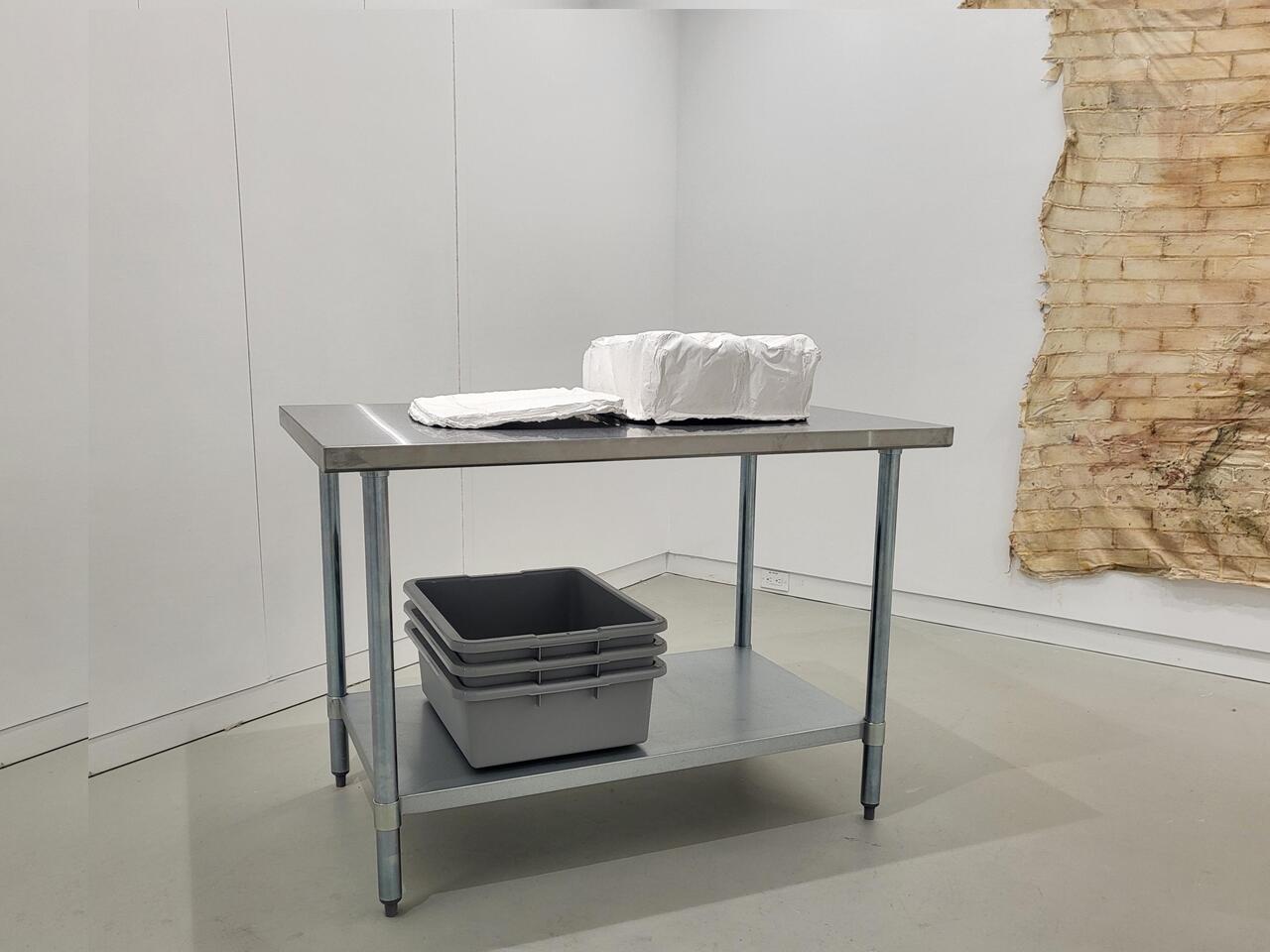
Installation view with Wang Zi: Inside Travel Land, 2024 (center) and Ro Dalzell: In Between Skins 2024 (right)
Inside Travel Land presents a cold, steel airport security table with stacked plastic trays beneath and, on top, a plaster cast of the hollow interior of a suitcase. At first glance, it reads like an ordinary border checkpoint. But as Wang explained, the quick decisions made at these tables—what to keep, what to discard—can be laden with memory and loss. She recalled her sadness at surrendering a pair of childhood scissors to security. The plaster cast, fragile yet firm, embodies this paradox: absence as presence, and vulnerability as strength.
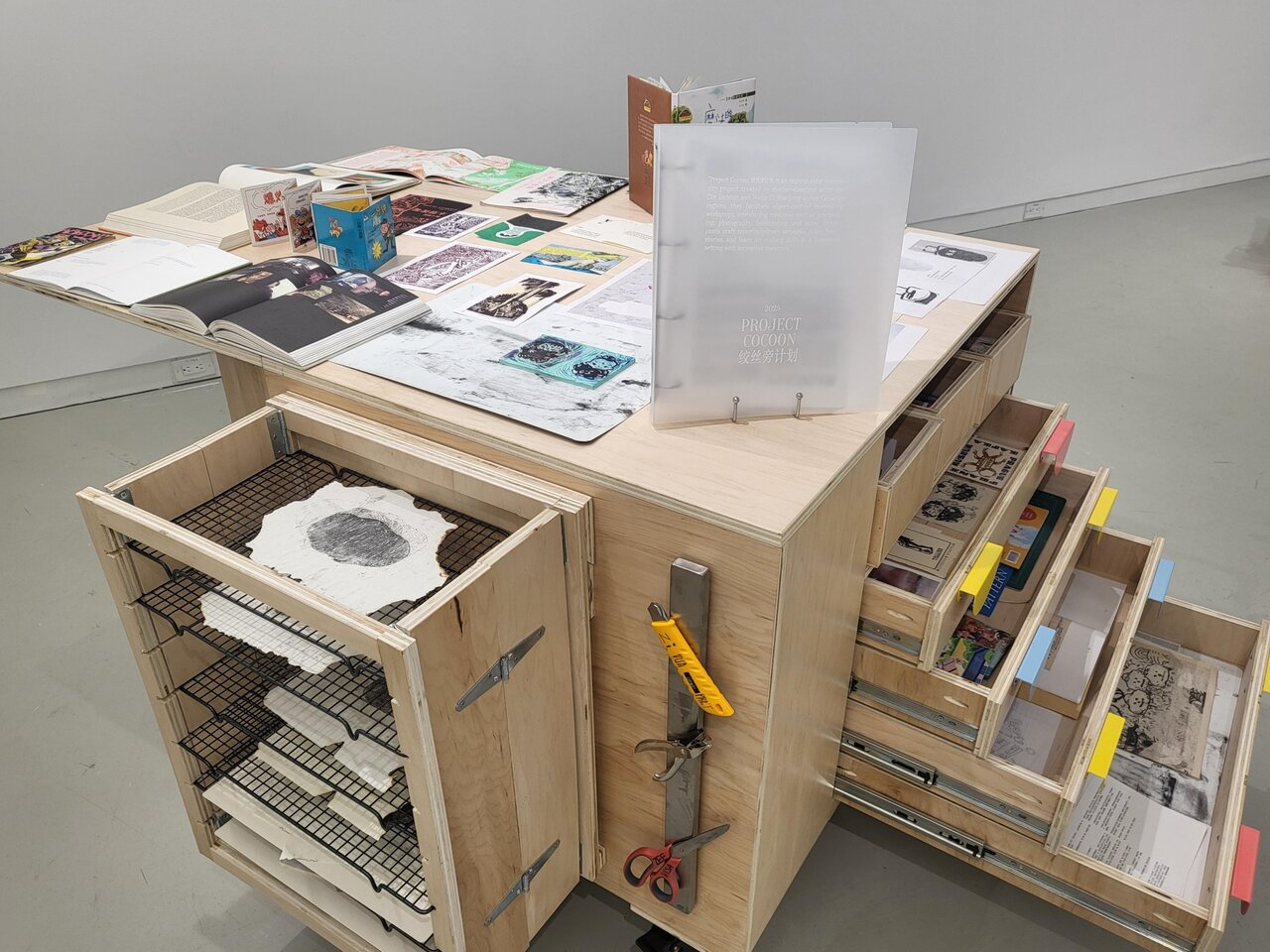
Wang Zi, Cancanvan, 2025
If Inside Travel Land holds the weight of individual migration stories, Cancanvan turns outward to collective practice. Designed as a mobile workshop cart built from Canadian maple and metal, it folds and unfolds with ingenuity: drawers for stools, a pegboard for tools, a collapsible drying rack, and a surface that doubles in size to display artist publications. Compact enough to pass through most doors and vans, it functions both as a portable print studio and as a traveling gallery.
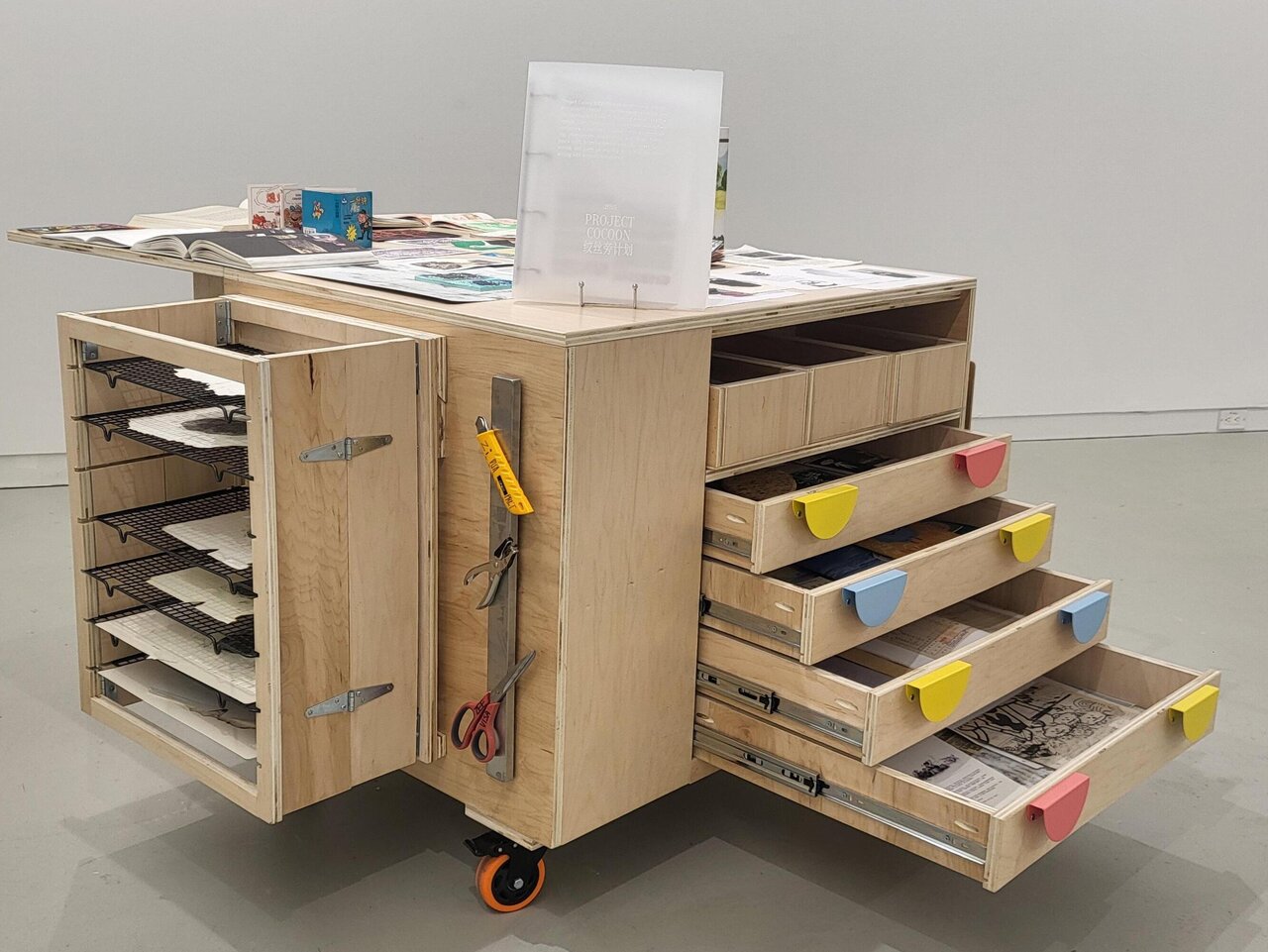
Wang Zi, Cancanvan, 2025
The cart grew out of Wang’s years of leading zine and printmaking workshops, and it carries the imprint of those encounters. On display were publications from her community projects, including an artist-in-residence initiative at the Richmond Hill Public Library, collaborations with her mother, artist Dandan Zhu, and her own artist book collection. The range from zines and illustrated books to more experimental formats underscored the accessibility and diversity of print culture.
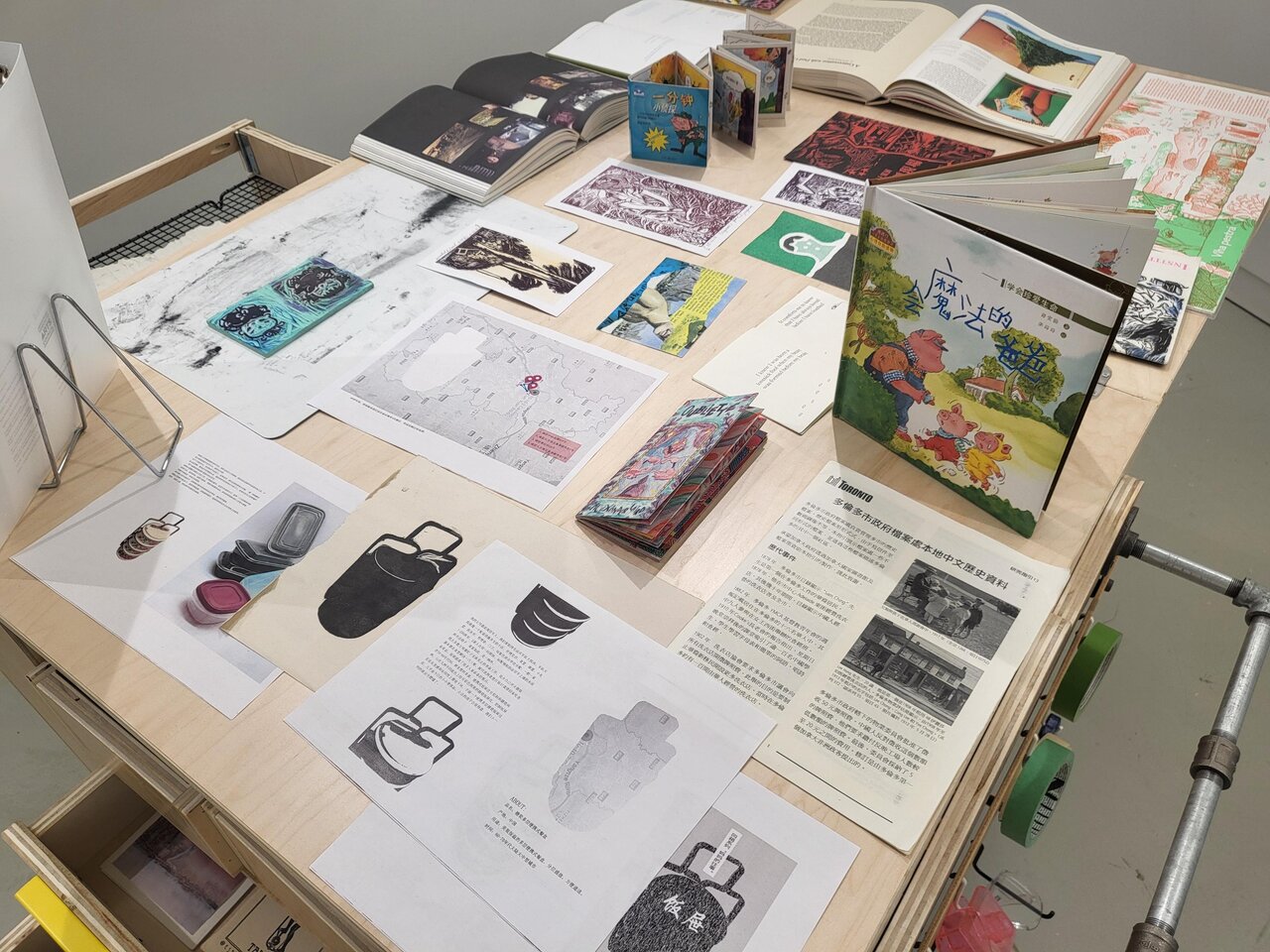
Wang Zi, Cancanvan, 2025, installation detail
Wang shared stories of workshop participants: newcomers mapping their migration routes on Google Maps, or professionals from non-art fields who discovered a new passion for creativity. One participant even continued to explore dancing as a form of self-expression after finding joy in making. These workshops often extended beyond the studio, sparking friendships and self-organized communities.
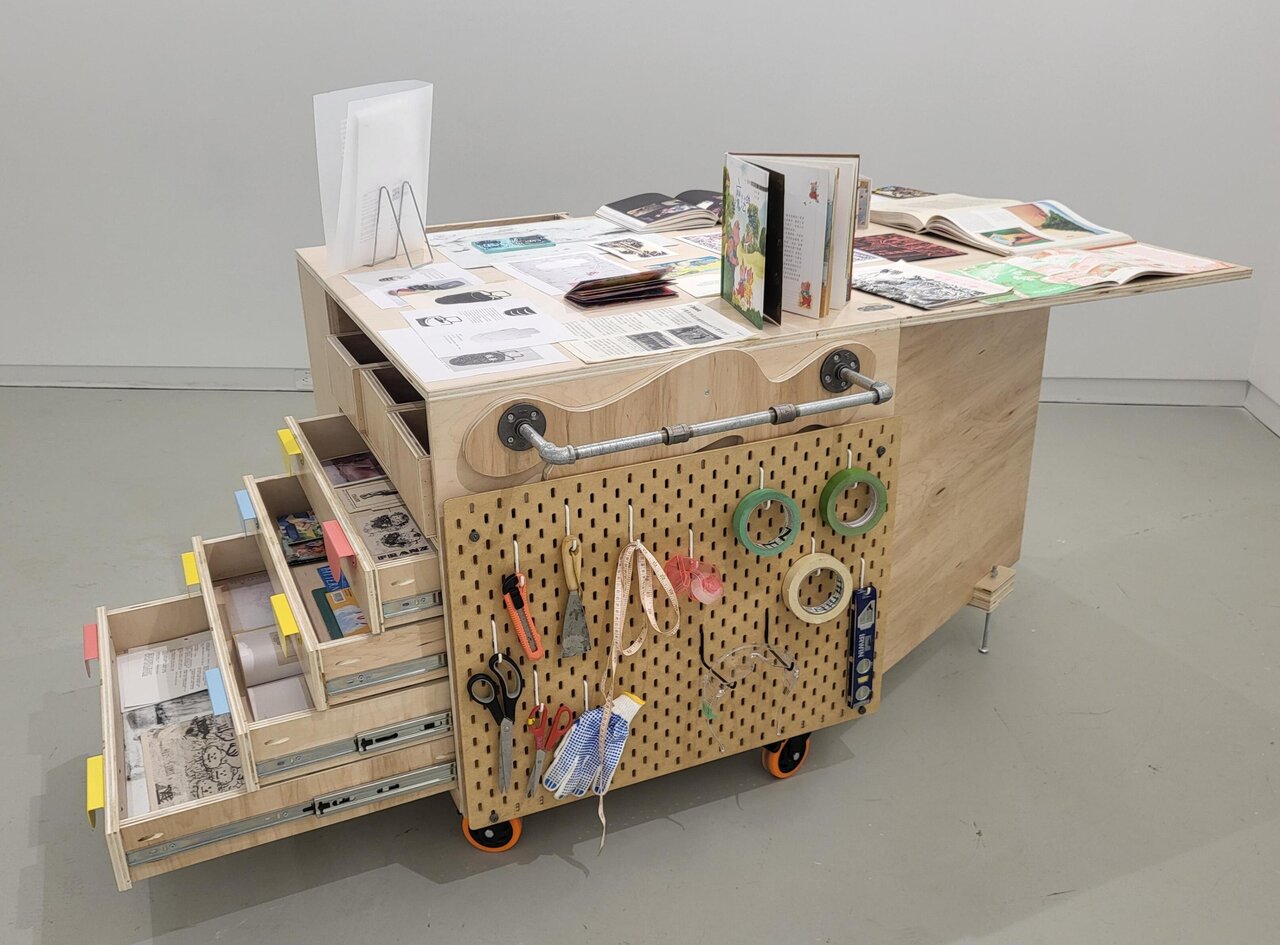
Wang Zi, Cancanvan, 2025
Through projects like Inside Travel Land and Cancanvan, Wang and Zhu weave their own diasporic experiences into larger networks of collective storytelling. Their recent collaboration, Project Cocoon, similarly archives migration narratives while fostering space for others to share their own. In this way, Cancanvan is more than an object—it materializes the often-temporary bonds created in community art, carrying them forward in tangible form.
In a world that moves too quickly for many stories to be told, Wang’s practice insists on slowing down, gathering, and remembering. Her works at Liminal Spaces reveal how the intimate can become collective, and how community-based art sustains the fragile yet enduring act of storytelling.
Text and photo: Sherry Chunqing Liu
*Exhibition information: Liminal Spaces / Group show, September 3 – 27, 2025, Ignite Gallery at OCAD University, 100 Mccaul Street, Toronto. Gallery hours: Monday – Saturday 8:30am – 7pm.