
How do artists use visual language to explore their understanding of symbols? Echo Without Origin invites us to reflect on this question by creating space for slowness, contemplation, and openness. In a world saturated with images and messages, where meaning is often handed to us already defined, this exhibition offers something different. It encourages a more intuitive way of looking, where meaning isn’t fixed, but fluid.
Rooted in the concept of the “floating signifier”—a semiotic term describing symbols whose meanings shift depending on context—the works in this exhibition ask viewers to pause. The artists peel back layers of memory, history, and form not to deliver a singular answer, but to invite interpretation. In this way, they craft a new type of viewing experience—one that is intimate, personal, and intentionally unresolved. Spending time with these works reveals how meaningful the act of looking can be. Sitting with ambiguity, questioning your assumptions, and engaging with the intentions behind an artist’s gestures becomes a special kind of interaction—one that values presence over resolution. The artists remind us how precious it is to slow down and invest time in art, and in doing so, in ourselves.
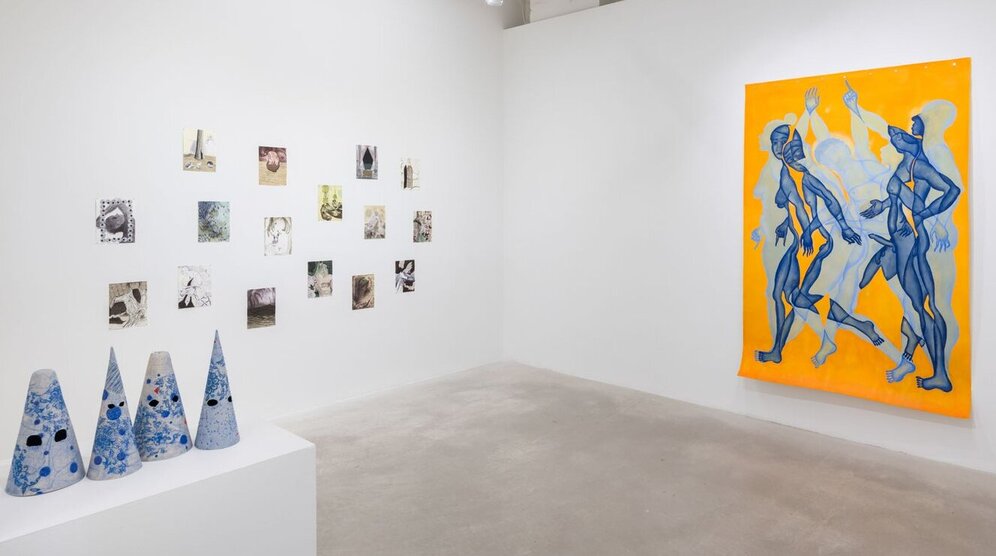
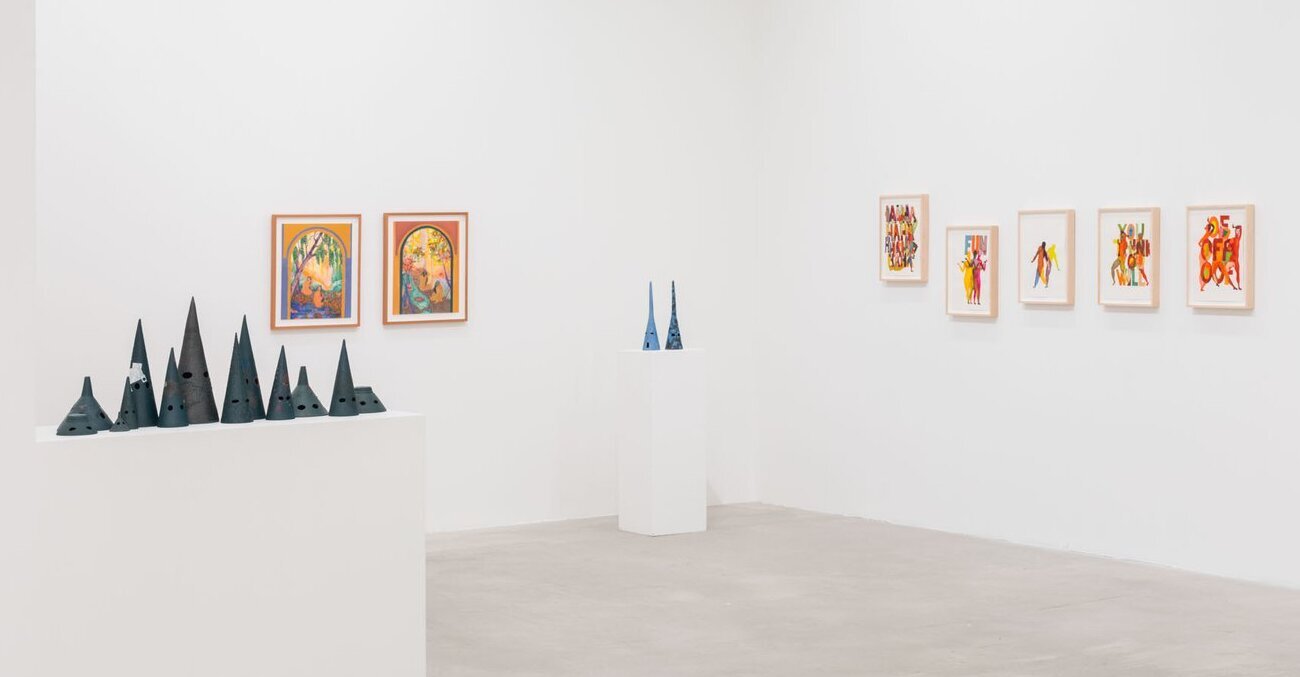
Installation view of Echo Without Origin at Patel Brown. Courtesy of Patel Brown
The individualized experience of art allows for a multitude of interpretations, pushing boundaries and encouraging viewers to see beyond a single idea or meaning. Throughout the exhibition, artists explore the tension between representation and abstraction, familiarity and mystery. Works by Winnie Truong and Balint Zsako focus on the human figure, but these figures often feel untethered, placed in ambiguous spaces, or fragmented across the surface.
Zsako’s bodies stretch and bend, frequently interacting with strange objects or symbols, giving the sense that they are caught in transition—between thought and action, past and future. Known for his intricate depictions of human figures engaged in ambiguous interactions, Zsako emphasizes the complexities of the human form. His playful approach invites viewers into a dialogue where meaning isn’t fixed, but open to interpretation.
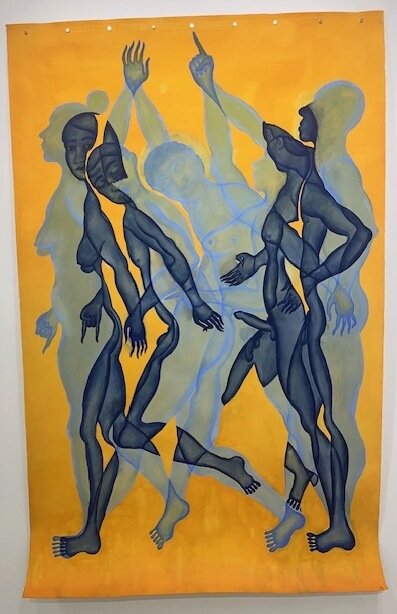
Balint Zsako, Untitled (Physical Comedy) 01, 2025, watercolour, gouache on paper, 90 x 60 inches. Photo: Abuk Lual
Truong and Zsako’s works are visually rich and intricately detailed, suggesting a powerful interplay between the body and surreal elements such as flowing strands of hair or vines. These forms partially obscure the figures, creating a sense of both intimacy and entrapment. These spiraling shapes highlight motion and fluidity, shifting focus away from fixed identities and origins and towards the constantly evolving nature of the body and self. Truong’s delicate pencil drawings and collaged hair forms create a surreal softness that blends identity with fantasy. Her figures seem to dissolve into dreamlike states, inviting viewers to reflect on the fluidity of identity.
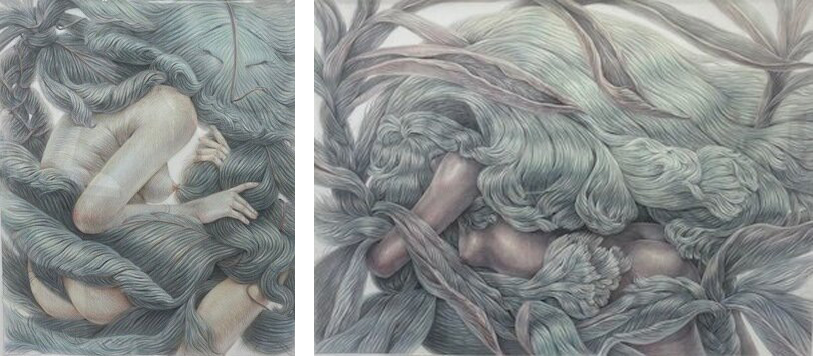
Winnie Truong, Basilisk with Tits, 2016 (left), coloured pencil on paper, 24 x 20 inches and Hermit of the Hollow, 2016 (right), coloured pencil on paper, 41.5 x 59 inches. Photo: Abuk Lual
In contrast, Mia Sandhu, Alberto Porro, and Tuan Vu present figures that feel more grounded within their environments yet still invite viewers into worlds of layered meaning. Sandhu’s works blend pattern, architecture, and the female form to create dreamlike domestic spaces that reflect on womanhood, privacy, and cultural identity. These intimate yet surreal environments offer a reflective space where personal and collective narratives intertwine.
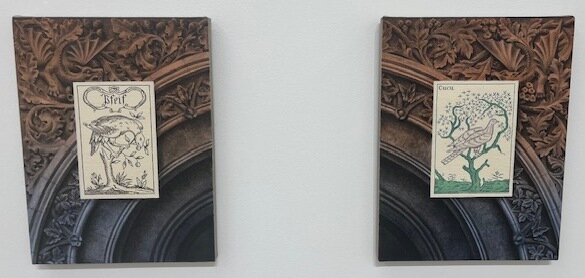
Alberto Porro, Pfeif, 2025 (left), Cucu, 2025 (right), both oil on linen, mounted on panel, 16 x 12 inches. Photo: Abuk Lual
Porro’s paintings reinterpret regional playing cards, transforming cultural symbols through a deeply personal lens. His work challenges viewers to reconsider preconceived notions and invites them to find meaning in the dynamic interplay of form, color, and symbolism. By blending abstract elements with cultural motifs, Porro creates a visual language that is both personal and universal, encouraging deeper engagement with the layers of meaning in his work.
Vu’s vibrant, color-rich scenes draw from both Eastern and Western art traditions, constructing mystical, tropical worlds where women and landscapes blend in quiet harmony. Though rooted in his early memories of Vietnam, Vu’s paintings are not direct representations. Instead, they weave together imagination and recollection to create dreamlike scenes where bathers seem suspended in time and place. These figures inhabit tropical landscapes that feel both familiar and surreal, evoking a sense of longing without pointing to a singular story or origin. Through his work, Vu taps into collective memory and personal history, creating a space for reflection and interpretation.
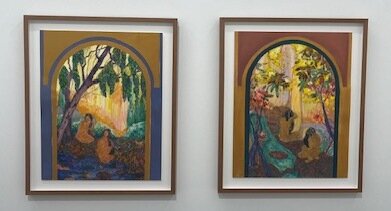
Tuan Vu, The Two Bathers, 2025 (left) and Bathers By the Falls, 2025 (right), both watercolour and oil on paper, 20 x 16 inches. Photo: Abuk Lual
Other artists in the exhibition explore symbolism through objects and decoration using material to carry cultural and emotional significance. Tammie Rubin’s ceramic sculptures function as cultural relics – beautiful, coded and full of implied memory. Rubin’s Always & Forever (forever, ever) No.19 (2024) crafted from pigmented porcelain with underglaze continues this exploration. Measuring 15 x 8 x 4 inches the piece transforms the ordinary into extraordinary prompting reflection on the interconnectedness on personal and collective histories, with ceramics serving as vessels of memory and identity.
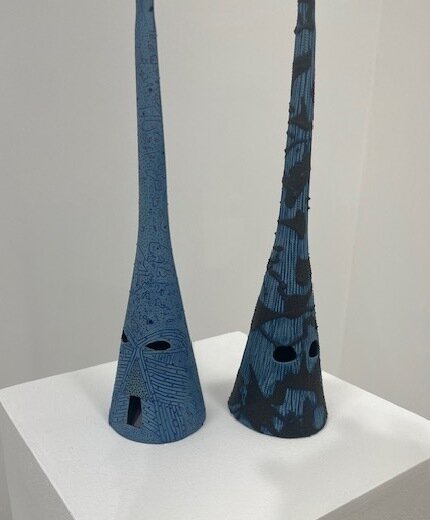
Tammie Rubin, Always & Forever (forever, ever) No.19 2024, pigmented porcelain, underglaze, 15 x 8 x 4 inches. Photo: Abuk Lual
Meanwhile, Luke Painter and Ron Siu collaborate to create theatrical, highly stylized scenes that mix queer fantasy, historical references, and ornamentation. Their work is layered and lush, resisting any singular interpretation. The symbols they use pull viewers into a visual world that feels both familiar and strange, inviting rich, complex engagement with the pieces.
Installation view of Echo Without Origin at Patel Brown. Courtesy of Patel Brown
What connects these practices is a shared openness—none of the artists present their works as fixed or final. Instead, each invites viewers to actively participate in discovering the meaning. There is no clear, linear path through the exhibition. Viewers are asked to pay attention to how things shift: how a symbol might take on new resonance in a different context, how a body in space can speak to presence, absence, or transformation, and how patterns, colors, and forms can carry emotional weight, even when we can’t immediately name why. Echo Without Origin is not an exhibition that demands resolution. Instead, it offers an alternative reality to the pressure to know, define, or explain. It reminds us that symbols are alive— they move, stretch, and take on new meanings depending on who engages with them. In a fast-moving world that often reduces images to soundbites or content, this show invites us to be still, to look again, and to allow ourselves to not fully understand.
Abuk Lual
*Exhibition information: Echo Without Origin / Group show. March 21 – May 10, 2025, Patel Brown, 21 Wade Ave, #2, Toronto. Gallery hours: Tue – Sat, 10 am – 6 pm.