
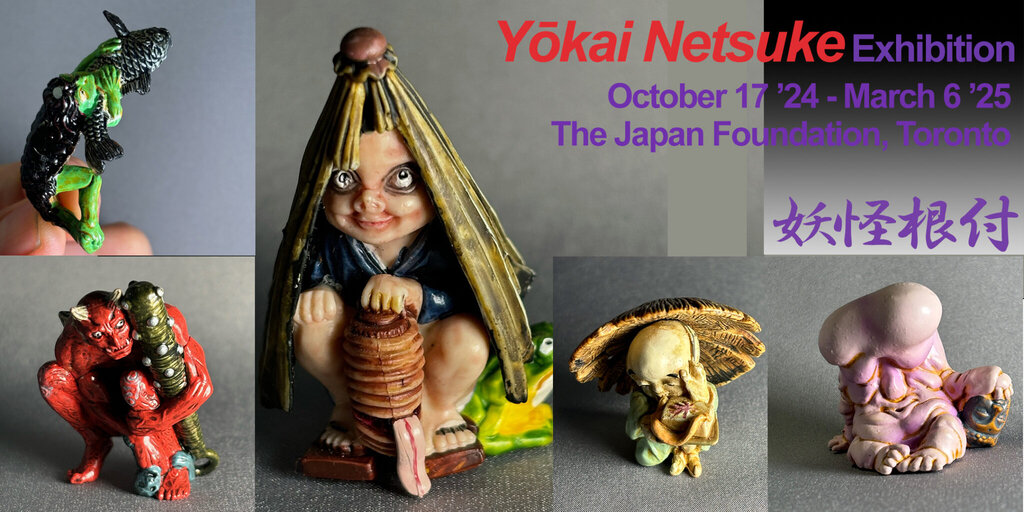
The poster of the exhibition
Down a narrow hallway, The Japan Foundation transports viewers to the realm of yōkai, displaying various species in the form of figures, flattened onto t-shirts and prints, and made into tokens and commodities. Yōkai, the Japanese word for demons, monsters, spirits, imaginative animals, and other-worldly creatures, stems from Japanese folklore and is often seen across anime, manga, books, and movies. Netsuke, the Japanese word for miniature sculpted figures or the personal items hung on an obi sash using toggles, is the medium that the exhibition focuses on. Illustrations and prints are shown alongside these figures, as variations in the interpretation of each species, unique to the individual artist creating them. This exhibit focuses on Kaiyōdō Co. Ltd.’s perception of yōkai.
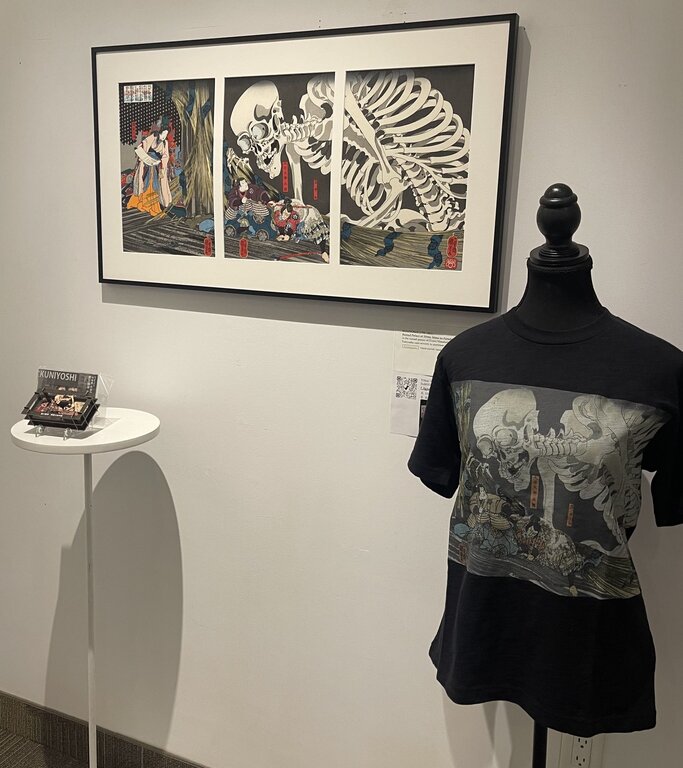
Kuniyoshi (1798-1861), Ruined Palace of Sōma, Sōma no Furudairi, hand-carved, hand-printed, contemporary reproduction and T shirt
Taken from the pages of the pictorial book series “Hyakkiyagyō (Demon Horde’s Night Parade)” published from 1776 to 1784, these characters are brought to life in three different styles: multi-colored, red-lacquer, and jade. These imaginative creatures, inspired by human activities and emotions, come from a world reflective of the one we live in, each with its counterpart in yōkai. For example, the “tofu boy” is a specie of yōkai that takes on the form of a human with an exceedingly large forehead, dressed in yukata robes, accessorized with a kasa, a Japanese straw hat, holding a piece of tofu. Similarly, the “red bean washer” hunches over a pot of red bean, guarding it with its boney elongated limbs, staring directly at the viewers with demonic eyes. Terrifying yet cute, the contrast between its miniature size and its grotesque features elicits a certain fascination rather than repulsiveness. With its exaggerated posture and devious smile, these netsukes embody a humorous sensibility that offsets the gruesomeness in their two-dimensional illustrative counterparts.
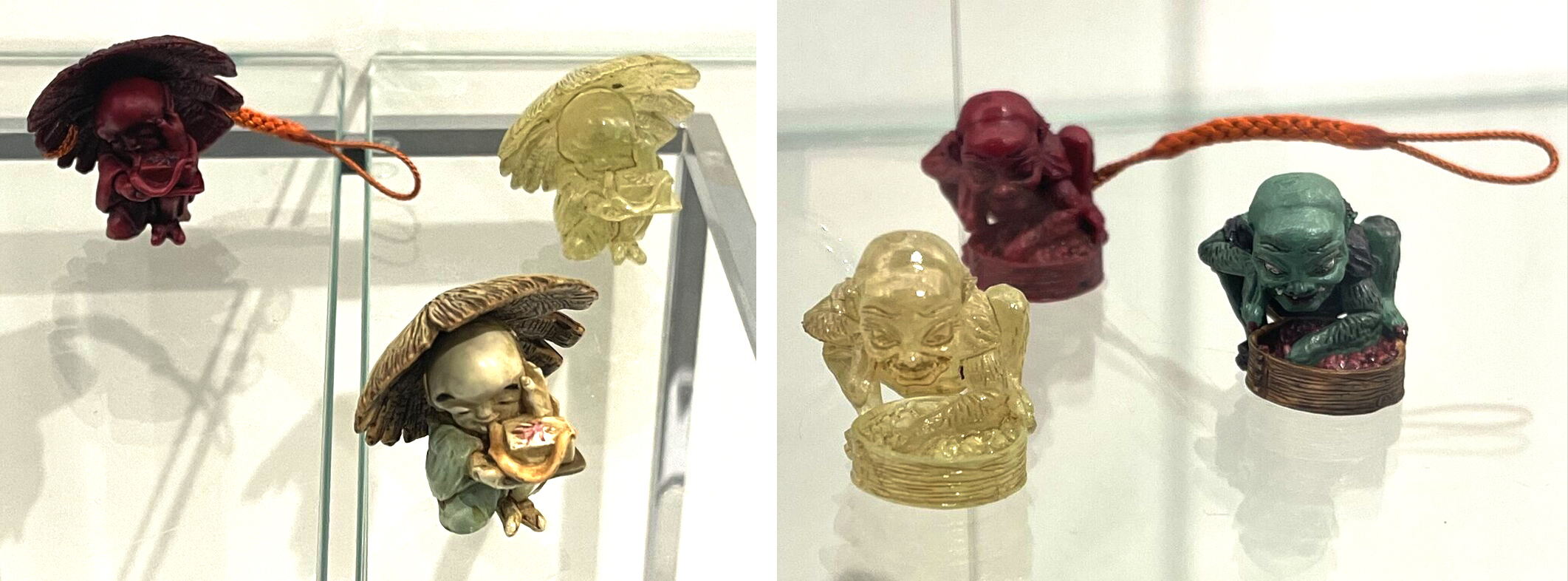
GOTŌ Jun, Tōfu Kozō, Tōfu Boy, multi-colored, red-lacquer, and jade (left) and FUJIOKA Yukio, Azuki Arai, Red Bean Washer, multi-colored, red-lacquer, and jade (right)
Trinkets or “toys” such as these may not be viewed as art, but the inspiration and the production of these works are rooted in artistic practices. In their original form, they are illustrations that demonstrate skill and imagination. Moreover, the change from two-dimensional to three-dimensional space requires craftsmanship and design as they are seen from different perspectives. Catering to the booming commercial culture, the transformation of these characters into commodities or collectibles, namely “gashapons”, which are vending-machine miniature figures, generates value and appreciation by allowing viewers to obtain a piece of the story and lore around these different characters in an enticing and accessible way. Some species are paired with a printed sketch from which these figures are inspired. This allows viewers into the creative process of the transformation of these yōkai species, imbuing them with life as they are molded in three-dimensions.
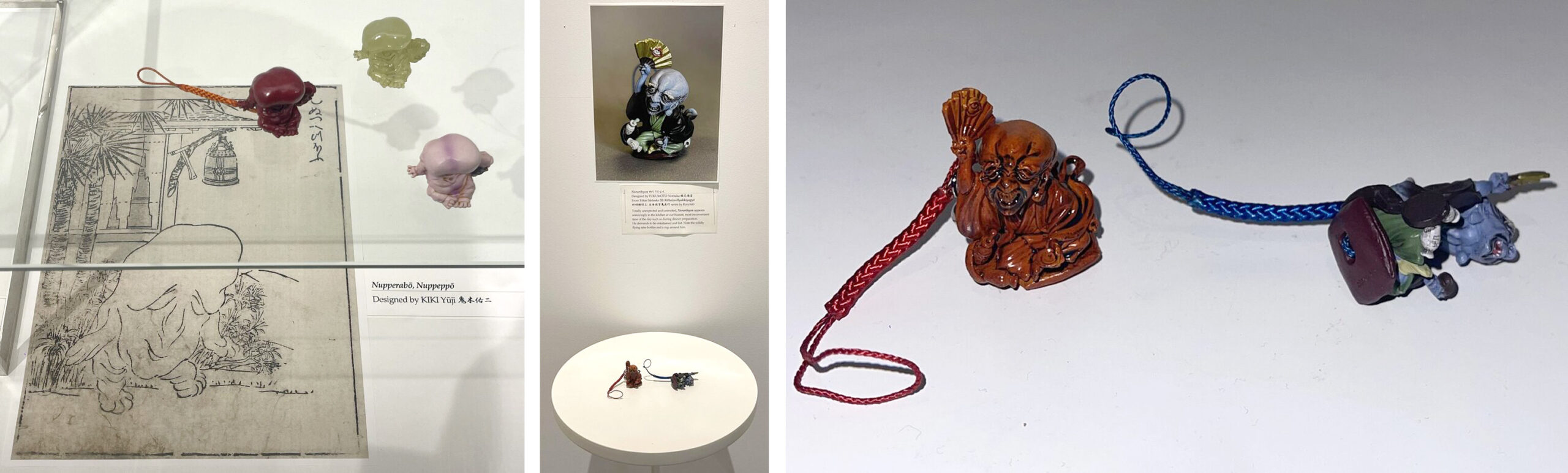
KIKI Yūji, Nupperabō, Nuppeppō, multi-colored, red-lacquer, and jade (left) and FUKUMOTO Noritaka, Nurarihyon, from Yōkai Netsuke III: Rittaizu Hyakkiyagyō, series by Kaiyōdō (middle and right)
Framed ukiyo-e prints by famous Japanese artists such as Hokusai and Hiroshige decorate the walls of the exhibition, offering insight into the creative minds of established woodblock print artists who have similarly made contributions to the world of yōkai. Moreover, it provides context for the stylistic practices distinctive to Japanese artists, separating yōkai from demons or spirits of other cultures. Famous for his ukiyo-e print, “The Great Wave off Kanagawa”, which is a part of his equally well-known “Thirty-Six Views of Mount Fuji” series, Hokusai also produced a series of prints, in his distinctive style, based on traditional ghost stories, known as “Hyakumonogatari.”
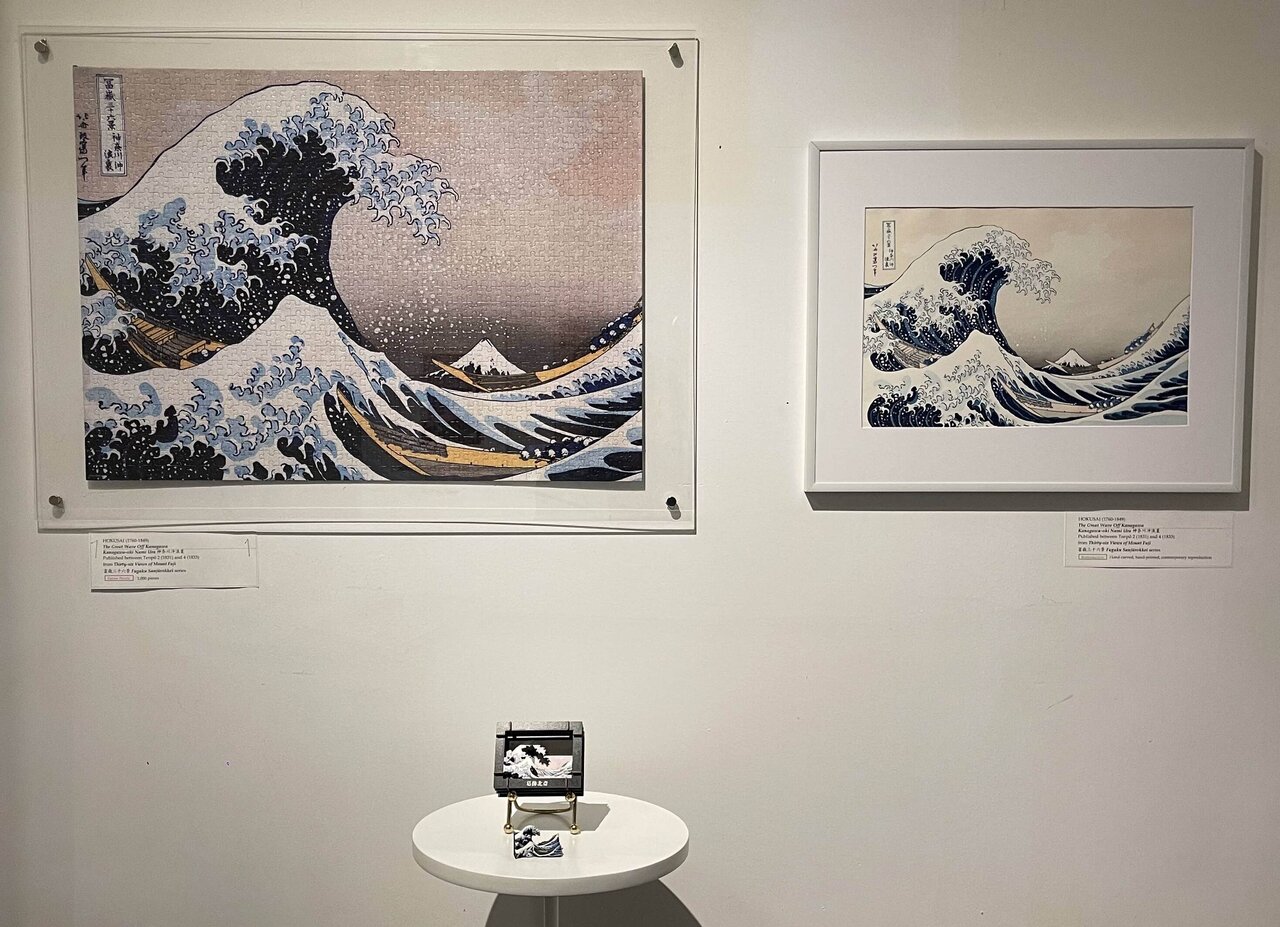
Hokusai (1760-1849), Kanagawa-oki Nami Ura, The Great Wave Off Kanagawa, from Fugaku Sanjūrokkei series, Thirty-six Views of Mount Fuji, hand-carved, hand-printed, contemporary reproduction
Hokusai had particular interest in yōkai who were once human. Each one of his works on display is from the “Hyakumonogatari,” known as “One Hundred Ghost Stories.” “The Ghost of Oiwa, Oiwa-san” was the neglected wife of a samurai. Upon her death, her soul was trapped in a lantern with her face morphing into one with the lantern. Her sorrow is expressed through the redness of her eyes, the result of endless tears. The folds in the lantern emphasize the frown on her face and the wrinkles developed from sleepless nights of worry. Sounds of her wailing can be heard from her gaping mouth.
The intensity of pain and suffering is embodied in the way these ghostly bodies are twisted in inconceivable ways, seeping through the gloomy and horrifying expressions on their faces. Tales of yōkai are deeply ingrained into Japanese culture and imagination, inspiring not only artworks but also acts as reference points to what Japanese culture entails. Images of yōkai are often seen on the walls of Japanese restaurants as well as life-sized sculptures, standing guard outside or netsukes lined up on ledges inside restaurants. This not only signals customers that they have entered a mysterious world of spirits and demons but also a Japanese establishment.
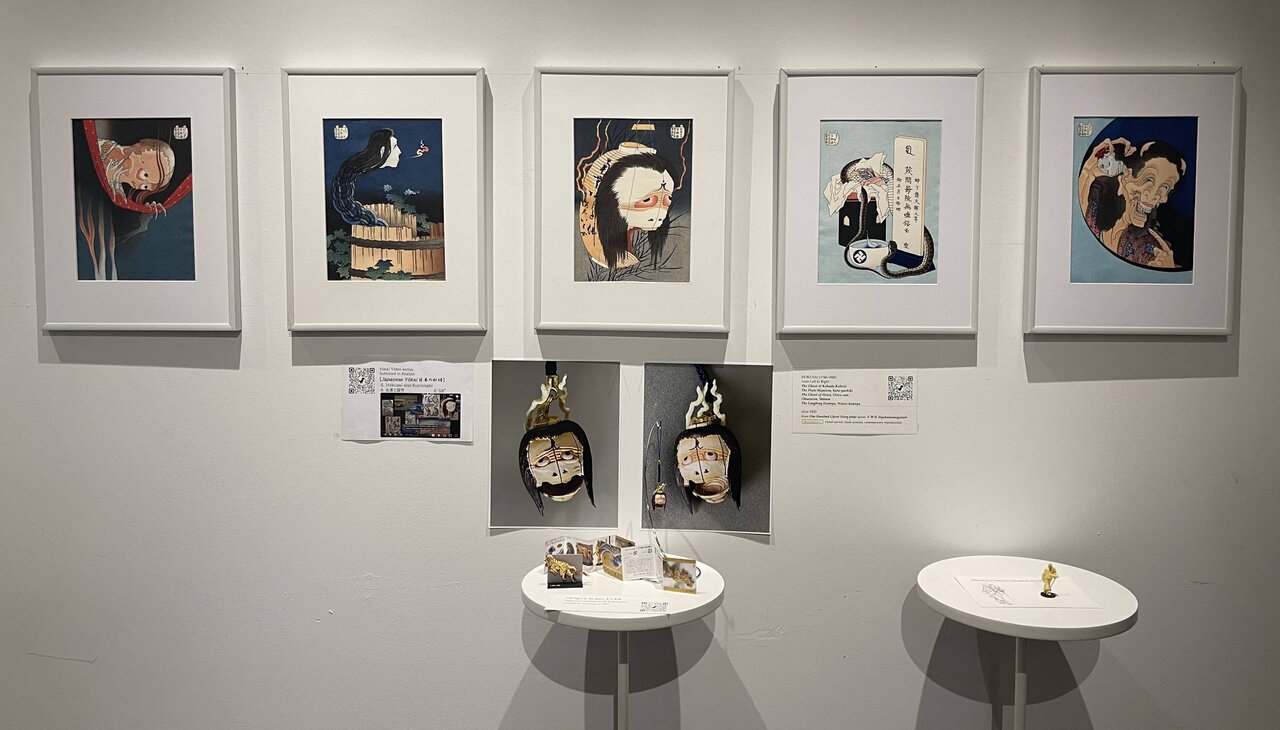
Hokusai (1760-1849), (L-R) The Ghost of Kohada Koheiji, The Plate Mansion, Sara-yashiki, The Ghost of Oiwa, Oiwa-san, Obsession, Shûnen, The Laughing Hannya, Warai-hannya, from Hyakumonogatari, One Hundred Ghost Story print series, hand-carved, hand-printed, contemporary reproduction.
Sherry Qin
*Exhibition information: Yōkai Netsuke Exhibition, October 17, 2024 – March 6, 2025, Japan Foundation, Toronto, 2 Bloor St. East, 3rd Floor. Hours: Tuesday, Friday, Saturday: 11:30 am – 4:30 pm, Thursday: 11:30 am – 6:30 pm.