
Delcy Morelos’ Ombligo doesn’t ask us to rethink our relationship with the natural world as much as it wants us to feel as though nature has given us everything from which we come from. It forces a physical reaction to the smell, texture and size of its form that places us at the mercy of mother nature, whether she is presented as a safe shelter or a trapped web.
Engulfed by the scent of a sharp natural musk, it is almost impossible not to feel transported to a different environment when first approaching this threatening presence that dominates the entire second floor of the gallery space. It initially feels invasive, curving to the forms of the concrete pillars and surrounding them as part of a larger circular structure. Its material seems untouched as if an exterior force of nature has accessed the space and invaded it over the course of several hundred years, molding to its architecture and slowly encroaching on every corner of its open space.
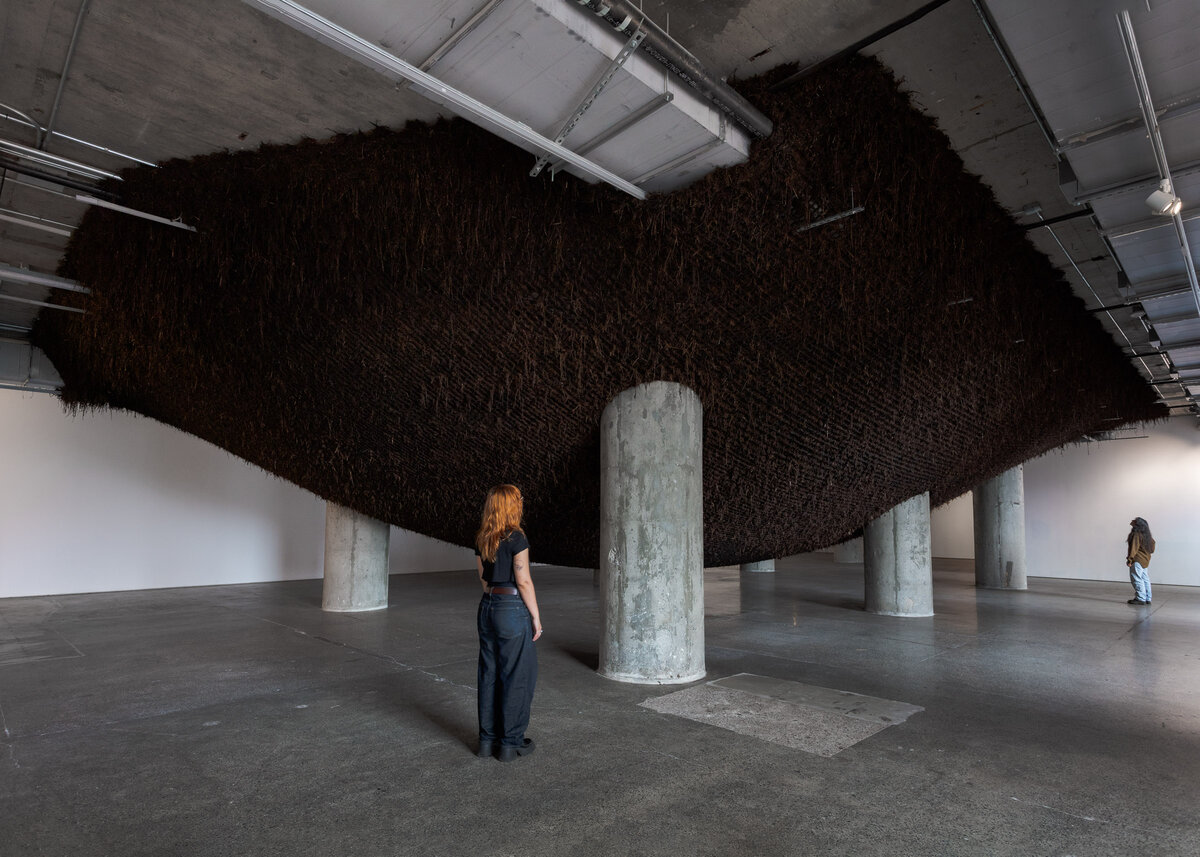
With a closer look, one that requires you to crouch down or slightly bend to the side, we start to understand its materiality and its conceptual ideals. The physicality of our interaction is within itself the embodiment of Ombligo, a reduction of the viewer to a smaller self that is at the mercy of a natural force. It at once asks us to think about our interaction with natural resources and what it really means to extract them from the earth while slowly grappling with our own natural source, birthed from the life-giving quality of our mothers. The structure’s woven fabric made of long strands of sisal rope treated with soil and corn roots harvested in the city, also recalls the strength and flexibility of these natural sources. One must wonder how methodical Morelos’ approach must’ve been to create such a daunting form within a relatively contained area.
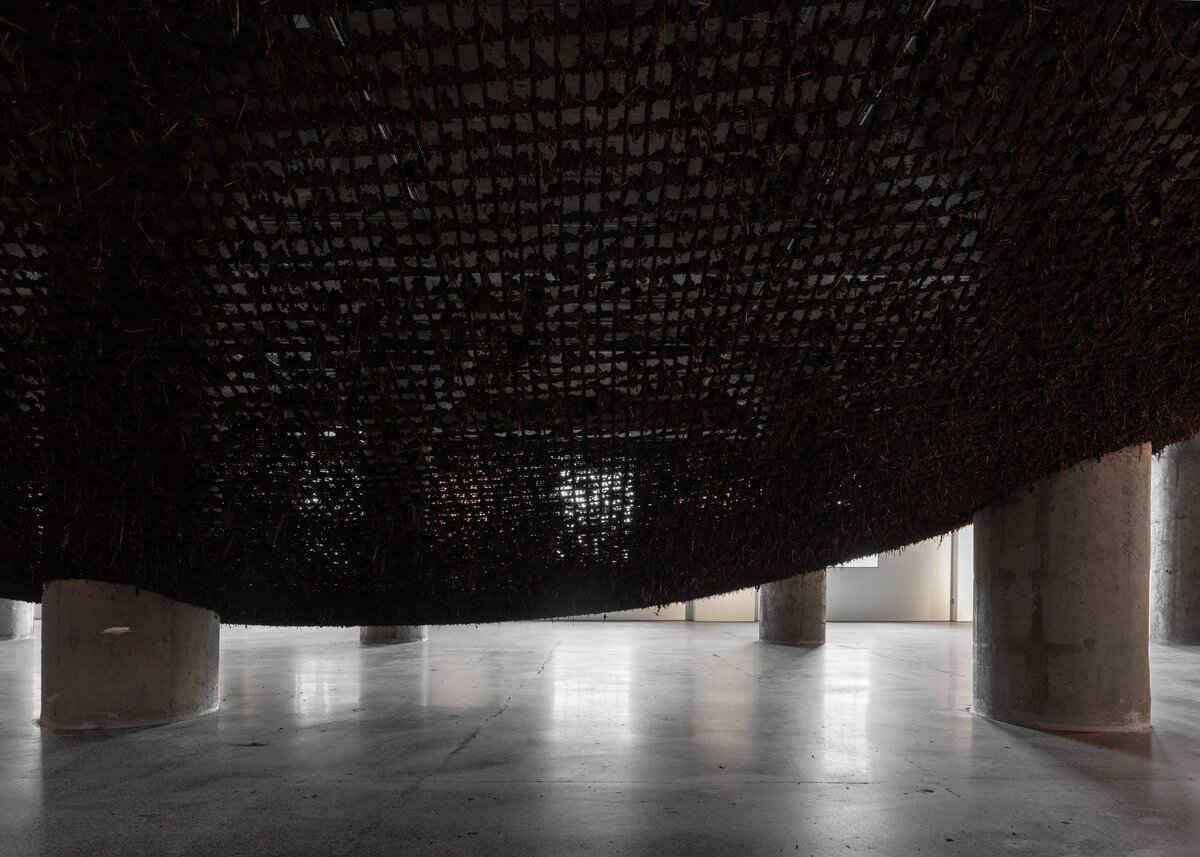
With Morelos’ practice stemming from her Emberá heritage and a deep connection to Colombian land, we see her approach to materiality and focus on earth’s regenerative strength as a focal point found in many of her large-scale installations. Working with the materials of the earth and local production, she naturally activates our sense of memory through sensorial experiences that confront us with questions of extraction and restoration. Ombligo keeps building on this practice while actively rethinking the spatial immersion of the viewer and completely flipping it upside down. Moving beyond a physical surrounding, it allows the viewer to encircle its structure, inverting the dynamics between environment and those experiencing it firsthand.
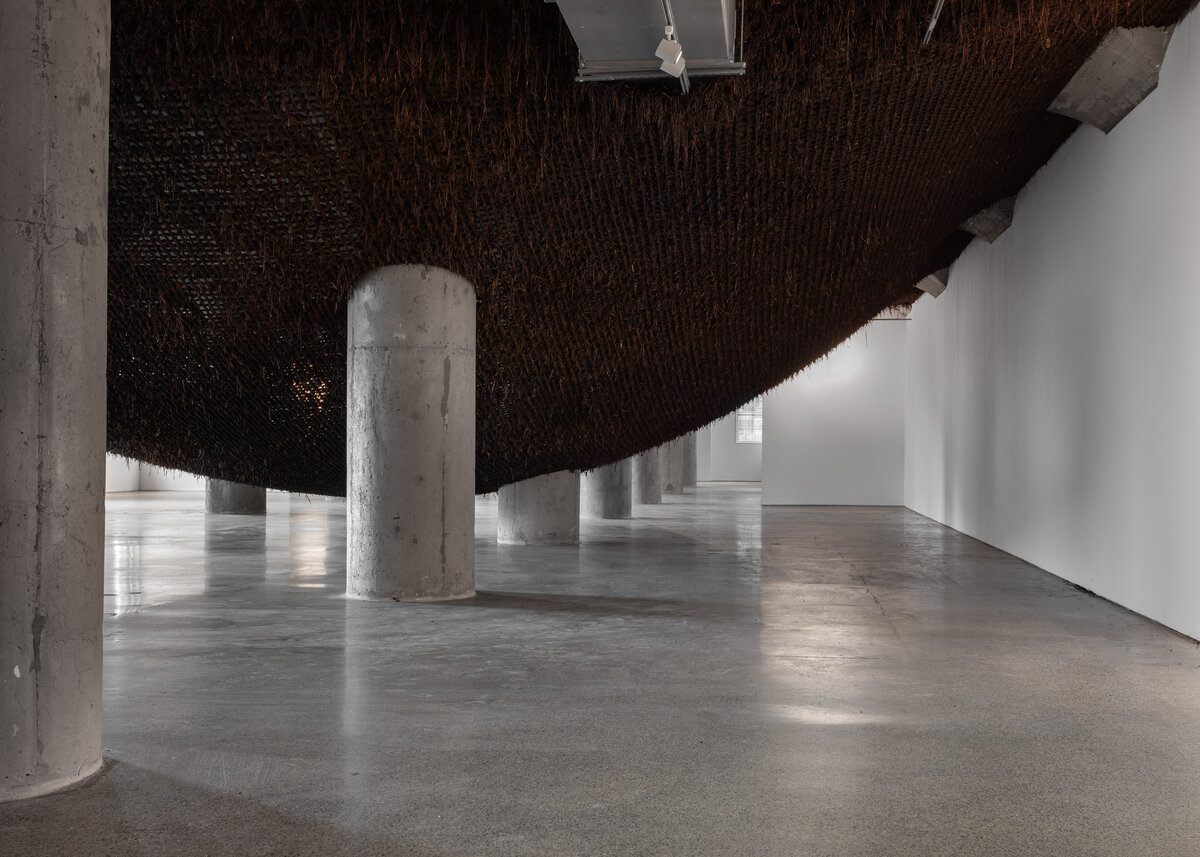
After spending some time in the space and seeing different vantage points, we start to embrace the serenity of the work that moves beyond the initial threat of entrapment posed by its size and presence. The natural fragrances become familiar, and we begin to wonder what the space ever looked like without this perfectly fitted form attached to its central pillars. The defined curvature becomes discernible as the globe shape of the earth or that of a womb, a space that provides sustenance and ultimately brings us to our closest inner selves. Ombligo then becomes a completely different work, understood and interpreted through the themes of extraction and ritual that re-occur in Morelos’ work. It is only by spending a certain amount of dedicated time with this installation that we start to connect with it beyond its formal qualities, a beautiful by-product of work that is deeply researched and meticulously constructed.
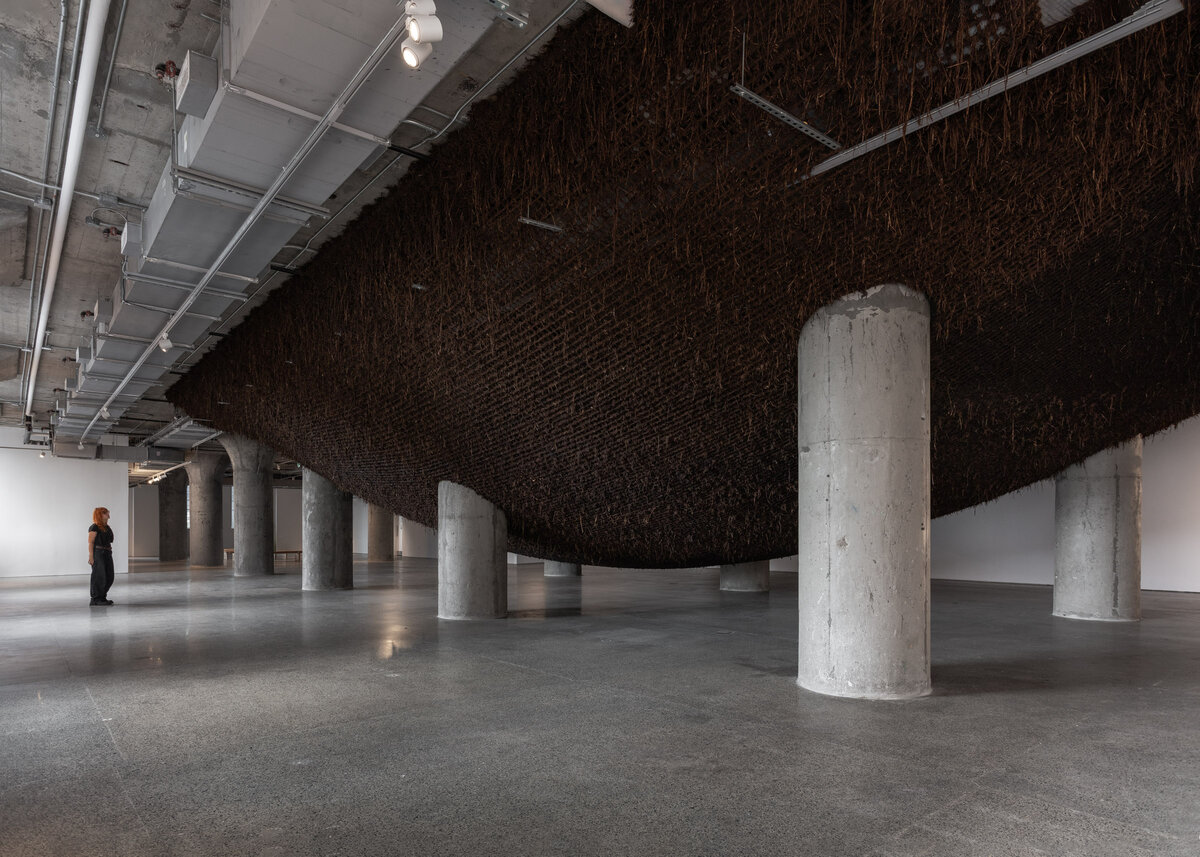
What allows Ombligo to move beyond the casual installations of contemporary artists attempting to work with grandeur (often falling short of confronting larger questions of spatial experience) is the delicate line that Morelos’ draws between full immersion and observation. Through deliberate organization of space and the help of Mexican based architecture studio Tamat, the work reads as intentional as does its methodical planning and execution.
Ombligo is beautiful, it is serene, but it is also dismaying. In it lies a complex confrontation that none of us can quite surmount. It asks us to live within fear for a short moment, allowing us to return to a smaller version of ourselves where everything appears giant and ominous. It comforts us, bringing us back to the earth and back to nature as a place where we once felt secure in our own powerlessness.
Marina Diolaiti
All images are Delcy Morelos, Ombligo, installation view, MOCA Toronto, 2026. Photo: LF Documentation.
*Exhibition information: Delcy Morelos, Ombligo, October 4, 2026 — February 14, 2027, MOCA,158 Sterling Rd, Toronto. Museum hours: Wed – Thurs & Sat – Sun 11 am – 5 pm, Friday 12 – 8 pm.