
Land, Sea, and the Afterlives of Colonialism: Reconsidering Caribbean Histories Through Contemporary Art
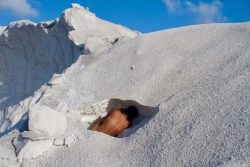
Las Nietas de Nonó, En el lugar de sal, 2018. Digital photograph on fabric, 16 × 24 in.
The Caribbean is frequently encountered through images of extraordinary natural beauty: its coastlines, tropical landscapes, and islands presented as destinations removed from the complexities of ordinary life. Such representations, however, risk obscuring the historical conditions and continuing inequalities that have shaped the region. The Art Museum at the University of Toronto’s Land. Sea. Sugar. Salt.: Terrestrial and Aquatic Contemplations of the Caribbean, presented from challenges these familiar perceptions through the work of eleven artists with familial and lived connections to the Caribbean. Curated by Michelle Jacques and Sally Frater of Remai Modern, the exhibition brings together photographic, video, and installation-based works that examine the region through its histories of colonialism, African diaspora, Indigenous presence, and environmental change. What makes the exhibition particularly compelling is its commitment to perspectives grounded in the experiences of those connected to the region. The Caribbean emerges as a place whose cultural and geographical identity cannot be separated from the histories that have produced them, or from the communities that continue to negotiate their consequences.
The exhibition’s title establishes an important framework for considering these relationships. Land, sea, sugar, and salt evoke the material conditions through which Caribbean history has been shaped. The region’s geography has long been central to its political and economic history, particularly through European colonial expansion, plantation economies, and the forced movement of enslaved African populations. The sea, frequently romanticized as a defining feature of the Caribbean landscape, also carries the history of displacement and transatlantic exploitation. Sugar similarly recalls the plantation system and the economic structures through which colonial powers extracted wealth from the region. By bringing these elements together, the exhibition draws attention to the historical significance concealed within seemingly ordinary features of the Caribbean environment. Its emphasis on terrestrial and aquatic experience also challenges the tendency to understand the region primarily through the visual conventions of tourism, which often detach its landscapes from the histories and communities that give them meaning.

Carolina Caycedo, Fuel to Fire, 2022. Still from HD video.
This historical perspective makes the exhibition’s postcolonial and anticolonial dimensions particularly significant. Art has an important role in challenging the visual and cultural narratives through which colonial histories have been represented and preserved. Colonialism shaped not only political and economic structures but also the ways in which places and their inhabitants were understood, categorized, and depicted. Artistic practices that foreground Indigenous histories, diasporic experience, and local forms of knowledge can therefore contest the assumptions embedded within those representations. The works assembled here approach the Caribbean through perspectives that resist reducing it to a singular cultural identity or a picturesque geographical setting. Their significance lies partly in their capacity to restore historical complexity to a region that has frequently been represented through the interests and perspectives of outsiders. In this respect, the exhibition demonstrates how contemporary art can participate in the reconsideration of colonial histories while recognizing the persistence of their effects in the present.
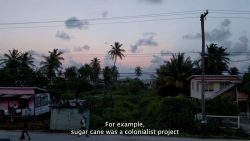
Farihah Aliyah Shah, Always About Land, 2023. Still from single-channel video, 3 min.
I find particularly important the exhibition’s emphasis on embodied knowledge and the artists’ personal and familial connections to the region. This approach suggests that an understanding of place develops through lived experience and the relationships with the surrounding environment. Such knowledge complicates the distance often maintained between historical interpretation and contemporary experience. The consequences of colonial exploitation, for instance, cannot be confined to the past when economic inequalities, environmental incursions, and the effects of climate change continue to shape Caribbean communities. The exhibition’s attention to environmental care is therefore inseparable from its historical concerns. Questions of land and water are also questions of access, ownership, displacement, and the unequal distribution of environmental harm. By bringing these concerns into an artistic context, the exhibition of course, can urge viewers to consider the relationship between ecological vulnerability and the longer histories of extraction that have shaped the region. The exhibition’s collective presentation of eleven artists is also valuable for the diversity of perspectives it makes possible. Bringing together Alexandre Arrechea, Charles Campbell, Carolina Caycedo, Giana De Dier, Braxton Garneau, Deborah Jack, Las Nietas de Nonó, Hew Locke, Farihah Aliyah Shah, and Kara Springer allows the Caribbean to be approached through distinct artistic practices and experiences. This plurality is especially important given the considerable geographical and cultural diversity of the region, which encompasses more than 700 islands as well as portions of several mainland countries. The exhibition consequently resists treating Caribbean identity as a uniform category. Its curatorial framework recognizes the historical connections that unite the region while leaving room for the differences that distinguish its communities and artistic traditions.
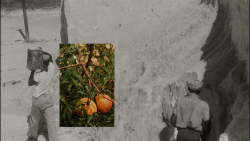
Deborah Jack, The Fecund, the Lush and the Salted Land Waits for a Harvest…Her People…Ripe with Promise, Wait Until the Next Blowing Season, 2022. Still from 7-channel video installation.
Land. Sea. Sugar. Salt. ultimately offers a meaningful reconsideration of how the Caribbean is understood and represented. Its greatest contribution lies in the perspectives it brings forward, particularly in its insistence that the region be encountered through the histories, experiences, and knowledge of those whose lives are connected to it. The exhibition also demonstrates why postcolonial and anticolonial perspectives remain essential to contemporary artistic practice, as they make visible the historical structures that continue to shape cultural representation and challenge the assumption of colonialism as a completed historical event. The Caribbean’s landscapes carry histories that cannot be separated from their present conditions, and the communities inhabiting them continue to shape their meanings. By directing attention toward these relationships, the exhibition moves beyond familiar images of the region and invites a more historically attentive understanding of its cultural and environmental complexity.
Yehyun Lee
Image courtesy of the artist from the Art Museum UofT.
*Exhibition information: Land. Sea. Sugar. Salt.: Terrestrial and Aquatic Contemplations of the Caribbean, February 25 to August 1, 2026, The Art Museum at the University of Toronto, 15 King’s College Rd, Toronto. Museum hours: Tue & Thu – Sat 12 – 5 pm, Wed 12 – 8 pm.